

The reading homework comes out of the backpack, and suddenly the word “cat” takes eleven minutes. Your child looks at the page, guesses “car,” then “cap,” then sighs like you personally invented vowels to ruin dinner. Reading can look mysterious from the outside, but for most kids the early work is concrete: they are learning how print matches speech.
Reading is code-breaking, not memorizing
English reading is a code. A messy code, yes. A code that occasionally acts like it had a rough morning. But still a code.
When a child learns to read, they are learning that marks on the page stand for sounds in spoken words. The word map is not a shape to remember. It is three sounds, /m/ /a/ /p/, and the letters are how we write them down.
Phonics is the part of reading instruction that teaches those letter-sound patterns: m says /m/, sh says /sh/, the a_e in cake usually says the long a. Kids use the patterns to read words they have never seen before.
Memorizing whole words can help with a few tricky ones, but it cannot carry a child far. There are too many words. A child who knows how the code works has a way into sand, truck, plant, and later, fantastic and misunderstood. That is the goal: not guessing from the picture, but looking at the letters and working the word out. Where this sits in the bigger timeline, from letter play to chapter books, is covered in when kids learn to read.
Sounds first, letters second
Before letters make much sense, kids need to hear the sounds inside words. Teachers call this phonemic awareness, which is a fancy name for something you can do while unloading groceries.
Can your child hear that sun starts with /s/? Tell that dog and dish start the same? Stretch fish into /f/ /i/ /sh/? Those listening skills come before smooth reading. Young kids hear words as whole chunks; to them, hamster is just “hamster.” Pulling words apart is a learned skill.
A few sound games that need no worksheet and no glitter:
- “What starts like mom? Milk, moon, muffin.”
- “Say cat. Now say it without the /c/. What’s left?”
- “I’m thinking of /sss/ /uuu/ /nnn/. What word?”
Once a child can hear the sounds, letters have something to attach to. The symbol b is no longer “that line with a belly.” It stands for a sound they can hear and say.
What “decoding” looks like at the kitchen table
Decoding means using letter-sound knowledge to read a word. It is the opposite of guessing. It is also slower at first, which is why it can test every adult nerve after 7:30 p.m.
Your child sees ship and says “/s/ /h/ /i/ /p/.” You point to the sh: “These two letters work together. They say /sh/.” They try again: “/sh/ /i/ /p/. Ship.” That little correction is phonics in action.
Or they read made as mad. “Check the end. That silent e makes the vowel say its name.” Then: made.
Your job is not a full lesson on vowel teams while the pasta boils over. Keep it small: “Look at the first sound.” “Slide through the word.” “Check the vowel.” Pictures can confirm meaning, but they should not be the main strategy. If the page says pony and your child says “horse” because the picture has four legs and a tail, that is a guess. A good next line: “That would make sense in the picture. Now let’s see what the letters say.”
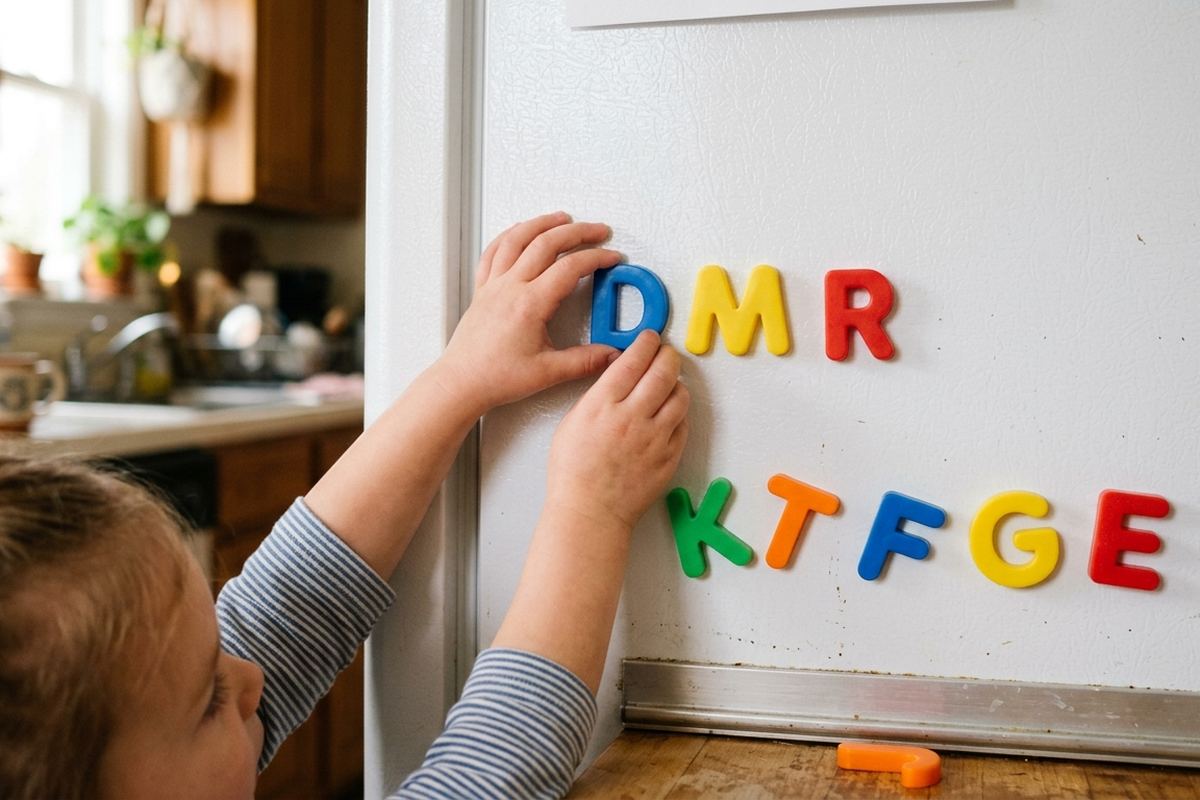
Sight words: the exceptions that need memorizing
Some words do need memorizing, or partly, because they break the common patterns. Words like the, said, was, and of show up constantly in children’s books.
Even then, “just memorize this shape” is not the best move. Try: “Look at said. The s says /s/, the d says /d/. The part to remember is the ai, because it says /e/ here.” Your child still uses the code where they can and learns the odd part where they must.
Flashcards are fine in tiny doses. Tiny. Five words while waiting for toast beats thirty words with tears. Spot sight words in the wild too: the cereal box, the bedtime book, the crumpled school flyer at the bottom of the backpack. A light word game like hangman gives kids another way to play with letters without it feeling like one more assignment.
From sounding out to reading smoothly
At first, sounding out is supposed to sound choppy. That is not failure. That is the brain doing construction.
A beginning reader reads “Thhhh-eee. C-a-t. S-a-t. The cat sat.” The slow work is how the word gets stored for next time. After a child decodes cat enough times, they recognize it instantly. That is how reading gets smoother, and fluency is the teacher word for the result: accurate, not too slow, with some expression.
This is where parents get stuck. We want kids to “read with feeling,” but if they are still wrestling every word, feeling is not available. Their whole brain is busy deciding whether that says then or than.
You can help by rereading. Yes, the same little book again. And again. Sorry. Familiar books are not cheating; they build the confidence and speed that make the next book possible. If your child likes quick practice on a screen, grade-level picks like the 1st grade games make a low-pressure break between books.
What you can do tonight (it’s less than you think)
You do not need to become a reading specialist after dinner. Ten calm minutes most nights beats one heroic hour on Sunday with everyone cranky.
Pick one book your child can mostly read. Not the hardest book in the bin, and not the one Grandma bought with paragraphs the size of a tax form. Sit close enough to point. When they get stuck, wait a beat, then prompt the letters, not the guess: “Start with the first sound.” “Look all the way through the word.” If the word is irregular, tell them the tricky part and move on. No courtroom drama over because.
After a few minutes of your child reading, you read to them. Bigger vocabulary, silly voices, the whole thing. Kids still need to hear fluent reading long after they start reading on their own, and the back of the mac and cheese box counts.
If your child is near the end of 1st grade or into 2nd and still cannot connect many letters to sounds, or guesses most words, bring it up with the teacher. No panic, just information. Teachers would much rather compare notes early and figure out what support makes sense.


