

Bedtime, and there it is again: book thirty-one of the same series, propped under your child's chin like a very rectangular teddy bear. You could recite the first chapter from the hallway. Somewhere behind your ribs a small voice asks whether this still counts.
It counts. It might be the most useful reading they do all year.
What all that sameness is actually doing
The most beloved bins in my classroom library were always the ones full of families: bent corners, half-peeled stickers, the same character on every cover. Kids would sit in the reading corner and work through them one after another because they already knew how that world ran.
That isn't laziness. It's the brain getting comfortable enough to read smoothly. Same characters, similar chapter lengths, the same sentence rhythms, vocabulary that keeps coming back, a problem that shows up on schedule and gets solved by the end. All of that frees up room.
Instead of spending every ounce of effort on the words, your child can predict, notice a joke, carry the plot across three chapters without stopping to ask who Jack is again. That's fluency, and it isn't about speed. It's reading with enough ease that the story gets to be a story. If the words themselves are still hard work, the level talk schools use is worth understanding, but a kid who has read forty of something has logged serious time with print. That shows up.
Why it feels babyish to you and not to them
You're reading the prose. They're reading the world.
You open it and think, this is pretty simple. Your kid opens it and thinks, I know this tree house, I know the rules, I know what kind of trouble shows up on page 18 and what kind of relief arrives by the end. They aren't just reading sentences. They're going back somewhere.
Adults do this constantly. We reread the cozy mystery. We rewatch the same six episodes after a bad week. Nobody stands in the kitchen doorway asking whether we're growing from the third rewatch, and if they did, we'd want new roommates.
The one thing worth watching is autopilot. If the book is so easy your child is barely looking at the page, mumbling through it nightly with their eyes half elsewhere, that tells you something about the week as a whole, not about the series. The fix is usually adding, not subtracting: a read-aloud that's a notch above what they can read alone, a library trip, a little more time with a book that asks something. And if reading feels stuck at school in general, that's a short, specific note to the teacher, not a change of policy at bedtime.
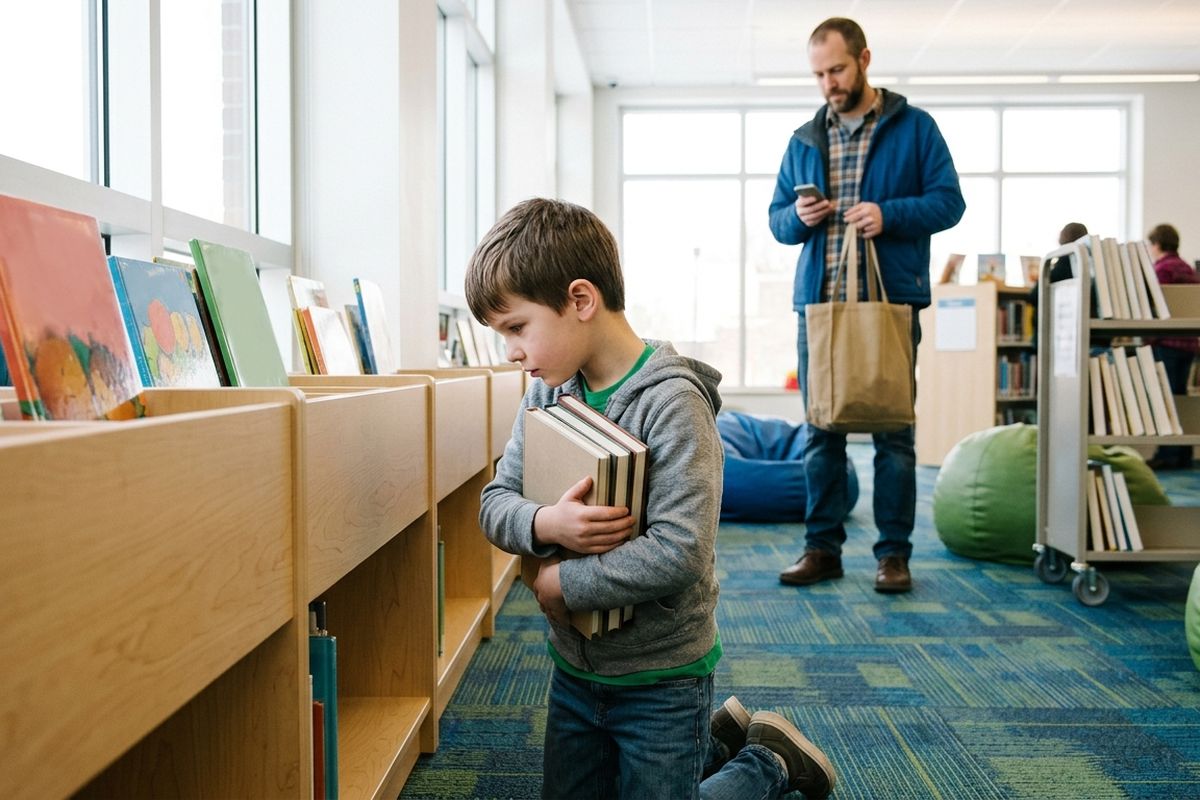
When and how to widen, gently
The wrong moment to broaden a kid's reading is the moment you're irritated by book thirty-one. Irritation makes us announce things, and children hear announcements as alarms.
Wait for a door to open on its own. The series ends. The library is out of number 12. You're packing for a long drive and need extras. A friend mentions something at recess.
Then offer the book next door, not the book upstairs. A time-travel series lover gets another adventure series with short chapters. A goofy-school-series kid gets another goofy school series. The line that works is "I found one that reminded me of your other books." The line that never works is "you're too old for those now."
Do not remove the beloved series to force the switch. That turns reading into a tug-of-war, and books make terrible ropes. Keep the favorite where it is and set a couple of neighbors beside it. Helpful: the if-you-liked shelf, the children's librarian who has met every kind of reader, a classmate's recommendation, and your own quiet stack left on the couch with no speech attached. Some of them will flop. Put those back.
Roughly where the series live
Grade ranges are squishy. A 2nd grader may plow through thick books and a 5th grader may still want something short and funny after a long day. Both fine. The general ladder looks like this.
- Kindergarten and 1st: picture books, patterned books and early readers. Elephant & Piggie, Frog and Toad, Henry and Mudge, Biscuit, and all the little ones that migrate under the car seat. These are real reading.
- 1st into 2nd: short chapter books. Mercy Watson, The Princess in Black, Owl Diaries, Nate the Great. Short chapters, pictures still helping, and the enormous pride of using a bookmark.
- 2nd through 4th: the long, fast-moving series stage. Magic Tree House, A to Z Mysteries, Dragon Masters, I Survived. Long enough to build stamina, familiar enough that nobody starts from scratch.
- 4th through 6th: fatter fantasy, mystery and adventure. Wings of Fire, Percy Jackson, and whatever is being passed around near the cubbies with great secrecy.
Graphic novels have the same ladder, from Narwhal and Jelly up through Amulet and New Kid. So does nonfiction, with the Who Was books, animal fact series and the shark books that appear to reproduce overnight in every classroom library. And if your child is just arriving at chapter books, that handoff has its own bumps and is worth taking slowly.
The cousin question
It shows up at family gatherings, somewhere between the rolls and the relative who has Opinions About Phonics. She only reads graphic novels. Does that count?
Yes. Same answer, different cover.
Panels ask kids to do real work: follow sequence, read faces, infer what happened in the white space between two pictures, track time jumps, sort out who is speaking. I watched children in the reading corner slow way down for a graphic novel because there was so much on the page to catch. The vocabulary is there too, just delivered in labels, narration boxes and side comments from a squirrel with attitude. Very literary, that squirrel. There's a longer case for them if you need ammunition for Thanksgiving.
If you want more prose in the mix, add rather than subtract. Read aloud from something above their independent level and carry the hard part yourself. Put a long series on in the car. Bring home a stack that's two graphic novels, one short chapter book, one fact book with photos, and a mystery you picked because the cover looked promising. Pair formats when you can: the graphic version at bedtime, the original as your read-aloud.
The sentence I'd keep in your pocket: graphic novels count, and we're going to keep other kinds of books around too. Then go back to book thirty-two.


