

A first grader once marched over from the writing table and held up the side of her left hand like evidence in a very small courtroom. The whole edge of her palm was silver-gray from dragging across a sentence about a lost tooth, and she was genuinely offended. Writing had betrayed her, and she wanted somebody to do something about it.
Left-handed kids collect a few of these grievances. Most of them have a fix, and most of the things parents worry about aren't the problem at all.
First, the things that are not problems
Reversed letters are not a left-handed thing. Backwards numbers are not a left-handed thing. Neither is a sentence that climbs uphill and falls off the right side of the page.
Those are kindergarten and 1st grade things, full stop. Right-handed children flip b and d, write a 3 that looks like an E, and slant their names so steeply the last letter ends up near the margin. Early writing is under construction: shape, direction, spacing, sounds and hand control all at once, by someone who is also thinking about snack. If the reversals are the part keeping you up, the b and d confusion has its own timeline, and it has nothing to do with which hand holds the pencil.
Slower, messier handwriting in the early grades is also ordinary. Messy is developmental long before it's directional.
Hand preference itself can take a while to settle, sometimes not until somewhere around 4 to 6. A preschooler who colors with the left hand, eats with the right, and picks up a rock with whichever hand is nearest is not confused. That's the body sorting itself out. The one thing I'd never do is move the pencil over for them. Adults used to make left-handed children switch, and what we learned from that era is mostly that children don't need grown-ups making writing harder on purpose.
The one thing that actually matters: the paper angle
Right-handed writers pull the pencil toward their body. Left-handed writers push it away, and their hand slides over the words they just made. With the paper sitting straight up and down, a lefty has to choose between seeing their letters and keeping their wrist comfortable. Kids are resourceful, so they invent a solution: a curled wrist, a tipped head, a body twisted halfway out of the chair.
So tilt the paper the other way. A right-handed child usually wants the top-left corner raised; a left-handed child wants the top-right corner up, somewhere around 30 to 45 degrees, and some kids want more than that. Fine. We're not framing a print. The target is simple: hand below the line of writing, wrist mostly straight.
In my classroom this was a twenty-second conversation. Turn the paper, say "try it like this, can you see your words now?" and watch a six-year-old write three letters, look suspiciously pleased, and carry on as though I'd handed over a secret. It fixes a surprising share of what adults try to fix by nagging about fingers. Check the paper before you say anything about grip. If your child is still somewhere in the scribbles stage, the road from scribbles to sentences is worth a look first, because a lot of what looks like a handwriting problem at five is just chapter one.
The hook grip, and when to leave it alone
The curled wrist, the one people call a hook, is something kids invent because it works. Their hand covers the fresh pencil marks, so they hoist the wrist up above the line to peek at what they wrote. It isn't a bad habit. It's engineering, kindergarten edition.
Caught early, the paper angle usually undoes it on its own. "Let's give your hand room to see" goes over better than "stop doing that thing with your wrist." Grip helps too, in a low-key way: lefties often do better holding the pencil an inch or so up from the tip, a little higher than a right-hander, so they can see past their own knuckles. Very short pencils are miserable for this. There's not enough pencil to hold.
By 3rd or 4th grade, a hook that's fully automatic usually isn't worth a fight. If your child writes comfortably and never complains, they've built a system that works. Leave it.
What's worth raising with the teacher is the physical stuff: a hand that cramps after a few sentences, pressure heavy enough to snap pencil tips over and over, pain, or a kid who avoids writing because it hurts. One sentence does it. "Writing seems to bother his hand lately, are you seeing that?" When the avoidance is coming from somewhere other than the hand, the reasons kids dig in about writing are usually easier to untangle than they look.
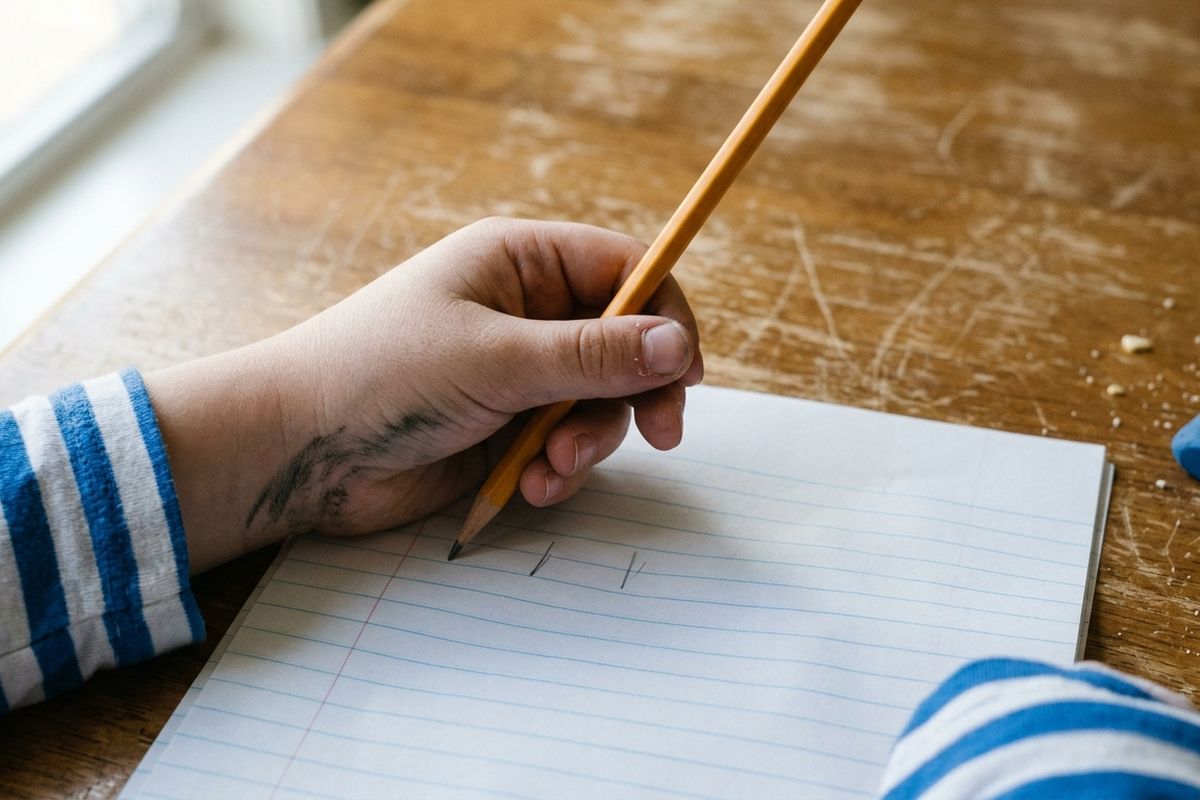
Smudging and the small stuff
Smudging is the left-handed tax. Graphite drags under the side of the hand, and by the end of a writing block the palm has a shiny gray stripe. Some kids wear it like a medal. Others take it personally.
A few small choices cut it down. Harder pencil lead smudges less than the very soft dark kind, so if your child comes home silver every afternoon it's worth trying a pencil that writes a little lighter. Mechanical pencils suit some older elementary kids and drive early writers crazy, since pressing hard snaps the lead roughly every four seconds. Pens are mixed: a quick-dry gel pen is a friend, a wet rollerball is a tiny smudge machine.
Then there's the stationery aisle, designed by and for right hands. Binders and side-spiral notebooks put the hardware exactly where a left hand wants to rest. A legal pad, a top-spiral pad, or flipping the notebook so the spiral sits on the other side solves it, and it looks odd for about three seconds.
Scissors deserve a mention too. Left-handed ones exist and cost almost nothing, and a lefty using right-handed scissors squeezes twice as hard for a ragged edge, because the blades close the wrong way for their hand. Before you decide your child "can't cut," check the scissors. A scrap of paper under the writing hand helps with the gray stripe, and when they go wash it off, skip the speech about neatness.
Where they sit, and who's next to them
Elbow room is the whole issue. A left-handed child seated to the right of a right-handed one bumps arms for forty minutes straight. Nobody's being rude; two writing arms are trying to occupy the same patch of air. In kindergarten it becomes a diplomatic incident, complete with sighing and one child announcing, "Your arm is ON my paper."
The fix is seating, and it costs nothing. Put a lefty on the left end of the table so the writing arm is on the outside, or seat two of them next to each other. At round tables, aim for open space on the left rather than somebody's elbow.
Those old chair-desk combos with the writing surface attached on the right side are genuinely bad for left-handed kids, who have to twist across their own body to use one. They still turn up in testing rooms and older buildings. Ask for a swap.
All of this is one sentence at back-to-school night, not a campaign. "She's a lefty, so she does better on the left end of the table." Most teachers will nod before you finish. We have lived through the elbow wars and we don't want them either.
The reassurance part
Being left-handed doesn't make a child more likely to struggle with reading or spelling. Those old stories come from an era when kids were forced to switch hands, which produced stress and some truly awkward habits, and not much else.
What lefties do get is a world of objects built for somebody else: scissors, binders, can openers, measuring cups with the numbers on the wrong side. They also get adults demonstrating everything backwards. If you're showing your child how a letter is formed, sit across the table instead of beside them. A mirror image is far easier to copy than a view over somebody's shoulder. I used to slide into the seat opposite a left-handed kid and make the letter slowly, top, down, around, while they watched without having to bend like a question mark.
And when they notice they're different, keep it plain. About one in ten people are left-handed. They'll get used to the smudge, and by 4th grade most of them have opinions about pens.


