

There it is on the counter, in purple marker on the back of a school flyer: "I luv bab." You know perfectly well the note is for dad. You also know you just felt something tighten a little.
At the writing table in my classroom I saw this every week, right next to the name cards and the one glue stick with no cap. Backwards letters in a first note, a signed birthday card, a labeled drawing of a dog with six legs.
What's normal, and when
In Pre-K and kindergarten, reversals are everywhere. In names, in numbers, in whole words written right to left as if the child were composing from inside a mirror. A five-year-old can write a gorgeous sentence, beam at it, and have three flipped letters sitting in the middle like they were invited.
In 1st grade they're still common, just less constant. Your kid writes b correctly in "bat" and flips it five minutes later in "big." Maddening from the adult chair. Completely ordinary from the small one.
Into 2nd grade, a lot of kids are still tidying this up, and the flips show up mostly when they're tired, rushing, copying from the board, or trying to get a big idea down before it escapes. Most children sort it out somewhere between 7 and 8, without anyone making it a project. It sits in the same category as the wobbly, phonetic writing that comes before neat sentences: a stage with an exit.
Why b and d in particular
They're the same shape pointed different ways. So are p and q. The numbers 5 and 9 pull their own version of the trick.
Here's what adults forget: nothing else in a child's world works like that. A chair is a chair from the side. A teddy bear upside down is still a teddy bear. The toy truck is a truck whether it's facing the wall or the window. Orientation has never once mattered.
Then print shows up and is extremely picky about it. One direction gives you /b/. Spin it and you have d. Flip it down and it's p. That's a lot of responsibility for one stick and one circle.
Young kids are also still installing the left-to-right habit. Plenty can recite the alphabet, find their name, and "read" a favorite Elephant and Piggie page from memory before their eyes and their hand have fully agreed which way English travels. Capitals cause less trouble, which is why early writing often looks more stable in all caps while the lowercase letters are still doing cartwheels.
The tricks that help, and the one that doesn't
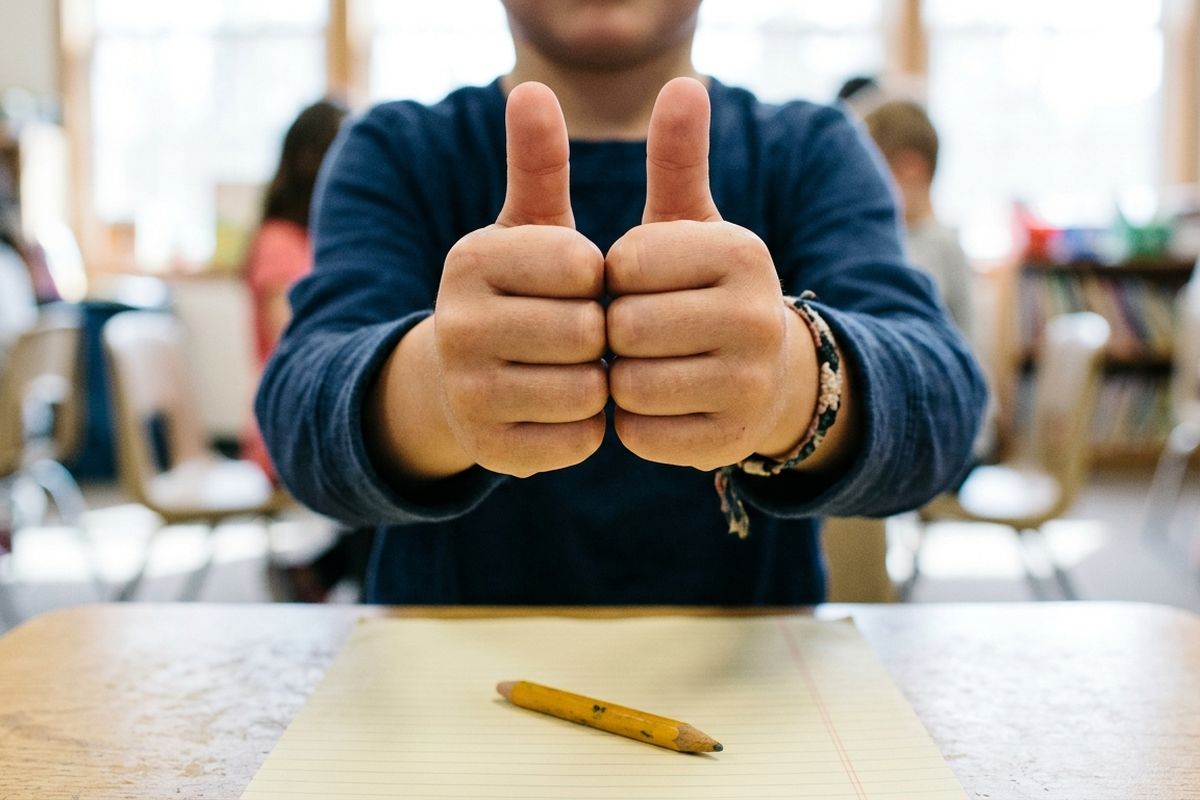
The old bed trick works for a lot of kids because it gives the body something to hold. Two fists, thumbs up. The left hand is the b, the right hand is the d, and together they spell bed. I used to watch six-year-olds check their hands under the table like tiny detectives, then keep writing.
When I remind a child, I go b first, then d, because the word bed reads in the direction we want their eyes going. A few other things that earn their keep:
- Trace the letter with a finger while saying the sound: /b/, bat.
- Write it big in the air before writing it small on the line.
- Start the b with the line, then add the belly.
- Keep the alphabet strip or name card where they can glance at it.
What tends not to work is ten minutes of b/d flashcards. The child guesses, gets tense, starts treating letters like a quiz, and then flips the d anyway the second they write a real sentence about a dragon who eats cereal. A trick is a handrail, not an afternoon.
Handwriting reversals versus reading reversals
Writing b for d is mostly motor memory and direction. Your child knows the word. The hand built the letter facing the wrong way. It's the shoe on the wrong foot: real shoe, real foot, wrong match.
Reading is a different animal. If your child reads "was" as "saw," or keeps guessing whole words from the first letter and the picture, that's decoding, not handwriting. You hear it when they read out loud and "Dad sat on the bed" comes out as "Bad sat on the deb," or when a child sails through a book they love and stalls completely on a new one because memory was doing more work than the print.
That second pattern is the one worth your attention. A backwards letter in a birthday card is a blip. Mixing up words while reading is about how text is getting into your child. This is the argument for sitting down and listening to your child read a couple of times a week, not as a test, just as a quiet check on what the print is actually doing.
When to say something to the teacher
If reversals are still going strong well into 2nd grade alongside slow, effortful reading, letter sounds that won't stick, or a kid who has started dodging writing altogether, mention it. One sentence does it: "I'm seeing a lot of b and d flips, and reading still feels really effortful at home. What are you seeing?"
No packet, no dramatic subject line. Teachers open that message happily, and a short, specific note is the version that gets a useful answer.
What the teacher looks at won't be the backwards letters on their own. They'll check whether sounds come quickly, whether your child can blend them into a word, whether their eyes track print across the line, and whether handwriting is eating so much effort that there's nothing left for spelling or ideas. They'll also compare settings, because a child can write beautifully during morning work and reverse half the alphabet in a rushed journal entry after recess. If the picture adds up to a cluster rather than a stage, that's a conversation the school will start, and it starts with a look at those pieces together.
What to do tonight, which is almost nothing
Let ordinary life do the work. Have them add bananas to the grocery list. Let them sign the card for Grandpa. Stick a note on the bathroom mirror and let them write one back, even if the d is leaning into a strong wind.
Correct once, lightly, then move on. "That one's a d. Watch, line first, then the circle." Keep going.
If your kid is writing a whole story about a cat who drives a school bus, do not stop at every flipped letter. Ask where the bus is going. Fix one letter if the moment is right and let the other four live.
The child who gets a correction for every reversal stops writing. I watched it happen at the writing table more than once: the shoulders come up, the pencil slows, the cat with the bus quietly disappears. Better to keep the words coming and let the letters settle, with time, practice, and a couple of quiet bed hands under the table.


