

There's a paper on the kitchen table covered in loops, dots, and one giant line that runs straight off the edge. Your child proudly announces, "I wrote you a note." It doesn't look like a note to you. To a young child, those marks are the beginning of real writing, and the road from here to actual sentences follows stages you can learn to spot.
Scribbles are writing (really)
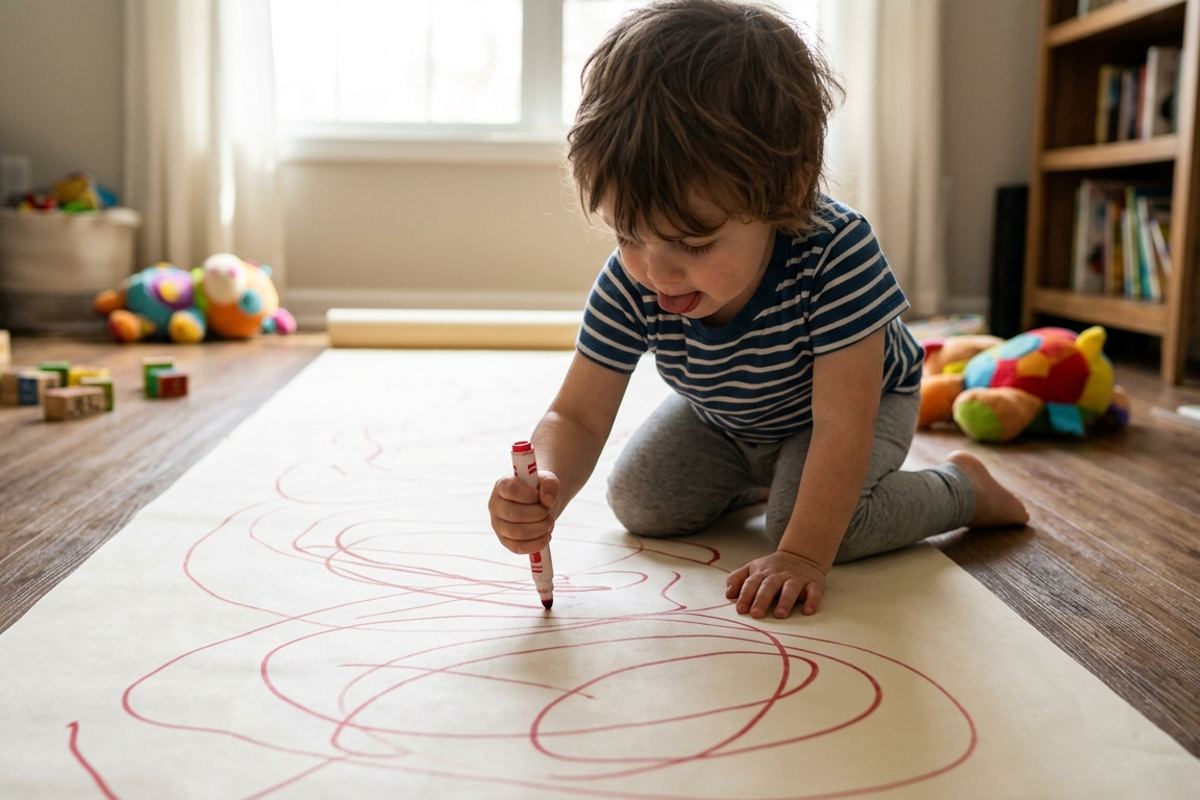
Around ages 2 to 3, writing looks like scribbling: circles, zigzags, pounding dots, lines with the energy of a small thunderstorm. This isn't throwaway "pre-writing." Your child is learning that hands make marks, marks stay on paper, and grown-ups seem to care a lot about those marks.
Drawing and writing are still mixed together here. A child may "write" a grocery list as five curly lines, point to one squiggle and say it means "Mommy," another means "cookies." That's a big idea landing: print carries meaning.
Your job is mostly to play along. "Read it to me" treats the message as real. If they want, write their words underneath: "You said this says I love Nana. I'll write those words here." Offer chunky crayons, sidewalk chalk, a wet paintbrush on the driveway. And skip the "what letter is that?" quiz. Sometimes a scribble is busy doing other work.
Letter-like shapes and long strings of letters
Somewhere around 3 to 5, the marks start looking almost like letters: tall sticks, little bumps, backward shapes, mysterious symbols off a treasure map. Then come long strings of real letters. M T A S B O O O L.
This stage is easy to misread. Parents think "they know letters, so why doesn't this say anything?" But the child has just figured out that writing is made from a limited set of shapes, and the shapes go in rows. That's a genuinely different understanding from "I made a picture."
Name letters usually lead the way, because those are the letters a kid owns first. If your child is named Mason, Grandpa's birthday card may say M A S O N N N. He doesn't think Grandpa is named Mason. Those letters just felt available.
Point out print in normal life: the stop sign, the cereal box, the tag inside the jacket. If you're wondering how much letter knowledge to build before school, learning letters before kindergarten covers what's worth doing and what isn't. Here, the best response is simply: "You used lots of letters. Tell me what it says." Then listen.
First words: the invented-spelling stage
Around 4 to 6, often through kindergarten, kids start matching sounds to letters. This is invented spelling, and it looks both adorable and slightly alarming. KT for cat. I LV U. HPE BRTHDA.
It's not laziness. It's a child using everything they know about sounds. First they catch the beginning sound, then the ending, and the middle comes last, especially vowels, which are the slippery noodles of early writing. BK for bike tells you they heard the b and the k. BIC means they're noticing more. Each version is data, and those weird spellings are progress, not a problem to stamp out.
Respond to the message first. If your child writes I WNT PZA, say "You want pizza? Very clear." If the moment feels friendly, you can add, "In grown-up spelling, pizza has two z's. Want me to write it under yours?" But don't turn every homemade sign into a spelling quiz. Nothing shuts down a young writer faster than pouring their heart into I MIS YOO and getting "actually, miss has two s's." There's a time for correction. The love note is not it.
Wobbly sentences (and where capitals and periods come in)
By 5 to 7, in kindergarten and 1st grade, sentences arrive. "Sentence" is generous at first. You may get one long breathless line: i went to the park and i saw a dog and it was big and we got ice cream. Honestly, a pretty good day.
A young writer is juggling a lot at once: holding an idea, stretching out sounds, remembering letter shapes, leaving spaces, gripping the pencil. Capitals and periods are the first things to fall out of the wagon. Most schools teach them in small repeated doses (capital at the start, capital for names and I, period at the end), and kids can recite the rule perfectly and still forget it five seconds into writing. Knowing a rule and using it mid-sentence are different jobs.
Spacing wobbles too. Some kids write everything as one giant word; others leave a canyon between letters. A finger space helps, on Monday, and vanishes Tuesday.
When you read their writing, make punctuation about the reader, not the rules. "I can read the first part. You wrote I went to the park. Let's give the reader a tiny period there so they can breathe." That lands better than a red pen ever will. And for letter practice that doesn't feel like school followed them home, a few minutes of kindergarten games after dinner covers similar ground sideways.
How to help at each stage without buying a workbook
Workbooks have their place, but young writing grows fastest when it has a reason to exist. A child who groans at a tracing page will happily write NO BROCLY on the dinner menu. Purpose is powerful.
For scribblers: materials and permission. A basket with crayons, scrap paper, junk-mail envelopes, sticky notes, and one clipboard, because clipboards make everything official. Let them take the order when you play restaurant.
For letter-string writers: model without taking over. If P L T M means "come to my party," say "I'll write it the grown-up way underneath so people can read your invitation." Their writing stays on top. Yours is the helper.
For invented spellers: stretch words out loud together. Say "sun" slowly, sound by sound, and ask what they hear first. If they catch one letter, take the win. Post five or six words they actually use where they write: the, love, mom, dad, to, from. Not fifty. Five.
For sentence writers: talk before writing. Kids lose the idea while wrestling the first word, so have them say the sentence out loud, count the words on their fingers, then start. Real-life jobs beat worksheets here too: one item on the grocery list, a pet adoption certificate, a label under a drawing ("dragon," "me," "hot lava," "Dad scared"), a three-page stapled book with an extremely dramatic title. A cheap workbook from the grocery store works for rainy afternoons when you want something ready-made.
If your child avoids writing entirely, or after lots of gentle practice still struggles to hold a crayon, recognize the letters in their name, or hear beginning sounds, mention it to the teacher or pediatrician. No panic, just information.
Meanwhile, celebrate the sign taped to the bedroom door: KEP OWT. Clear message. Risky spelling. Excellent writing work.


