

You bought the alphabet flashcards because kindergarten is coming, and your child is now using them as tiny plates for stuffed animals. Very normal. Four-year-olds are built to learn through pretending, touching, moving, singing, and noticing the giant M on the McDonald's sign. Letters can live in that world just fine. They don't need to sit at the kitchen table like a spelling test in miniature.
What “knowing letters” actually means at 4
When a parent says “my child knows their letters,” it can mean five different things. One kid sings the alphabet song perfectly but recognizes almost nothing on a page. Another spots the first letter of her name everywhere but mixes up B and D. A third knows S says “sss” because his best friend is Sam, except he calls it the snake letter. All of that counts.
At 4, letter knowledge might look like recognizing some uppercase letters, spotting their own name in print, knowing a few sounds, or writing letters that come out backwards, wobbly, or frankly invented. The range in Pre-K (ages 4 to 5) is huge. Some kids know all 26 names before kindergarten. Some know five, mostly from their name and their favorite cereal. Some are fascinated for three weeks and then pivot hard to dinosaurs.
Try not to turn it into a hidden checklist. Letter knowledge grows in layers: familiar shapes first, then names, then sounds, then “hey, that word starts like my name!” That last one is the good stuff.
Why flashcards fall flat with preschoolers
Flashcards make sense to adults. One card, one answer, done. Very tidy.
To a 4-year-old, a black letter on a white card is an abstract squiggle with no reason to matter. It's not their name. It's not on the cereal box. It's not stuck to the fridge next to the pizza coupon. It just sits there demanding to be identified, which is nobody's idea of preschool magic. And the attention span math doesn't work either: the same child who spends 22 minutes building a mud birthday cake for a worm runs out of patience for adult-led drills in about 90 seconds.
The bigger risk is that drills make letters feel like pressure. A kid who guesses wrong a few times starts saying “I don't know” before even looking. Or gets silly, which is preschool code for please make this stop. Flashcards aren't evil, and if your child genuinely enjoys quick quiz games, fine. For most preschoolers, though, they're the weakest tool on the shelf because they separate letters from anything real.
Play that teaches letters without anyone noticing
The best letter practice at this age looks suspiciously like regular life. Nobody has to announce “alphabet time” in a serious voice.
Sidewalk chalk is perfect because letters can be huge. Write your child's first initial on the driveway, then let them jump on it, trace it with a stick, turn it into a monster, or surround it with fourteen circles for reasons known only to them. Big-body movement helps young kids feel a letter's shape long before they can control a pencil.
Magnetic letters on the fridge are the low-pressure classic. Skip the full lined-up alphabet; put out a handful, heavy on the letters in their name, and let them shuffle while you cook. If the fridge spells MTAQ for a week, that's allowed.
Letter hunts cost nothing. “I see a big C on the cereal box. Can you find another one?” Stop signs, shampoo bottles, birthday cards, pajama tags.
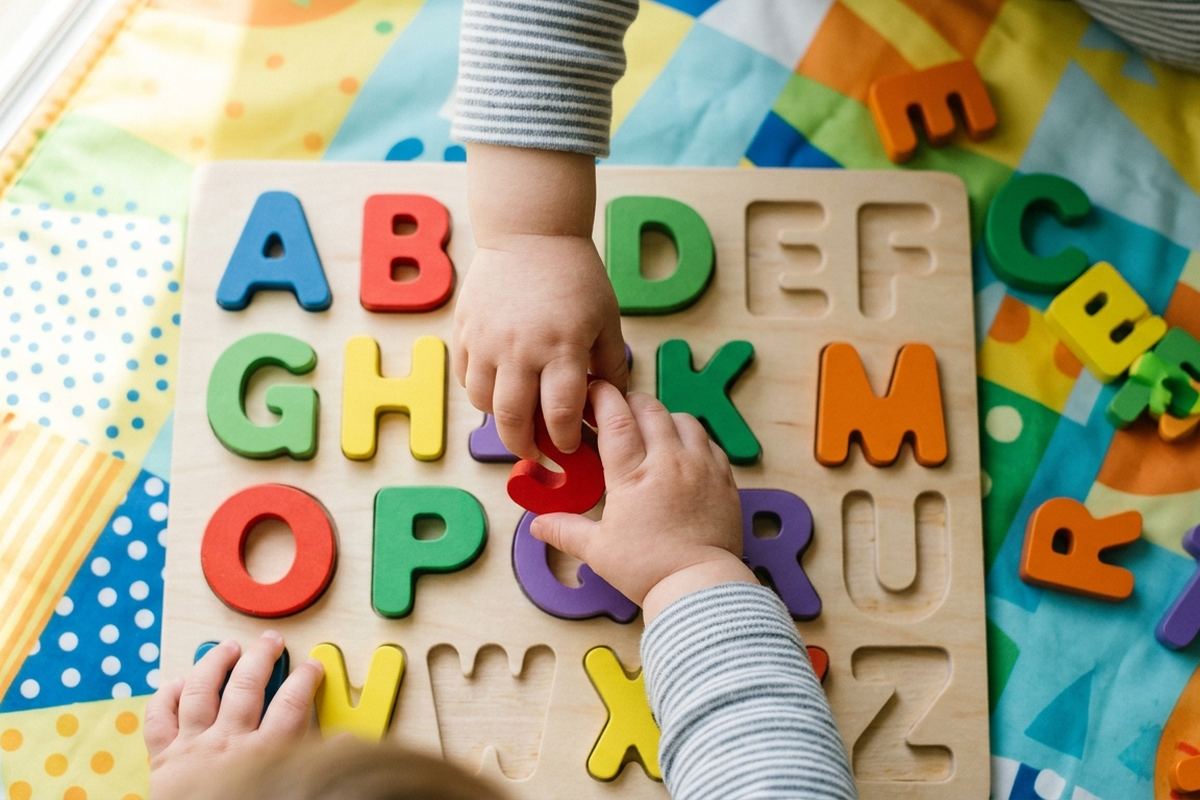
Start with their name, not with A
Adults love alphabetical order. Preschoolers do not care that A comes first. They care about me, mine, and that's MY letter.
Your child's name is the most motivating word in the world because it belongs to them. If your child is named Maya, M isn't just a letter. It's Maya's letter, on the cubby at school, the card from Grandma, the drawing taped to the fridge. Point out the first letter casually (“there's your M on the milk carton”) and then leave it alone. If they're interested, keep going. If they grunt and keep eating toast, the seed is still planted.
After the first letter, the rest of the name usually follows. Then siblings, parents, pets, favorite characters. A kid may learn Z early because the dog is named Ziggy. Great. Alphabetical fairness is not the goal. Let them sign cards even when the signature is mostly loops, and don't sweat backwards letters; early writing is part muscle control, part memory, part artistic interpretation.
Letter sounds beat letter names (a little)
Letter names are useful and your child will need them. But sounds do more for reading, because reading runs on connecting print to spoken sounds. Knowing the name “em” is nice. Knowing M says “mmm” helps your child hear the start of mom, moon, and muffin.
Keep it casual. “Mmmmilk starts with /m/, that's your M sound,” while pouring. No quizzing after every sentence; preschoolers can smell a quiz from across the room.
One small technical note: stretch the sounds that stretch. M, S, F and L can be held. B, D, G and T are quick pops, so try not to tack a big “uh” on the end. B is /b/, not “buh,” when you can manage it. No need to get fussy about it. Rhyming, clapping syllables and playing with beginning sounds all feed early reading too, even before a child can name every letter.
What kindergarten actually expects
Kindergarten teachers expect a mix, because that's what walks in the door every year. Some kids arrive reading simple books. Some recognize their name and a few letters. Some are still working on sitting on the rug without slowly tipping into a neighbor. Teachers have seen it all, and teaching letters is literally in their plans.
Most schools hope an incoming kindergartner recognizes some letters, especially in their own name, can hold a book right-side up, listen to a short story, and take a stab at writing their name. Almost none expect all 52 letter shapes plus every sound. If you're wondering what else matters for the big start, there's a fuller picture in what kindergarten readiness really means.
A light touch is enough when your child is making steady, playful progress. Read picture books. Point out letters in the wild. Let them write menus for the stuffed-animal restaurant, and pull out the tracing pages on the days they're in a paper-and-pencil mood. Stop before it sours.
And if your child is close to kindergarten and doesn't recognize their name, avoids books entirely, or gets very frustrated with language play, mention it to the Pre-K teacher or pediatrician. Not in a panic. Just as useful information.


