

The kindergarten backpack is tiny, but somehow it carries every parent worry at once. Can they write their name? Do they know enough letters? What if they cry at drop-off and attach themselves to your leg like a determined koala?
Readiness is real, but it is usually less about flash cards and more about how a child handles the ordinary business of school: bathroom trips, snack wrappers, waiting for a turn, trying again when the block tower falls.
The checklist parents worry about vs. the one teachers use
Parents often show up at kindergarten orientation with an academic checklist in their head: alphabet, counting to 100, name writing, maybe a few sight words if the preschool grapevine has been intense.
Teachers are looking at a different checklist. Can your child separate from you with support? Sit for a short group activity? Follow a direction like “put your folder in the basket and sit on the rug”? Tell an adult they need help? Keep hands mostly to themselves, even when someone else has the blue crayon?
Letters and numbers matter too, and a child who recognizes some letters and can count small groups of objects has a nice running start. But teachers expect a spread. In a typical class, some kids read simple books in September and some are still mixing up M and W. Both can belong there.
The harder part is school stamina. Kindergarten is cheerful, but it is also long. Transitions, noise, shoes, lunch containers, fire drills, and 22 children who all need the teacher at once. Readiness is partly the ability to be one small person in a group. For more of the school-side picture, the School Life & Milestones section is a better read than another printable readiness chart.
Self-help skills beat sight words
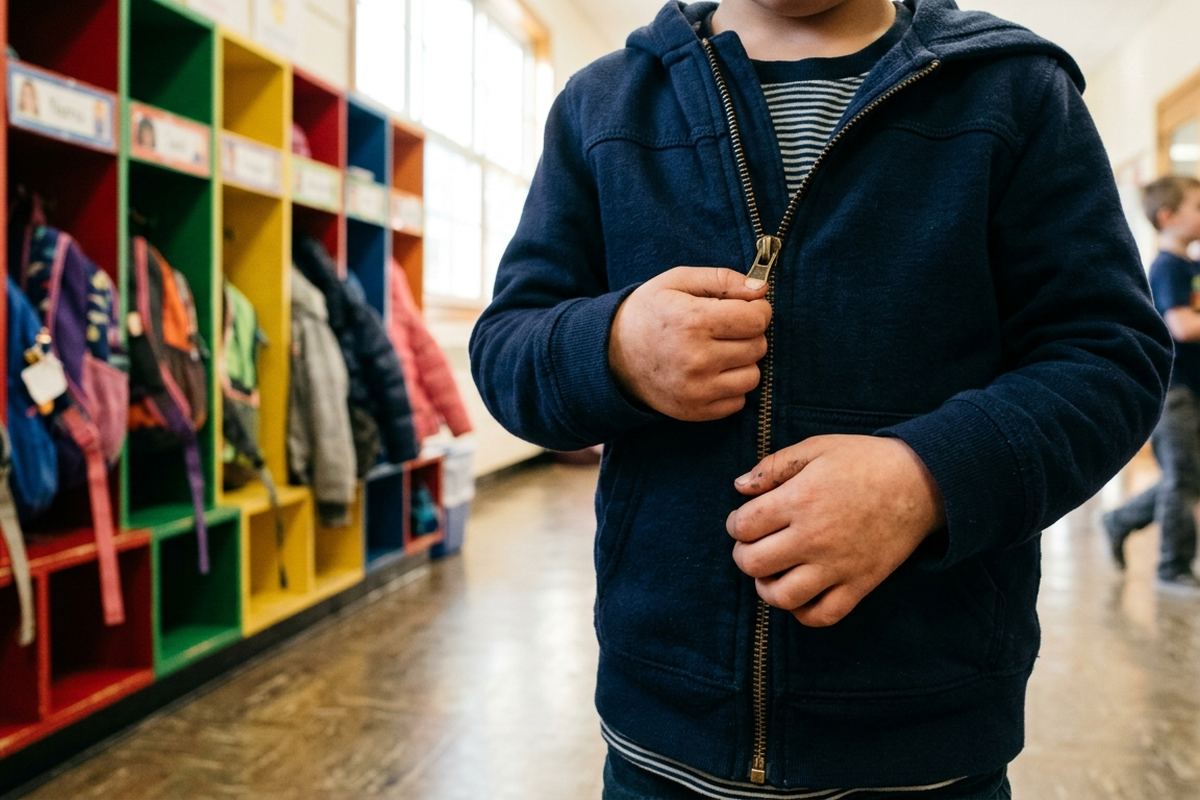
If a kindergarten teacher could wave a magic wand in August, many would use it on zippers, bathroom independence, and lunch containers before sight words.
A child who can manage the basics has more brain space for learning. They are not spending half the morning waiting for someone to open their applesauce pouch. They feel capable, and capable kids try more.
The big ones:
- Use the bathroom independently, including wiping, flushing, and washing hands
- Put on and take off a jacket
- Open most of their lunch, or ask clearly for help
- Blow their nose and throw away the tissue
- Pack up a folder, water bottle, and lunchbox with reminders
None of this has to be perfect. Teachers help all day long. We tie shoes, rescue stuck coat sleeves, and solve mysteries like “whose banana is this?” But practice in normal life pays off: let your child zip the backpack even when it takes forever, and have a “school lunch” picnic at the kitchen table with the actual containers you plan to send. If the yogurt tube requires adult-level engineering, better to find out in July.
Can they wait, share, and bounce back?
Kindergarten asks a lot of a five-year-old heart. Wait while the teacher helps someone else. Share the blocks. Hear “not right now” and survive it.
Teachers do not expect tiny polite adults. There will be tears. Someone will announce, with deep sincerity, “You are not invited to my birthday party,” even if there is no birthday party. What teachers look for is the beginning of flexibility: can your child recover with help, accept a simple fix like “you can have the red marker when Sam is done,” try again after a mistake?
Board games help, especially if you do not always let your child win. So do little delays: “I can help you after I put the pasta in the pot.” Sharing is tricky because at home most kids never have to split 18 glue sticks among 18 people. Try low-stakes practice with sidewalk chalk, magnatiles, or that one dinosaur that’s missing a leg but is still somehow the favorite.
Language: conversation, not vocabulary drills
A kindergarten-ready child does not need a giant vocabulary list. They need practice using language with real people.
Can your child answer simple questions? Tell what happened first and next? Ask for help in a way an adult outside the family can understand? Those skills matter more than fancy words from a deck of cards.
Conversation sneaks in everywhere. At the grocery store: “We need three apples. Can you count them?” At bedtime, when they are clearly stalling: “Tell me the best part and the worst part of today.” Congratulations, the stall is now language practice. Reading aloud is still one of the best things you can do, and it quietly builds the skills that turn into reading later; there’s more on that whole timeline in when kids learn to read.
If your child’s speech is hard for unfamiliar adults to understand, or they rarely use sentences to communicate, mention it to your pediatrician or the school. Sometimes kids just need time. Sometimes they need support. Asking early is checking the map before the bus leaves.
What “not ready” actually means (and the redshirting question)
“Not ready” can sound like someone stamped your child with a big red NO. In real school life, it usually means a mismatch between what kindergarten will demand and what a child can handle right now. Sometimes it is age: a late-summer birthday can mean being almost a full year younger than classmates. Sometimes it is stamina, or self-help skills, or very little experience being part of a group.
Redshirting, waiting an extra year when a child is eligible, is one of those decisions parents can worry into dust. There is no clean answer. In some communities it is common, in others rare. Some kids benefit from another preschool year. Some are bored and ready. And some families cannot afford another year of child care, which is a real part of the decision, not a footnote.
Ask the preschool teacher specific questions: “How do they handle transitions?” “What happens when they get frustrated?” Those answers tell you more than “are they ready?” Many elementary schools also offer screening or a chance to talk placement. Teachers have seen every version of ready: the wiggly child, the quiet watcher, the kid who knows every dinosaur period but cannot open a cheese stick.
The summer before: what’s worth practicing
The summer before kindergarten does not need to become tiny boot camp. Please let there be sprinklers, popsicles, and at least one day when everyone forgets what time it is.
A little practice woven into regular life goes a long way:
- Read together most days, even ten minutes
- Practice opening lunch containers and cleaning up after snack
- Play games with turns, waiting, and losing without flipping the board
- Run a simple morning routine: dressed, breakfast, teeth, shoes
- Give two-step directions during chores: “put the socks in the drawer and bring me the basket”
Name writing is worth a little attention, with sidewalk chalk or a marker on a cardboard box from the recycling pile. If the letters are giant, wobbly, and drifting downhill, that is very kindergarten of them. Counting should be hands-on: strawberries, socks, crackers shaped like fish.
Visit the school playground if it is open to the public. Practice the drop-off sentence you will use: “I love you. I’ll pick you up after school.” Short and steady beats a long goodbye negotiation in the doorway. And teach them to recognize their backpack. You would be shocked how many identical dinosaur backpacks join the same kindergarten class.


