

An August birthday turns perfectly reasonable parents into tiny actuaries at the kitchen table. If we send him now he graduates at 17, but if we wait he'll be almost 19, and now there's long-range math happening over a half-eaten waffle at 7:20 in the morning. I taught the early grades for years and watched both choices work beautifully. I also watched a lot of parents wear themselves out looking for the one correct answer, which mostly isn't there.
Why this feels blurrier than it used to
Kindergarten used to run on autopilot. Your child turned five before the cutoff, you bought the backpack, off they went. Now the edges are softer. State cutoffs vary, most landing somewhere between August 1 and October 1, with a handful later. A May birthday feels like an easy yes. An August or September birthday drops you straight into the gray zone.
That's where the vocabulary starts multiplying: transitional kindergarten, young fives, developmental kindergarten, bridge year. Some are official public programs. Some are preschool marketing. Some are just a phrase a parent invented to describe the feeling of "technically old enough, but."
Summer birthdays get the attention because a few months is genuinely a lot at this age. Line up a kindergarten class and the oldest and youngest child can be close to a year apart. That gap shows up less in letters than in stamina, in frustration tolerance, in bathroom independence, and in how long a kid can sit through a read-aloud before slowly melting into the carpet.
Where transitional kindergarten exists you may have three options. In most places you have two: kindergarten this fall, or one more year of preschool.
What TK actually is, where it exists
Transitional kindergarten, TK, is best known in California, where it has grown into a substantial public option for children close to kindergarten age. Other states and districts run similar bridge programs under different names and different eligibility rules. Your neighbor's TK experience two states over may have nothing to do with what's available to you.
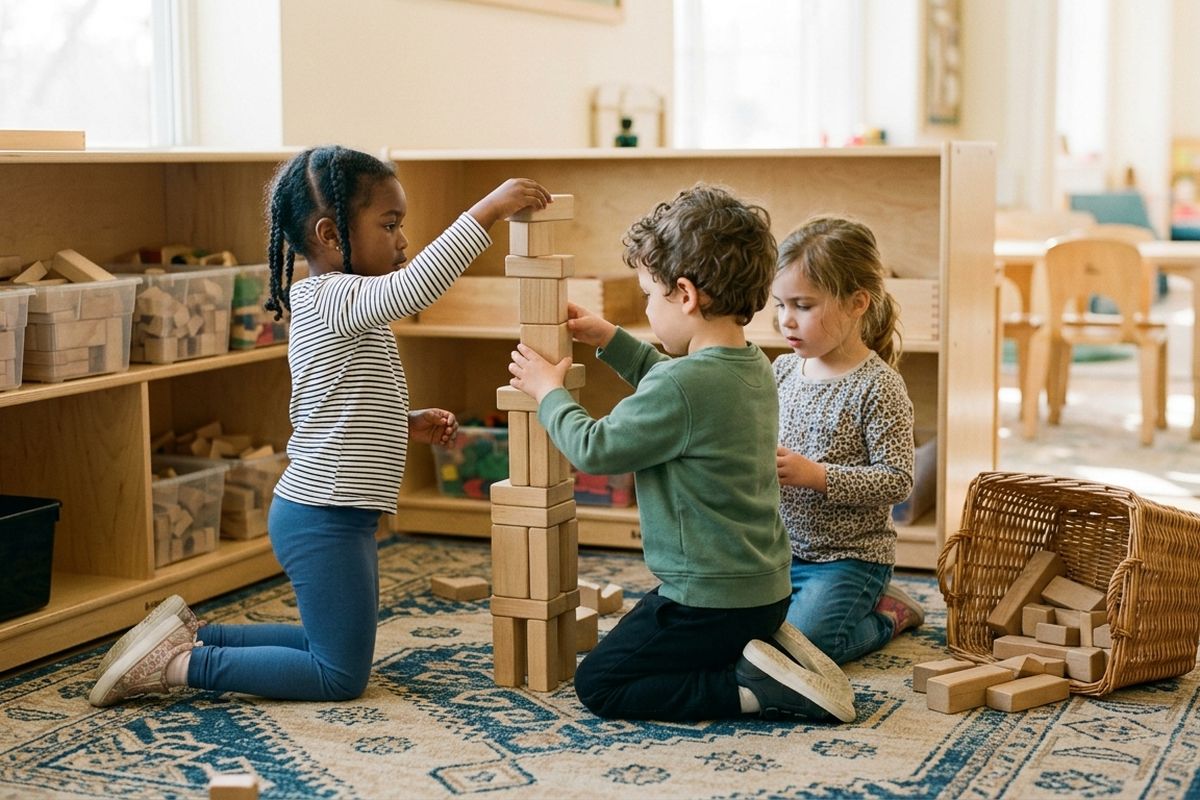
At its best, TK is a genuine bridge year: more play-based than kindergarten, shorter academic blocks, more room for the social side, kindergarten standards spread across two years instead of crammed into one. More blocks and dramatic play and songs on the rug, plus daily practice at opening a milk carton without looking personally betrayed by it.
It is not kindergarten-lite, and it isn't a consequence. It's a softer landing for a younger five-year-old.
Ask what the day actually looks like, though, because labels are slippery. One TK room is all movement and centers and outdoor time. Another looks exactly like kindergarten with a different sign on the door. Ask about the schedule, whether there's rest or quiet time, how long children sit for whole-group lessons, how much of the day they choose. If the answer is "oh, it's basically kindergarten," keep asking. Basically-kindergarten may suit your child fine. It just isn't a bridge year.
Readiness is a lot more than letters
Parents worry about the alphabet first. Can she name them, write them, make the sounds. Those things help, and a child who recognizes their own name and likes books walks in with useful tools in hand. But that's a small slice of what the fall actually asks for.
The children who settled fastest in my classroom were rarely the ones who knew the most letters in September. They were the ones who could say goodbye at the door, hang up a backpack, follow a two-step direction, sit through a short story, and recover when something small went sideways.
What a kindergarten teacher is quietly watching for looks more like this:
- Can they separate at drop-off without staying upset for a long stretch?
- Can they follow "put your folder in the basket and come sit on the rug"?
- Can they manage a zipper, a lunchbox, the bathroom and handwashing most days?
- Can they play near other children, share materials, and survive not being first?
- Can they bounce back from a small disappointment?
I have taught children who could read at four and could not share a marker without courtroom drama. I've also taught children who knew six letters in September and were reading by May. A year of maturity tends to do more work than a year of alphabet practice, partly because the letters arrive on their own schedule anyway once a child is settled enough to take them in.
The case for going, and the case for waiting
Plenty of young fives belong in kindergarten. Some are hungry for it: they ask when school starts, they like group time, they can be disappointed and try again. They may have friends heading in, or they may have simply outgrown the preschool room. Being the youngest is not automatically a problem, especially for a kid with solid language, decent stamina, and a school day that still leaves room to play. I had children in my room who were small enough to disappear behind a coat hook and walked in with a lunchbox, a plan, and the confidence of a mayor cutting a ribbon.
Waiting has its own good reasons. A summer birthday plus a hard time with transitions deserves a slower look. If your child still struggles badly with separation, runs out of gas by ten-thirty, avoids group activities, or comes apart whenever the plan changes, another year can be a kindness rather than a verdict. The everyday-machinery side of readiness is usually what tips this one.
Listen hard if the preschool teacher gently raises it. She sees your child in a group of same-age peers, which is a view you almost never get. At home a kid can seem obviously ready, because at home they can build a zoo out of couch cushions and argue convincingly that socks are optional. In a room with seventeen other children, the picture is sometimes different.
The trade-off is real and worth naming: your child will be among the oldest for the rest of school. Older during puberty, first to drive, occasionally a little out of step socially in middle school. Those are distant concerns and they aren't imaginary. I still wouldn't let the driver's license question outweigh the actual five-year-old in front of you, the one whose backpack is already full of rocks. And waiting now is a different thing entirely from the retention conversation that can come up later, which happens after a child has already spent a year in the grade.
What to ask, and who to ask it of
Start with the preschool teacher, and skip "do you think she's ready?" Most teachers answer that one carefully, because they don't want to frighten you and they don't want to make the decision for you.
Ask instead: What does he do when something is hard? How does she handle the group, does she join the play or watch first or need an adult to get her in? What would you want them practicing before fall? And the useful one: if you had to bet, where would my child land in a kindergarten class? That question invites a real answer about a real child rather than a checklist.
Then ask the elementary school what kindergarten looks like there. How long are the academic blocks, how much outdoor time, is there rest or quiet time, what happens with a child who's wiped out by two o'clock. Some kindergarten days still hold plenty of centers and songs and block building. Some are considerably more academic. Neither answer settles it, but it lets you match the child to the room instead of to the idea of kindergarten.
If you can visit, visit, and watch your child's body more than their words. Do they lean toward the room or freeze in the doorway? Do they spot the blocks, the cubbies, the reading corner? Five minutes in a hallway sometimes tells you more than another three weeks of grown-up debate. And try to decide in spring if you possibly can. August decisions get made in the heat, against a deadline, under the strange emotional pressure of a school-supply aisle.


