

The room gets very quiet the first time a teacher floats it. Spring conference, the little plastic chair doing its best under you, a folder of work samples on the table, and then: "We may need to talk about whether another year would help." Sometimes nobody says it out loud at all. You've just watched your child drag through a hard year and you've started wondering it yourself, usually at eleven at night.
How the question usually comes up
Almost no retention conversation starts cold. It comes after months of smaller worries: a child still guessing at words in the spring of 1st grade, a kid flattened by the pace of the day, someone who misses directions, avoids writing, cries at drop-off, or announces from the back seat that they're the only one who can't do it.
In kindergarten through 2nd grade the question surfaces more often, because the early grades are one big developmental stew. A kindergarten class holds children who are barely five and children nearly six and a half, all working on letter sounds, stamina, lunch trays, pencil grip and not putting the glue stick in a pocket. Some kids are academically close but socially wrung out by two o'clock. Some are terrific at recess and lost the second a book opens.
After 2nd grade retention gets rare. The academic gaps may be wider, but the social cost climbs fast, and a 4th or 5th grader knows exactly what repeating means.
One thing families run into without warning: some states have 3rd-grade reading laws that can force the question when a child sits far below a reading benchmark, even when the teacher sees a more complicated child than one score. If reading is the heart of the worry, it's worth sorting out which kind of "behind in reading" you're actually looking at before anyone talks about grades at all.
What the research generally says, loosely
On balance, research has not been kind to retention as a stand-alone fix. Another year of the same instruction, the same materials and the same expectations rarely closes a gap on its own. Plenty of children who repeat show a bump early on, because September feels familiar and easy. Then the work gets harder again and the old trouble tends to come back.
Which doesn't mean it never helps. It means retention without a different plan attached is a very large maybe wearing the costume of a solution.
The social side is real too. Younger children often don't fully grasp what repeating means, though they absolutely notice that their friends moved on. Older ones feel the label sharply. In a classroom, status attaches itself to strange things: who lost a tooth, who reads chapter books, who still needs help with shoelaces. Six-year-olds are sweet and also about as subtle as a tambourine.
The exceptions people point to are genuine ones. A very young kindergartner with an August birthday. A child who missed a large stretch of school. A year derailed by illness, a move, or something hard at home. In those cases the question shifts from "should this child repeat" to "did this child ever get a fair run at this grade in the first place."
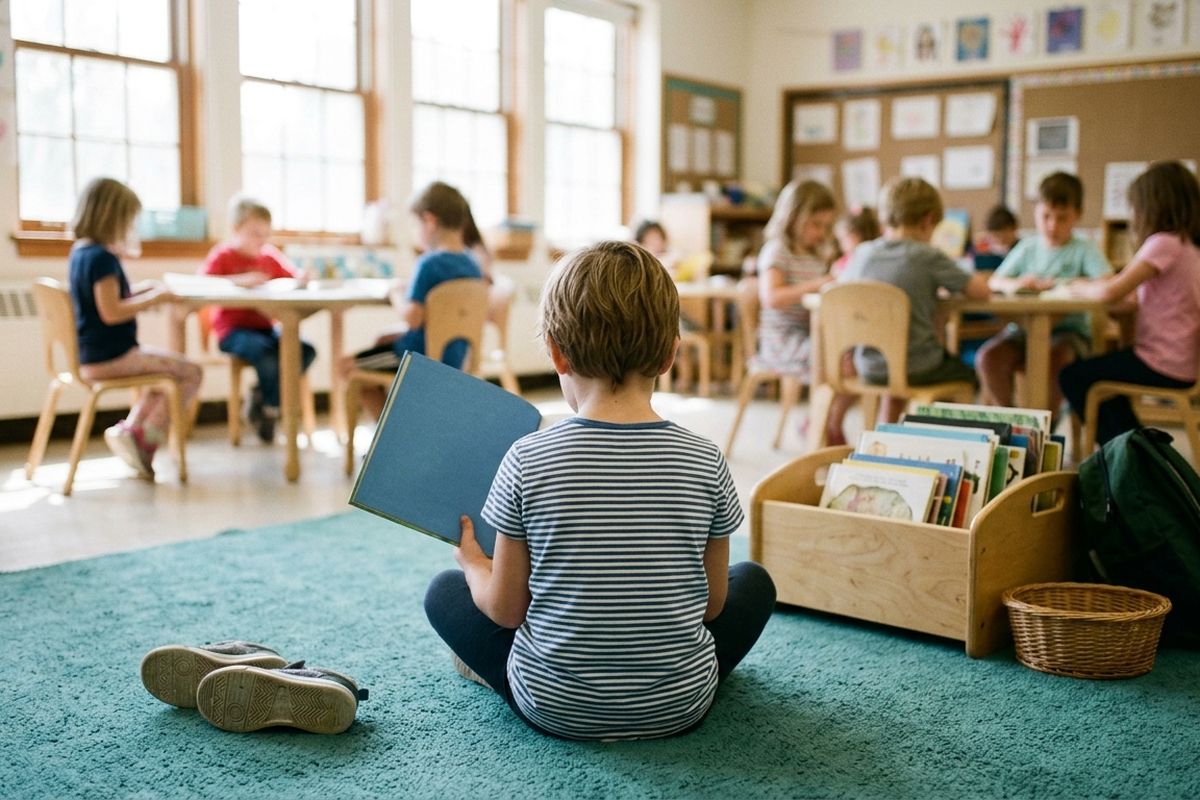
In my classroom I tried hard to separate "not ready for this grade" from "not there yet in one area." Those are two different children. A kid who is young, worn out by the full day, still shaky on routines and behind across the board is one conversation. A kid who is happy, talks at circle time, builds elaborate things in the block corner, explains how rain works, and still can't hold onto short vowels is a completely different one.
What schools actually weigh
Schools usually look at several things before recommending retention. Not perfectly, because schools are made of humans and calendars and a copier that jams on the worst possible morning, but there should be more than one data point on the table.
Age compared with classmates. Reading level. Writing stamina. Math readiness. Attendance. Social maturity. Most teachers are also quietly weighing how your child handles frustration: do they shut down after one hard problem, can they ask for help, do they seem connected to the other kids.
Supports matter more than any of it. Before retention gets seriously discussed, ask what's already been tried and for how long. Small-group reading? An intervention block? A different phonics approach? More fine-motor work for writing? Has anyone raised a 504 plan or an evaluation, if attention, speech, language, hearing or vision might be part of the picture? That's a conversation for the teacher or your pediatrician, and it's a fair one to open.
Retention shouldn't be the only tool on the table either. A summer reading program, an intervention block, a different classroom placement, outside tutoring, a plan for check-ins through the first grading period. There's a lot of ground between "repeat the year" and "hope it sorts itself out," and most of what helps a child who has fallen behind lives in that middle.
The sentence I always listened for was: what will be different? If the answer amounts to "they'll hear it again," that's thin soup.
The kindergarten cousin: redshirting
Redshirting is retention's cousin, not its twin. Retention means repeating a grade already attended. Redshirting means holding a child out of kindergarten for a year before they ever start, usually for a late spring or summer birthday.
Families do it for different reasons. A child can be full of questions and still very young socially. Some can't separate at drop-off yet, run out of gas by lunch, or are still working on the everyday machinery of school: sitting through a short story, managing the bathroom alone, getting the snack open, waiting for a turn without dissolving next to the cubbies. I've taught children who were bright as buttons and simply needed another year to be ready in the Velcro-shoe sense.
The trade-off is that the child will be among the oldest in the grade forever after. That often feels helpful in kindergarten and 1st grade. It can feel more complicated in middle school, where age gaps show up in size, sports rules and social expectations.
There's a fairness piece too. Another year of preschool or childcare isn't something every family can buy, and teachers know it. A good kindergarten room expects a wide spread of ages and skills; it shouldn't require everyone to arrive as a small 1st grader. If you're weighing it, ask what kindergarten actually looks like in your school now. Half day or full day, rest time or none, mostly play or mostly table work. Fit depends partly on the child and partly on the room they're walking into, which is also most of what readiness really means.
Questions to ask before anyone decides
This decision should not get made in one meeting, at the end of a long day, while the custodian vacuums outside the door. Ask for time. Ask for specifics. Ask for a written plan either way.
- "What would be different the second time?"
- "What supports have been tried, and for how long?"
- "What's the plan if we move ahead instead?"
- "How will we measure progress, and when do we meet again?"
Ask the teacher what they see past the scores. Does your child have friends? Do they talk in class? Are they starting to use strategies even when the work is still hard? A child can sit below grade level and still be blending sounds instead of guessing from the picture, and that shift matters enormously. Slow, still puffing, but moving.
Ask your child too, sideways. Not "do you want to do this grade again," please no. Try what feels hard at school, when do you feel proud, what one part of the day would you change. Kids hand you a shrug first and the real answer three days later from the bathtub or the back seat.
Then get it in writing. If retention is recommended, the plan should say what instruction or intervention changes during the repeated year. If promotion is recommended, the plan should say what support comes along into the next grade. Either way: who's responsible, when progress gets checked, and what happens if your child is still struggling in November. Bring the report cards, the attendance record, the reading scores, and your own knowledge of the kid who falls asleep with one sock on and a library book under their cheek.


