

At 9:14 two kids start the same worksheet at the little kidney table by the cubbies. One is done before I finish tying the shoe of the child next to him. The other is still on question two eleven minutes later, erasing hard enough that the paper has started to pill.
Same page, same directions, wildly different pace. Parents ask me about this at conferences more than almost anything else, usually in the form of "should I be worried that he's always first?" or "she's always last."
Speed is noisy information
Pace tells a teacher something. It just doesn't tell us one clean thing.
How fast a child works depends on how quickly they take in directions, how long their hand lasts before it gets tired, how sure of themselves they feel, how much they care about neatness, and how badly they want to get to the book bins. Some kids treat a worksheet like a race. Some treat every letter like it's going in a museum.
What pace does not measure is understanding. I have had a child finish a phonics page in four minutes and miss the spot where the directions changed halfway down. I have had a child use the entire work time and get every answer right, including the one everyone else skipped. Two kids can hand in the same score with eleven minutes between them.
What teachers actually watch is the combination: accuracy, independence, stamina, and what happens when we say "tell me how you knew."
The fast finisher, up close
There are two of them, and they look similar from across the room.
The first one really has it. The work is familiar, they caught the directions the first time, their letters come out without a fight. That child looks relaxed when they're done. Not triumphant, just finished. Ask them about any problem on the page and they can tell you.
The second one is racing for the fizzy feeling of being first. Pencil goes down like a gavel. Eyes sweep the table to see who noticed. The first three answers are careful and the last three look like a squirrel got hold of the pencil.
Teachers sort this out with two small moves. I flip the paper over and ask them to show me one they're proud of and how they figured it out. Or I compare the top of the page with the bottom. If row one is neat and row four is full of skipped words and backwards numbers, speed has become the point.
That habit costs kids later. In kindergarten, rushing means writing "cat" when the picture is a cap. In 4th grade it means missing the word "not" in a problem, or answering the first half of a two-part question and stopping. Nobody needs to make a quick kid slow. They do need to learn that done and checked are different words.
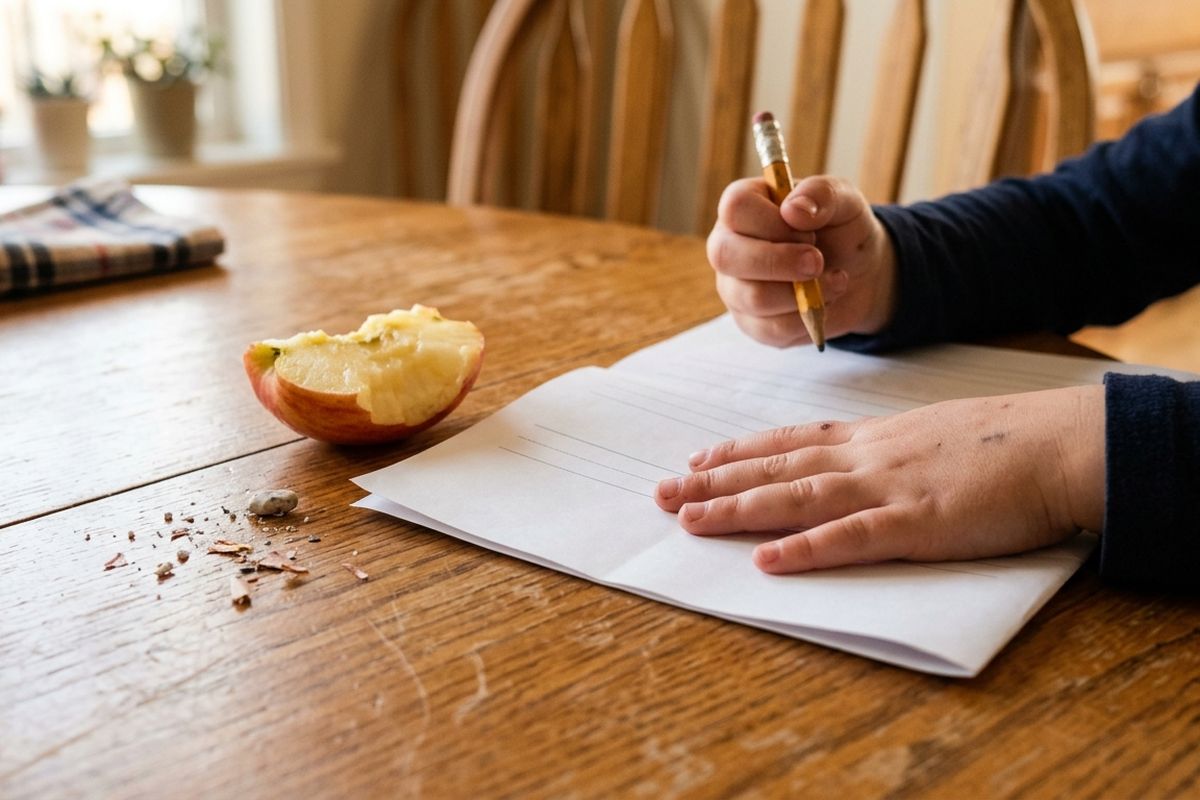
The careful one
Now the other kid. Eraser holes. The letter started over four times. Still on question two while the rest of the class is choosing books.
Often this child understands the work completely. The slowdown is somewhere else. Perfectionism can turn a six-word sentence into a twenty-minute project. A tired hand makes writing feel like carrying a grocery bag by one finger, which is its own problem and worth reading about separately, because handwriting stamina shapes a lot of what shows up on paper. Some kids second-guess answers they actually know. And some minds simply wander off. The fish tank bubbles, a chair squeaks, a leaf taps the window, and the child returns from a short trip to another planet to find everyone on number seven.
"Just hurry a little" almost never works. If hurrying were the missing skill, they'd have used it.
What works is making the job look smaller. I cover half the page with a folder and say, do these three. I circle the must-do problems and let the rest go. I give a quiet cue, one tap on the paper and the word "next," so the child doesn't get a whole speech in front of the table. For a kid whose hand gives out, four written answers can show more than a full page of exhausted scratching.
What we actually do with early finishers
The goal is something useful and calm that doesn't rattle the child still working two feet away. In most K to 2 rooms that means a book box, a classroom job, one challenge question, or the teach-it-to-a-partner move, which has to be handled carefully. No six-year-old wants a tiny deputy hovering over their shoulder pointing out missing capitals with the authority of a town mayor.
More of the same worksheet is the worst option, because it teaches a kid that finishing earns extra paperwork. It also still happens. A reading group is waiting, someone has knocked over a water bottle by the cubbies, the copier ate the extension page, and the extra copies are right there on the counter. Teachers are people having a Tuesday.
When your child says they're always bored, it's worth finding out which kind of bored. Sometimes the work is genuinely too easy. Sometimes they hate waiting, or the early-finisher choices are thin, or they're rushing to get to the thing they'd rather do. Those lead to different conversations, and "bored" and "ahead" are not automatically the same diagnosis.
What to ask at a conference
Ask about accuracy and independence, not ranking. Teachers won't tell you who's fastest, and the answer wouldn't help anyway.
- "When he finishes quickly, does the work hold up?"
- "Does she seem stuck when she's slow, or just careful?"
- "Does the pace get in the way of showing what she knows?"
- "Is it slow across the whole day, or mostly with writing?"
One calm note about timed work. Plenty of schools still use timers for math facts, and some kids freeze the second one appears. That's usually about the timer and not the math, and fact fluency and clock pressure are worth separating before anyone decides a child is behind. If timed pages consistently change your child's accuracy or end in tears at the kitchen table, say so to the teacher. And if your child is much slower than classmates across many kinds of tasks, or the pace changes suddenly, mention that too, without alarm: "Homework takes a very long time even when he understands it. Are you seeing that?"
At home, without starting a race
Stop timing homework unless the teacher asked you to. "How fast can you finish?" produces sloppy work from the rusher and panic from the careful one.
Learn the difference between slow-and-thinking and slow-and-stuck. Slow-and-thinking looks like rereading, whispering the question, checking the example, trying something, erasing, trying again. Slow-and-stuck looks like staring at the wall, sharpening a pencil for the fourth time, sliding halfway under the table, or informing you that the dog understands subtraction better than they do.
Then give the work a visible end. Numbers one through four, then bring it to me. Fold the page. Sticky note under the line they're on. When these five are done and checked, homework is over.
And when the announcement comes, meet it sideways. To the one who says "I finished first!" try: you were quick, did your work hold up? To the one who groans that they're always last: last isn't lost, show me where your brain worked hardest. Then look at the paper together instead of the clock. The paper tells a better story.


