

The third water bottle of the year is the point where a parent starts doing math in their head, and not the cheerful kind. Then the jacket "was right there," except there turns out to be the blacktop, the bus, the cafeteria, or some fourth location known only to children and single socks. Some kids lose things with such commitment that you start wondering whether they're running a small donation program out of the backpack. What fixes it is not a bigger lecture. It's a smaller system.
Why kids lose things, and why yelling doesn't fix it
Most elementary kids aren't losing the jacket out of laziness. They're losing it because working memory is small, busy, and already holding a dozen other things.
Working memory is the mental sticky note that has to keep "bring your folder home" alive while also keeping "line up," "stop talking," "where's my lunchbox" and "I hope we get the good bus driver." For kids in roughly kindergarten through 3rd grade, that sticky note is tiny. Not much has to happen for something to slide off it.
Transitions are the actual thief. Recess to class. Library to classroom. Classroom to bus. A jacket taken off at recess vanishes from a kid's mind the second the whistle blows, because they are not thinking "I shall now abandon this jacket by the slide forever." They're thinking: run, line, teacher said hurry.
By 4th or 5th grade a lot of kids get better at it, because they can hold more steps in their head and they've had more practice. A lot. Not all. My own 4th grader can recite a sports statistic from last March and once left the same sweatshirt at school for nine days straight.
Yelling adds stress without adding memory. A panicked kid does not develop a filing system because someone asked "how many times have I told you?" at higher volume in the car. I have tried it. It did not produce the library book.
The one-hook rule at home
The home half of this has to be boring enough to hurt: everything school-related lives in one spot.
Not near one spot. Not usually by the stairs. One spot.
A hook or a bin by the door does the job. Backpack, jacket, water bottle, folder, library book, anything that has to leave the house tomorrow. The backpack does not go up to the bedroom, because bedrooms are where permission slips fossilize under pajamas.
Put the hooks at kid height. This sounds like a small thing and it isn't. If your child has to stretch or fling the backpack like a carnival game, the backpack ends up on the floor, then the jacket ends up on the floor, and then everyone steps over the pile for three days asking whose it is.
My entryway is not cute. Two hooks, one bin, one lost-and-found basket. One hook per kid, the bin for school shoes and anything that has to go back to school, the basket for items that clearly belong to someone in this house who denies all knowledge of them. The whole rule is four lines:
- Backpack on the hook.
- Water bottle in or next to the backpack.
- Jacket on the same hook.
- Library book in the bin.
When your kid comes in and detonates in the hallway, stop them before the snack. "Backpack first." Two words, same two words, every day, until their hands do it without you. It's the same principle that makes a morning routine hold together: fewer decisions, always in the same order.
Labels, but the right kind
Labels aren't magic. They're a return address.
Name on the water bottle lid and on the bottle, because lids and bottles wander off separately. First and last name if there's more than one kid with that first name in the class, which there is. Name inside the jacket collar, written on the fabric, not on a tag that will quietly fall off in October. Sharpie is fine. Fancy iron-on labels are also fine, if you are the kind of person who knows where the label sheet is right now. I admire you from a distance.
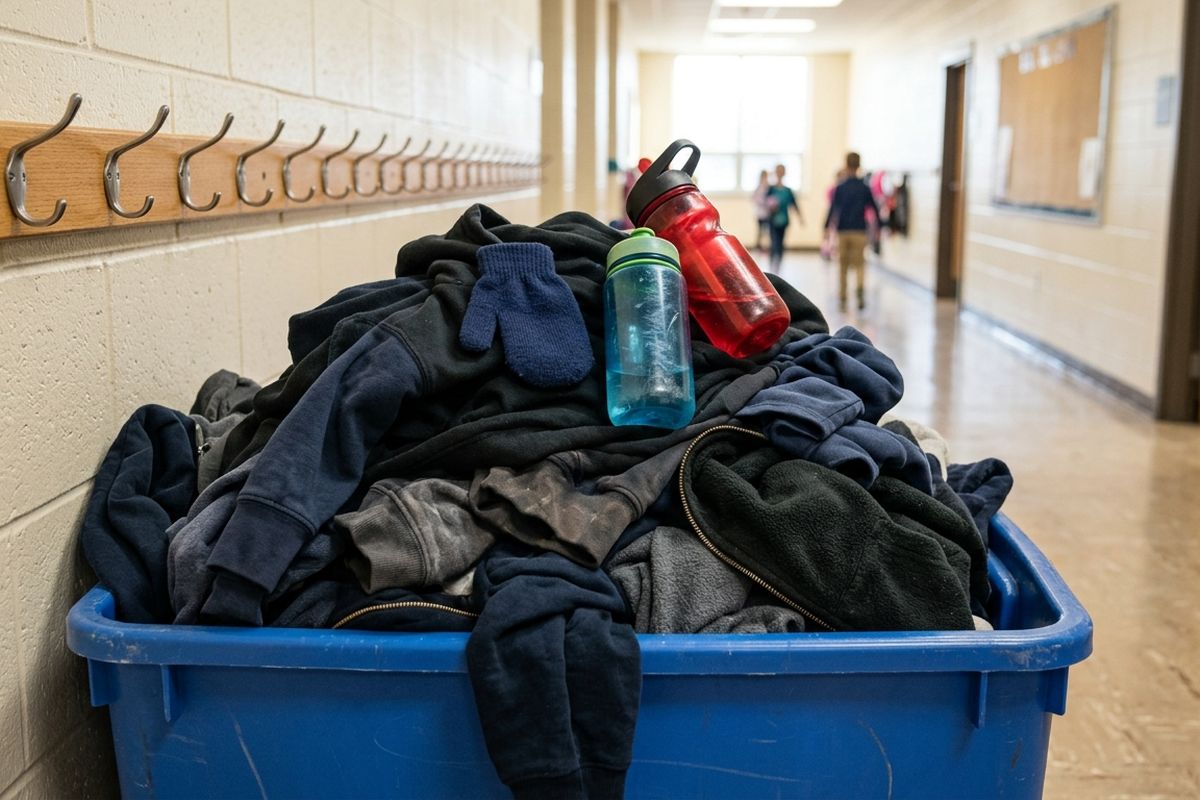
The school lost-and-found is the place labeled things come home from and unlabeled things go to die. A black hoodie with no name, in a bin with 47 other black hoodies, has effectively entered witness protection.
Owning fewer things helps more than any label. One water bottle in rotation is easier to track than four. I know the logic behind the extras, there's always a clean one. In practice there are zero clean, two missing, and one growing something in the back seat. One main bottle, one plain backup if you must, and the plain one is the replacement when the good one disappears.
The Friday sweep
Do the sweep before the weekend eats everyone's memory. Friday afternoon beats Monday morning, because Monday morning is already carrying too much: missing shoes, spilled cereal, and someone who has just remembered they need a shoebox.
Pick a time and stick to it. Four o'clock on Friday, before screens, dump the backpack out. Not lovingly. Dump and sort. You're looking for the jacket, the water bottle, the folder, the library book, and the lunchbox, which is its own separate adventure.
If your school lets parents check the lost-and-found, check it weekly. If it doesn't, send your kid, and be specific about it. "Look for your blue hoodie with the soccer patch on the sleeve" works. "Check for your stuff" gets you a five-second glance from six feet away while thinking about crackers.
Then put a checklist on the door, and keep it short enough that a child will actually read it. Jacket. Bottle. Folder. Library book. Four words near the doorknob beats a laminated command center with subcategories.
One more habit worth teaching: the last-place question. Not "where is it," because they genuinely don't know, that's the whole problem. Ask "where were you when you took it off?" Then "was that before or after lunch?" and "did you have it on the bus?" You're teaching them to rewind the tape. At first you do all the rewinding. Eventually a lot of kids start running the questions themselves, which is the actual skill buried inside the lost-jacket drama.
When to let the consequence land
Sometimes the fix isn't a system, it's arithmetic. If the nice water bottle goes missing, the next one is the plain one. If the plain one goes too, part of the replacement can come out of their own money, without a speech attached. "The bottle's twelve dollars. You've got five saved. Put in the five and I'll cover the rest this time." For kids in 4th grade and up, paying a share lands harder than another lecture, and it's a lot more concrete than "be more careful." If you don't have a system for that money yet, it's worth setting up an allowance they actually control first.
What I'd avoid is rescuing every time. Driving back to school at 5:30 for a water bottle teaches that someone else maintains the system. Some days you'll drive back anyway, because the thing is expensive or needed tomorrow. Fine. But if every forgotten jacket comes with chauffeur service, there's no reason for the habit to grow.
And go easy on a kid who forgot once. A first grader leaving a sweatshirt on the playground is not a character flaw, and a rough week that ends with a missing library book isn't either.
If it's every single day, and your child is past 3rd grade, it's worth asking the teacher what they're seeing, in a low-key way: we're working on lost items at home, do you notice where the day falls apart? Teachers usually know the pattern immediately. The jacket goes after recess. The bottle stays in the cafeteria. The library book never makes it back into the bag. Then give your child one next step, not six. Touch your bottle before you leave lunch. Jacket goes on when the whistle blows. Library book straight into the bin.


