

The first time your child asks, "Can I buy that with my own money?" you can almost hear the math lesson hiding inside the question. Suddenly quarters matter. Dollars disappear. A plastic dinosaur from the checkout lane becomes a real financial decision, which is both funny and slightly tragic when the dinosaur costs $7.99.
\nWhy allowance is math homework in disguise
\nAllowance is one of the sneakiest math tools in a house. It looks like money and feels like independence. Underneath, your child is practicing counting, comparing, estimating, subtracting, waiting, and making choices with real stakes.
\nWorksheets have their place. But real money has a weight that paper math does not. A 2nd grader who groans over 10 minus 6 may suddenly nail it when they have $10 and the stuffed keychain costs $6.
\nAllowance also teaches trade-offs. Spend every dollar at the school book fair on Friday, and there is nothing left for the ice cream truck on Saturday. That lesson stings a little, but it is small and safe. Better to learn it over scented erasers than over a phone bill someday. It is also the natural first chapter of teaching your kid about money in general: earning, spending, and the sad discovery that money is finite.
\nSystem 1: the flat weekly allowance
\nThe simplest system: your child gets the same amount each week, no matter what. It is not tied to making the bed, clearing the table, or remembering that socks go in the hamper instead of under the couch.
\nThat last part matters. In this system, basic chores are part of being in the family. You do not get paid to brush your teeth or carry your plate to the sink. You do those things because you live here and the kitchen is not a restaurant.
\nThe allowance becomes pure money management practice. Your child learns, slowly and with much dramatic sighing, that money runs out. If they blow the whole amount on a tiny toy that breaks before dinner, you can be sympathetic without rescuing them. "Oh, that's disappointing. You'll get allowance again on Friday."
\nFlat allowance works especially well for younger elementary kids because the rules are clear. Same day, same amount, same parent trying not to say "I told you so." Weekly beats monthly, by the way. "Next month" sounds like the age of dinosaurs to a 6-year-old. "Friday after school" makes sense.
\nSystem 2: commission for extra jobs
\nA commission system pays your child for extra work, while regular family chores stay unpaid. Many parents like this one because it connects effort and money without turning every tiny responsibility into a negotiation.
\nThe key is separating "you live in this house" jobs from "above and beyond" jobs. Base chores might be clearing dishes, feeding the dog, packing the backpack. Those are expected, and there is a reasonable chore load for the school year that stays free. Extra jobs are things that genuinely help and take real effort.
\nConcrete prices help. Kids do better when the job and the pay are visible:
\n- \n
- Match a basket of clean socks: 50 cents\n
- Wipe the hallway baseboards: $1\n
- Pull weeds from one garden bed: $2\n
- Wash the car floor mats: $3\n
Keep the jobs small enough to finish. "Clean the garage" is too big and too vague for most elementary kids. "Sweep the garage steps and put the soccer balls in the bin" is doable.
\nThis system also protects you from the classic "How much will you pay me to put my shoes on?" moment. Shoes are free, my friend. The bus is coming.
\nSystem 3: the three-jar split
\nThe three-jar system gives money a place to go before it burns a hole through your child's pocket. The usual jars are spend, save, and give. Actual jars, envelopes, zipper pouches, or three sticky notes on a notebook page all work if your house is not currently in a mason jar era.
\n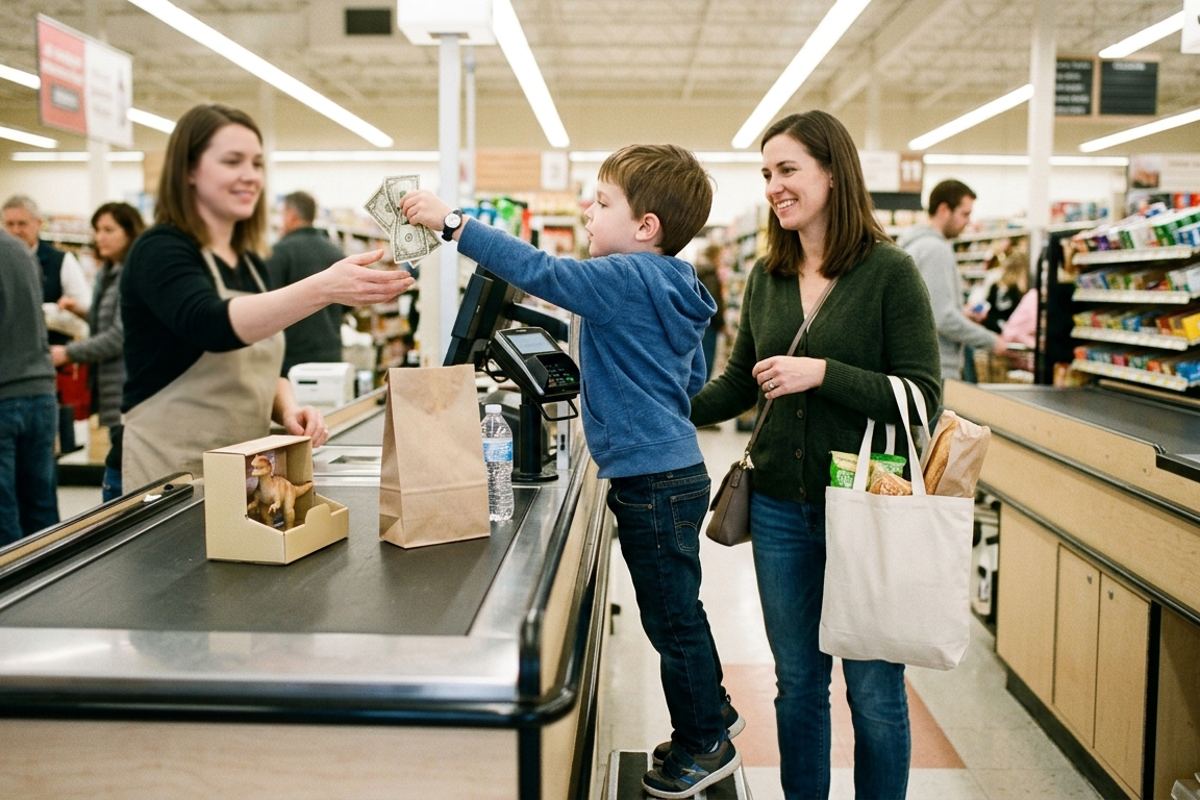 \n
\nThe point is that the split becomes visible. If your child gets $5 a week, they might put $3 in spend, $1.50 in save, and 50 cents in give. Younger kids do not need tidy percentages at first. They need to see that money can have different jobs.
\nThe save jar is the slowest, and often the most powerful. A child saving for a $24 Lego set gets to watch the pile grow week by week. That beats any lecture about patience. They count it, recount it, announce the total to the cat, and ask if birthdays can be moved up.
\nThe give jar can stay simple: an animal shelter, a classroom food drive, a cause your family already supports. The amount can be small. The habit is the lesson.
\nThe one that backfires: paying for grades
\nPaying for grades sounds tidy. An A gets $10, a B gets $5, and suddenly everyone is motivated. Except children are not vending machines, and grades are messier than that.
\nThe biggest problem is that paying for grades shifts the focus from learning to the reward. Some kids start asking "What do I get if I read this?" instead of "What happens next in the story?" That shift is hard to undo.
\nGrades also depend on more than effort. A child may work very hard in spelling and still earn a C because spelling is genuinely tough for them. Another may coast through math and collect cash for work that barely made them blink. And a kid who is already anxious about school does not need a family paycheck riding on Friday's quiz.
\nIf you want to celebrate effort, aim there directly. "You studied your multiplication facts three nights this week. Want to pick our Friday dessert?" notices the work your child can actually control.
\nHow much, and when to start
\nMany families land on a simple rule of thumb: 50 cents to a dollar per year of age each week. So a 6-year-old might get $3 to $6, a 10-year-old $5 to $10. Your budget matters more than anyone else's chart. An allowance should not stress the grown-ups paying the mortgage.
\nMost families start somewhere around kindergarten or 1st grade, roughly ages 5 to 7, when counting coins begins to click. Your child does not need to understand everything about money yet. They just need enough number sense to count small amounts and grasp that spent money is gone.
\nA few practical guardrails:
\n- \n
- Pick one allowance day and stick to it as much as real life allows.\n
- Use cash at first. Coins and bills make more sense to young kids than a number in a parent's app.\n
- Decide up front what your child pays for. Book fair extras? Treats at the pool?\n
- Do not advance next week's allowance every time. That turns you into a very tired bank.\n
By 4th or 5th grade, kids can handle more: covering friend birthday gifts, snacks at games, part of a bigger wish-list item. And once they are carrying their own money, errands get interesting. Bring them along and try some math practice at the store, where the spend jar meets the price tag for the first time.


