

The school drive at our house is eleven minutes, assuming the light by the pharmacy behaves. That's long enough for one kid to ask for a screen, the other to open negotiations about the backpack situation, and me to decide I cannot play I Spy one more time before eight in the morning. So we do math facts in the car instead. Badly, briefly, and that's exactly why it sticks.
Why the car beats the kitchen table for this
At the table, math facts turn into a production. Pencil grip. Eraser crumbs. One kid sliding off the chair like a cooked noodle. A page of sixty problems sitting there looking like it has unpaid rent.
In the car there's no pencil and no page. There's also no eye contact, which helps more than adults like to admit. Kids can groan all they want, but they can't storm off to their room unless your commute has some very unusual features.
Car math is short by design, too. A red light is maybe forty-five seconds. A drive to school comes with a built-in ending. That matters, because math facts are half memory and half nerve, and five decent minutes beat twenty-five minutes of family courtroom drama. Fluency is built out of a lot of small, low-stakes reps, not one heroic session on a Sunday.
Then there's the loophole. Say "let's practice subtraction facts" and most kids hear homework. Say "I need two numbers that make 24 before we pass the gas station" and it's just something to shout from the back seat.
License-plate math
Pick a plate in front of you and use the digits. Add them. Make the biggest two-digit number you can. Hunt for two digits that make 10.
If the plate has a 3, an 8 and a 1, one kid says twelve. The other says eighty-three. If you're stuck behind the same minivan for three lights, you have a full lesson and possibly a new enemy.
Kindergartners and 1st graders can stick to spotting and naming: "there's a 7, there's two 4s." Second and third grade do sums, differences and ten friends. Fourth grade and up multiply the pairs. My own 4th grader has strong opinions about 7 × 8, none of them tender.
Where it falls apart: one kid sees the plate first and claims permanent ownership of all math within twenty feet. Assign jobs instead. One adds, one makes the biggest number, one checks. With two kids, the checking job is yours, which mostly means saying "wait, say that again" while you merge.
Target number
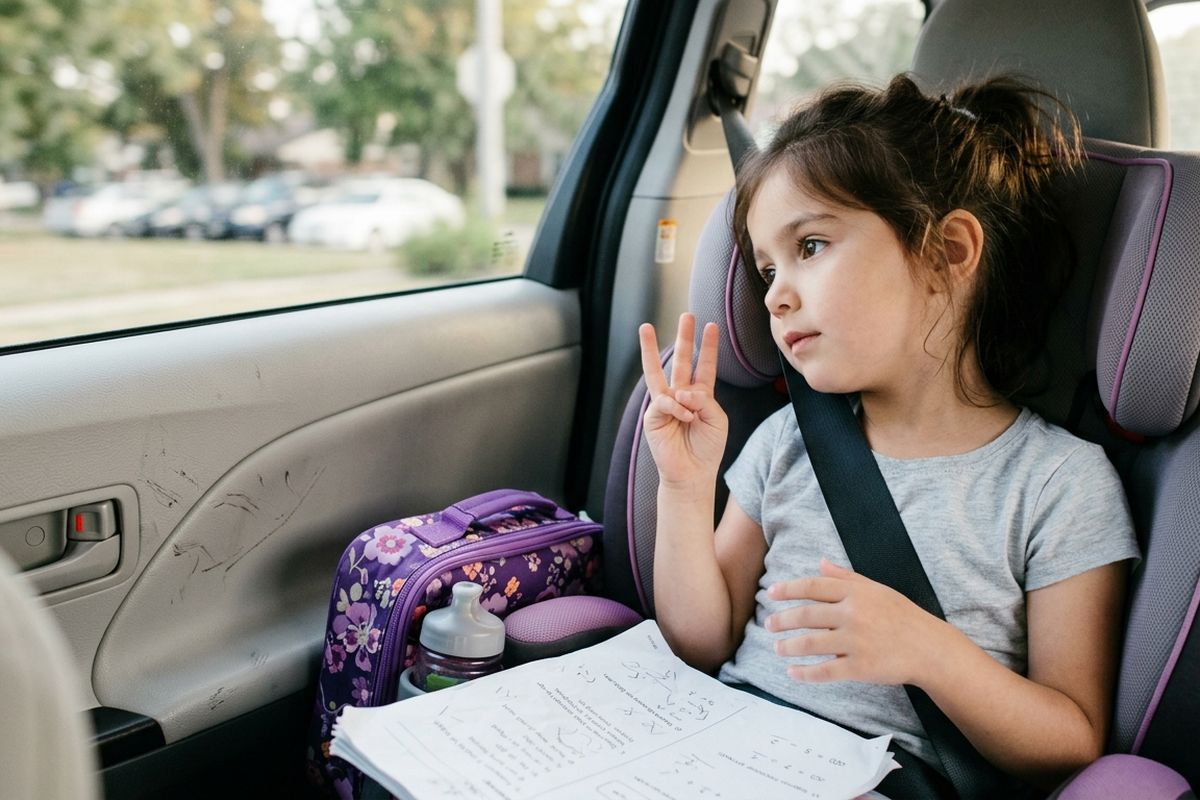
Pick a number. Say 24. Everybody finds a way to make it with two numbers: 20 + 4, 12 + 12, 6 × 4, 30 − 6. Once that's easy, go to three numbers.
What I like about this one is that nobody has to announce their level. A younger kid can offer 23 + 1 and it counts. An older kid can use division or parentheses. I allow the ridiculous routes too, like 100 − 76, because the whole point is seeing numbers as movable instead of frozen in place on a worksheet.
Where it falls apart: one kid dominates. There's usually a fast one back there firing off six answers before the other has blinked. Give turns, or make the quick kid the judge for a round. "New rule, nobody may use addition" also works, since it evicts the speedy child from the easy answers.
What's my rule?
You give pairs, they guess the pattern. Try 3 → 7, 5 → 9, 10 → 14. The rule is add 4. Keep feeding pairs until somebody says it out loud, then let them test it on a new number.
Start easy and climb. Doubling is a good second round: 3 → 6, 5 → 10, 8 → 16. Older kids can take a two-stepper like "times 2, then add 1."
The reversal is the better game, honestly. Your kid invents the rule, gives you the pairs, and you guess wrong on purpose. Not wildly wrong forever, that gets old fast, just wrong enough: "Is it subtract 5?" when every output is clearly bigger. Kids love catching a grown-up being confidently incorrect. It's one of the few free joys left.
Where it falls apart: a kid invents a rule and then quietly changes it mid-round. Very common, especially in 1st and 2nd grade. Ask them to whisper it to themselves first. If the outputs stop matching, skip the trial and just say "new rule, new round."
Doubles, halves, and how many more to 100
Doubling looks like a small thing and carries an enormous amount of later multiplication. Double 6 is 12. Double 12 is 24. Double 24 is 48. Keep climbing until somebody laughs or the numbers get too big for the driver to verify safely.
Halving runs the other way: half of 80, then half of that, then half again. Younger kids stay in friendly even numbers. Older ones can take half of 90 or half of 150 and discover that halves don't always land neatly, which is a fine thing to notice behind a delivery truck.
"How many more to 100" is subtraction without the sighing. We're at 37, how many more? A kid counts up: 37 to 40 is 3, then 60 more gets to 100, so 63. That counting-up move is cleaner than borrowing for a lot of kids, and it comes back later in money and in elapsed time problems, where the same trick does the same work.
Where it falls apart: we get excited and the doubling chain jumps a cliff. One minute it's double 12, the next we're asking for double 384 like we're auditioning for a math circus. Keep the numbers friendly. The goal is quick recall, not proving your 3rd grader can suffer.
How long to play, and what to change by grade
Five to eight minutes. That's it. Stop while it's still fun and your kid may put up with it again next week; keep going until everyone is silent and resentful and you have invented a worksheet without paper. Once a week is plenty. Car math shouldn't become one more parental performance category, and we already have lunches, permission slips, library books and the single sock that lives in the back seat.
- Kindergarten and 1st grade: name numbers, count digits, find ten friends like 7 and 3, count up past 20.
- 2nd and 3rd grade: sums, differences, doubles, near doubles, how many more to 100.
- 4th through 6th grade: products, factors, multiples, divisibility. "Is 126 divisible by 3?" Add the digits, get 9, so yes.
- Mixed ages: let the younger one answer first sometimes, and hand the older one a restriction, like no using 10.
Quit mid-laugh if you can manage it. Stop in the school parking lot. Stop when the kid in the next car is waving a banana at you. Stop when yours says "do one more," because a round left unplayed is the whole reason they'll say yes on Thursday. The morning scramble is hard enough without adding a second thing nobody wants to do before eight.


