

The square-versus-rectangle argument always starts at the worst possible moment. Six-fifteen, pasta boiling over, someone with a glue stick stuck in their hair, and your third grader announces that a square is not a rectangle "because rectangles are long." Dinner is now a geometry seminar. Annoying, and also a good sign, because the kid is arguing about a definition instead of a picture.
Kindergarten and 1st grade: naming shapes, noticing sides
Early geometry is mostly naming and noticing. Circle, square, triangle, rectangle, hexagon. Kids start with the looks-like version: a triangle is a pizza slice, a circle is the clock, a rectangle is the door.
Then school tightens the language. A triangle has three sides and three corners. A square has four equal sides and four corners, and those corners are called vertices, which a fair number of first graders pronounce "vert-a-sees" for a semester and survive.
Position words come in at the same time, which sounds like baby stuff until your child has to put the triangle above the circle and not beside it on a math page. Above, below, between, next to. Half the errors on those pages are position errors, not shape errors.
Pattern blocks are quietly doing the heavy lifting in these grades. The standard set has a yellow hexagon, green triangles, blue rhombuses and a red trapezoid. When a kid covers one hexagon with six green triangles, they've just seen composition: small shapes build bigger shapes. No amount of circling the hexagon on a worksheet gets you there.
The kitchen-table version takes thirty seconds. Put down the hexagon and ask whether they can cover it without using another hexagon. Then let them fiddle. Fiddling is the math.
2nd and 3rd grade: attributes, and the square-is-a-rectangle fight
This is where geometry stops being cute. Kids get asked to define shapes by attributes instead of by the picture in their head.
A rectangle is a four-sided shape with four right angles. A square has four right angles too, plus four equal sides. Which means a square is a rectangle; it passes the test. A rectangle isn't always a square, because the sides don't have to match. Your child is thinking "but rectangles are the long ones," and that's a visual habit, not a rule. A sticky note is a square and still a member of the rectangle family. A dollar bill is a rectangle and never a square.
These grades also split flat from solid. A square is flat, a cube is solid. A circle is flat, a ball is a sphere. A cereal box is a rectangular prism, a soup can is a cylinder, and kids learn to count faces, edges and vertices on the real thing. The soup can makes some children deeply suspicious, because two circular faces plus one curved surface doesn't behave like the others.
Fractions sneak in through the back door here too, when kids partition shapes into halves, thirds and fourths. Fold a paper rectangle in half, then in half again: fourths. Cut a sandwich into three equal strips and thirds stop being marks on a page. That's the same idea the fraction unit builds on a year later, which is why the folding is worth doing even when it looks like crafts.
4th and 5th grade: angles, lines, symmetry
Now the vocabulary gets sharper. Right, acute, obtuse. A right angle is 90 degrees, the corner of a sheet of printer paper. Acute is smaller, obtuse is bigger but still less than a straight line.
Angle size is where kids get fooled. Give them one angle with long arms and one with short arms, and plenty of fourth graders will call the long one bigger. The size is the opening, not the length of the lines. Scissors are the fix: open them a little or a lot, the blades never changed length.
Parallel and perpendicular arrive around here as well, and the words are fancier than the ideas. Parallel lines never meet, like the two long edges of a piece of notebook paper. Perpendicular lines meet at a right angle, like the corner of a cutting board.
Then the protractor, which children hold upside down, backward, and with the center hole roughly two inches from the actual corner. The order that fixes it: center mark on the vertex first, then swing one ray onto zero, then read where the other ray crosses. If your kid reports 130 degrees for an angle that is visibly skinny, they read the wrong scale, which is the protractor's fault and not theirs.
Symmetry shows up too. A line of symmetry cuts a shape into two matching halves. Fold a paper heart down the middle and it works. Fold a capital A and it works. Fold a capital R and it very much does not, which is more convincing than any explanation. And kids start sorting shapes into families: a rhombus is a parallelogram, a parallelogram is a quadrilateral. Fussy at first, same structure as a beagle being a dog being an animal. If you want the wider view of when all this lands, the grade-by-grade map puts it next to everything else happening that year.
Why the blocks beat the worksheet
Short rant. Geometry worksheets that ask a child to circle the triangle eighteen times are fine for quick recognition and useless as the whole meal.
Spatial reasoning gets built by moving shapes: flipping them, turning them, trying arrangements that don't work. A kid who covered that hexagon three different ways in kindergarten has already seen that one whole can be two trapezoids, three rhombuses or six triangles. Two years later, when a teacher says one-half, one-third and one-sixth, there's somewhere in the brain for it to land.
Block play also settles a thing worksheets rarely address: shapes keep their names when they turn. A triangle pointing down is still a triangle. A rhombus leaning left is still a rhombus. The shape didn't change because the table did.
You don't need a curriculum for this. Pattern blocks if you own them, tangrams, cardboard cut off a cereal box, folded paper, sticky notes chopped into triangles. Draw a big hexagon or rectangle on scrap paper and ask how many ways they can cover it. Gaps are fine. Overlaps are fine. The gaps are where the thinking happens, and it's the same argument for choosing a game over a worksheet most evenings.
My own 4th grader once spent eleven minutes insisting that two trapezoids were "almost a hexagon except for the tiny weird part." The tiny weird part was the entire point. I didn't need him to be right.
Three things that trip kids up
Rotation is the first. A square balanced on its point is still a square, not a diamond. Diamond is a playground word; math class wants square or rhombus. Four equal sides and four right angles, tilted or not.
Angle size is the second, and it's worth two minutes with a napkin. Draw one angle with very long arms and a narrow opening, another with stubby arms and a wide opening, and ask which mouth is open wider. That picture sticks where a paragraph doesn't.
Third, mixing up flat and solid words. A ball isn't a circle, it's a sphere. The end of the soup can is a circle, the can is a cylinder. The side of the cereal box is a rectangle, the box is a rectangular prism. Kids get this wrong partly because adults are sloppy all day long; I say "hand me the square container" when I mean a cube-shaped tub with a warped lid.
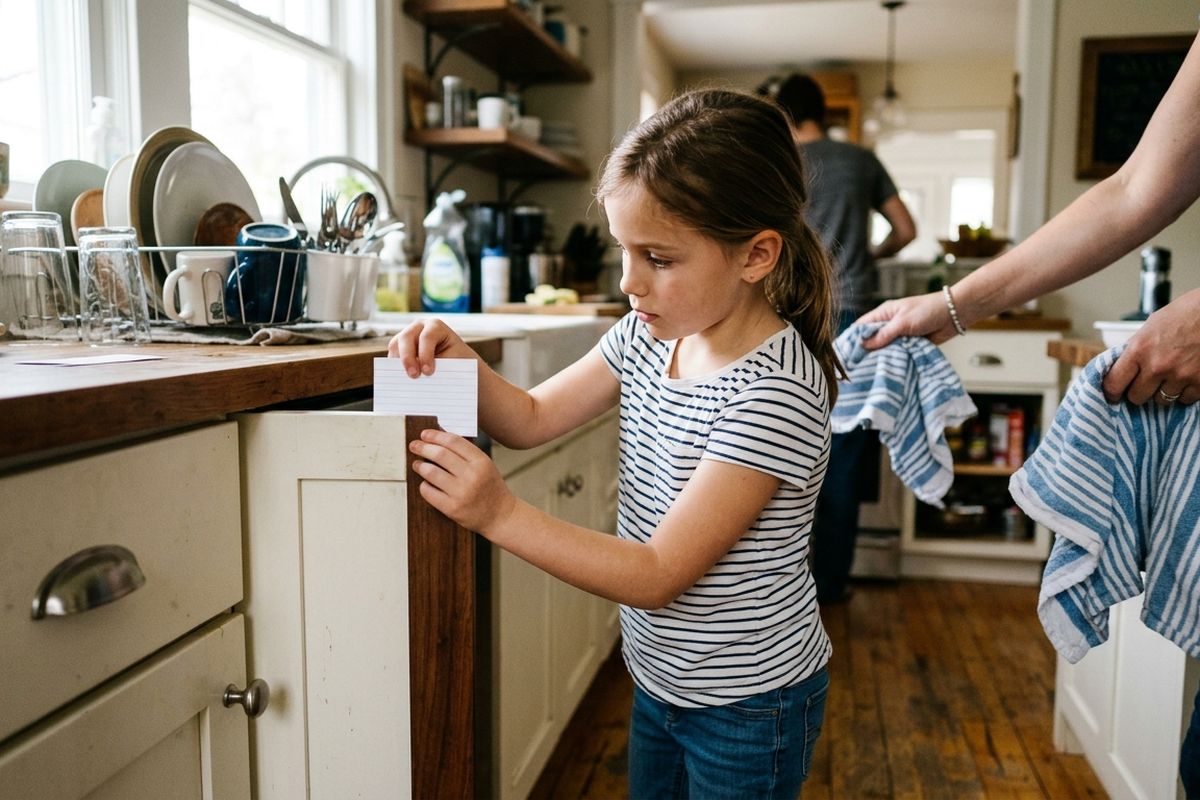
Here's a five-minute version that works better than any of my explaining. Cut one corner off an index card so you've got a clean right angle, and go hunting in the kitchen. Table corner, cabinet door, baking pan, the edge of the microwave, the weird angle where the counter turns. Card fits exactly, right angle. Opening smaller, acute. Bigger, obtuse. Set a timer and stop when it goes off, before it becomes a whole production.


