

There's a receipt going soft in the cup holder, a kid asking for gum, and a cashier saying "that'll be a dollar twenty-five." That small amount is usually the first decimal a child genuinely understands, years before a workbook asks them to shade twenty-five tiny squares. Money is sticky and real, which is the whole reason it works.
$1.25 is a decimal your kid already gets
Start with the sentence they already own: $1.25 is one dollar and twenty-five cents. Now say it in math: one and twenty-five hundredths.
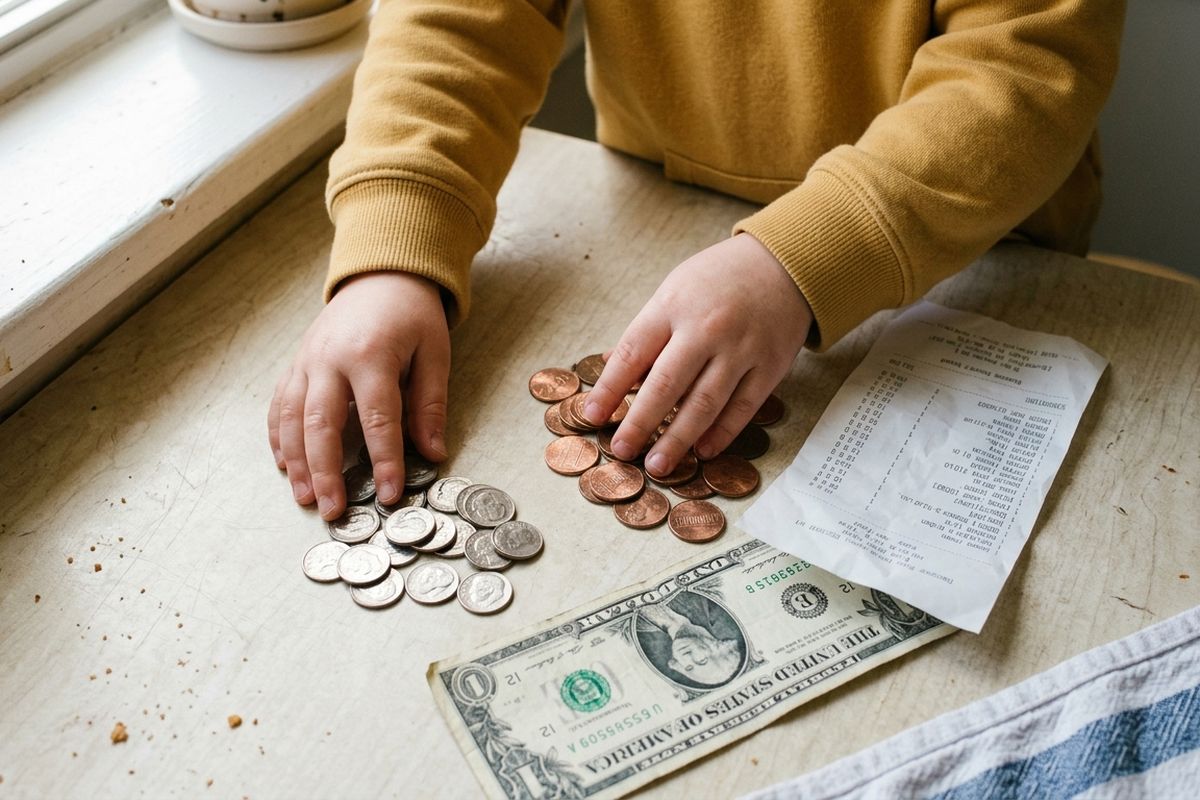
That sounds like a lot until you remember it's just pennies. A penny is one hundredth of a dollar, because it takes 100 of them to make one. A dime is one tenth, because ten dimes do the job. So $1.25 is one whole dollar, two dimes (two tenths), and five pennies (five hundredths).
I'd rather start there than with a printed grid of a hundred boxes. The grid is tidy. Too tidy. A dollar bill, two dimes and five pennies have weight, and a kid can trade ten pennies for a dime and watch the swap happen in their own hand.
Textbooks tend to introduce decimals like a brand-new animal has arrived. It hasn't. Your child has been hearing "one twenty-five" at vending machines and school book fairs since kindergarten. The job is showing them that money talk and decimal talk describe the same thing. So when they say "one point twenty-five," you can answer, "Right, one dollar and twenty-five hundredths of a dollar," and then stop. Don't turn it into a lecture unless you enjoy watching eyes glaze over at 6:17 p.m.
Place value keeps going to the right
Whole numbers grow leftward: ones, tens, hundreds. Decimals keep going the other way: tenths, hundredths, thousandths.
The decimal point does not mean "the middle." That's where a lot of kids quietly fall off. The point marks the ones place. Left of it, whole dollars and whole cookies and whole miles. Right of it, parts of one.
Take $4.68. The 4 is four whole dollars. The 6 is six tenths, which is six dimes. The 8 is eight hundredths, which is eight pennies. That's place value in receipt form, and it's the same idea your child met back when they were building 40 out of four ten-sticks.
A receipt helps because it stacks the numbers in columns: $2.49, $1.30, $0.75. Cents always take two digits, because stores are showing tenths and hundredths together. When the tag says $1.30, that zero is working. It says three dimes and zero pennies. Kids treat zeros like freeloaders, and this one is not.
Why 0.5 looks smaller than 0.25 to a kid
Here's the classic trap. Your child sees 0.5 and 0.25 and says the second one is bigger, because 25 beats 5.
Which is fair. With whole numbers, 25 does beat 5. They're using a rule that worked perfectly yesterday and has quietly changed neighborhoods overnight.
Money settles it in about four seconds. Would you rather have fifty cents or twenty-five cents? Nobody hesitates. Then write it out: 0.5 is 0.50 is 50 hundredths, and 0.25 is 25 hundredths. The missing zero was the entire problem.
Same story with 0.3 and 0.30. Kids assume the extra zero makes it bigger, because 30 is bigger than 3. But thirty cents is thirty cents either way. This is where I'll allow myself a small rant about worksheets: a page covered in 0.7, 0.07, 0.70 and 0.77 turns into symbol soup fast, and a kid drowning in it doesn't necessarily misunderstand decimals. They may just need the numbers attached to something real. Try it at the counter instead. Which is more, four dimes or four pennies? Then write 0.40 > 0.04, and the symbol has a reason to exist.
The receipt is a better worksheet
Receipts are sneaky good practice. Short, real, already full of money, and nobody had to print forty near-identical problems with a cartoon frog in the margin.
Say the receipt has milk at $3.29 and a banana at $0.59. Ask for an estimate first: about three dollars plus about one, so roughly four. Then do the real thing. If they line up the decimal points, the dimes stay with the dimes and the pennies stay with the pennies. If they don't, the answer goes strange in a hurry, which is its own useful lesson.
Questions that work while dinner is in the oven:
- "That's $3.88. If I hand over $5.00, what comes back?"
- "Tax was $0.31. Closer to 30 cents or 40?"
- "Which cost more, the $1.09 thing or the $0.99 thing?"
- "Find me anything under two dollars."
For the change, I'd count up rather than stack and subtract. $3.88 to $4.00 is twelve cents, then a dollar to get to five, so $1.12. That route is far friendlier than $5.00 minus $3.88 for a kid who borrows across zeros and comes away feeling personally betrayed by math. If you want more of this kind of thing, the grocery store is full of it.
Most schools get formal about decimals somewhere around 4th and 5th grade, though plenty of kids meet money notation earlier and pacing varies by district. Grade-level expectations are a rough map, not a schedule. If your 3rd grader is curious because they saw $2.75 on a menu, go ahead. If your 5th grader still wants actual coins in hand to compare 0.6 and 0.45, that isn't babyish; it's using the model that makes sense.
The gas station and the ninth of a cent
Then one day a kid looks out the car window and wants to know why the gas sign says $3.459.
Congratulations. Thousandths in the wild.
The 3 is dollars. The 4 is tenths, so forty cents. The 5 is hundredths, so five more cents. The 9 is thousandths, and with gas that last digit is usually described as nine tenths of a cent. Not nine cents. Nine tenths of one cent, which is a fairly ridiculous thing to put on a sign twelve feet tall.
So the car-window version goes: three dollars, forty-five cents, and nine tenths of one more penny for every gallon. Which prompts the obvious follow-up, namely how anybody pays nine tenths of a penny. You don't hand over a shaved coin. The pump adds it across every gallon and rounds the total to the nearest cent. Ten gallons turns that $0.009 into nine cents, which is exactly why the tiny digit is there.
You're also allowed to run out of answers. "I know it means thousandths and I know the total gets rounded. Why they price it that way, I'd have to look up." Your child hears an adult using place value in real life and admitting the edge of what they know, which is worth more than a smooth explanation delivered while merging.


