

You planned to grab milk, bananas, and the shampoo your family goes through like maple syrup. Your child, meanwhile, is asking for gum, steering the cart sideways, and touching every avocado in the display. Good news: the grocery store is also one of the easiest places to sneak in real math practice, with no worksheet, no pencil, and nobody sighing at the kitchen table.
The store is a worksheet with better lighting
Errands are full of math hiding in plain sight: prices on tags, quantities in the cart, coins in your wallet, and the great family mystery of how three items became $42.
Kids remember math better when it has a job. "Count to 10" is fine. "Put 10 apples in this bag so we have enough for lunches" gives counting a reason. The apple has weight, the bag crinkles, and your child gets to be useful, which is a powerful little motivator.
Store math also shows kids what numbers are for. Math tells you whether the bigger cereal box is actually a deal, whether you brought enough cash, whether the cart is about to drift into "put one snack back" territory. None of that lives on a workbook page. And the setup cost is zero. You were going there anyway.
Pre-K and kindergarten: the cart is a counting machine
For Pre-K and kindergarten kids (roughly ages 4 to 6), grocery math is counting, sorting, comparing, and matching one number to one object. That last part, one-to-one counting, is a big deal. A child can chant "one, two, three, four, five" and still count the same orange twice. The produce section is perfect practice because the objects are real and slightly wobbly.
Try tiny jobs: "Put 5 apples in the bag and touch each one as you count it." "Can you find 3 round things in the cart?" "Which is bigger, the watermelon or the lemon?"
Sorting counts too. If your child groups boxes by color, cans by size, or snacks by "things I like" and "things I claim I hate this week," they are noticing attributes, which matters later for patterns and geometry.
Keep the numbers small. Five apples counted carefully beats twenty counted in a blur. If your child skips a number, no speech needed. "Let's slow down and touch one each time." Then move on before the bananas become a sword.
1st and 2nd grade: coins, prices, do-we-have-enough
In 1st and 2nd grade, many kids are working on place value, addition and subtraction, and the idea that coins have different values. The store gives all of it a place to land.
Start with price tags. Have your child read simple prices out loud: "This says $2.49. The 2 means two dollars." No need to explain decimals in full. Just let them see the pattern: dollars on the left, cents on the right, and the little dot matters.
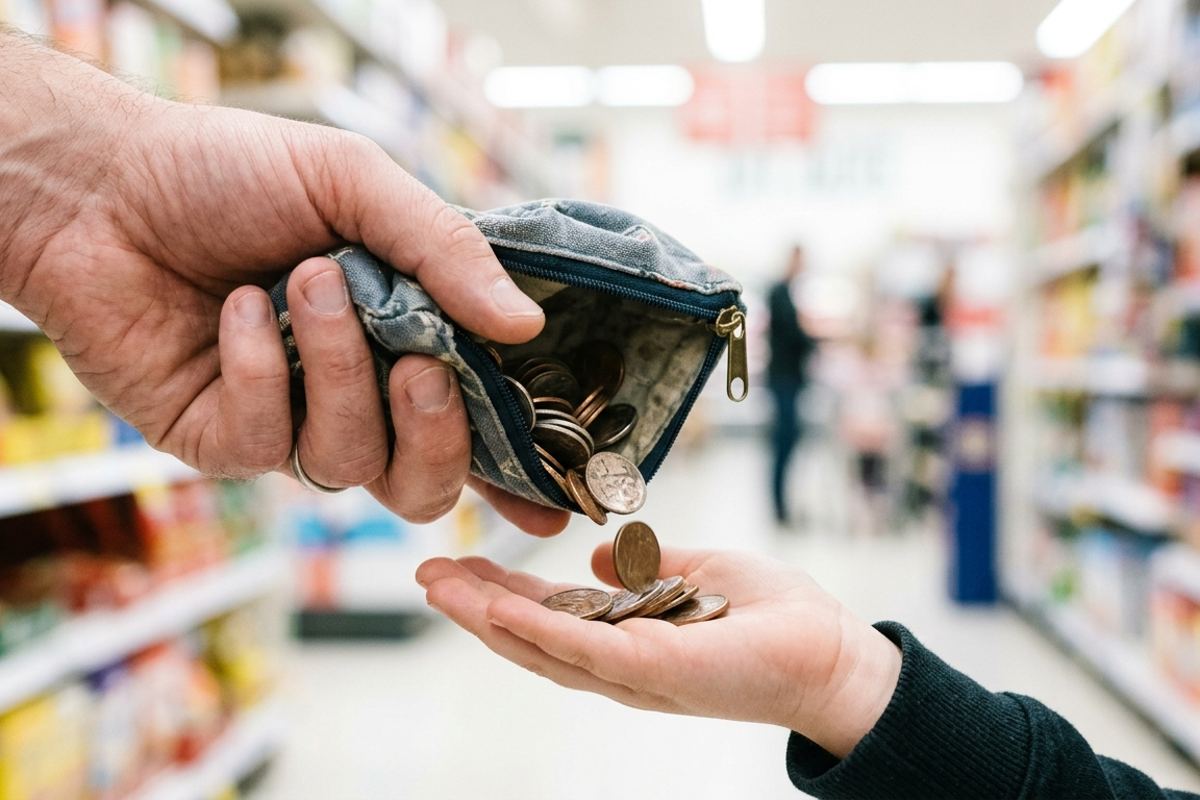
Coins are tricky because size does not match value. A dime is smaller than a nickel, which feels rude to young children and, frankly, is a little rude in general. If you are paying cash for one small item, let your child count the coins. "This granola bar costs 75 cents. Can we make 75 with quarters?" Three quarters in a small palm teach more than a page of coin pictures.
A small purchase with their own money works well at this age, and it is where an allowance system starts paying off in math practice. Your child brings $2, chooses something, and checks whether they have enough. Sales tax may nudge the total higher depending on your state, so keep the first tries simple or quietly cover a few cents without making it a courtroom drama.
3rd grade and up: unit prices and discount detective work
By 3rd grade and up, kids can handle the math adults actually use in stores: estimating, multiplying, comparing unit prices, and spotting discounts that are less exciting than the sign wants them to be.
Unit price is a great place to start. Many shelf tags show the price per ounce in tiny print. Pick two similar items and ask, "Which ketchup is the better deal?" The bigger bottle is not always cheaper per ounce, and kids love catching a trick. It feels like being a detective whose suspects are condiments.
Discounts are another good target. If a shirt is 20 percent off, show the friendly estimate: 10 percent of $30 is $3, so 20 percent is $6, so about $24. If that is too much, round first: "$18.99, call it $20, half off is about $10."
Estimating the running total is the real grown-up skill. Have your child round each item: $3.49 becomes $3.50 or $4, $12.99 becomes $13. They can track it on a scrap receipt or in their head. If you want the case for why this rounding habit matters so much, estimating is the most underrated math skill your kid will learn.
The checkout game
This is the main event, and it works with almost any age: before the cashier scans the first item, everyone guesses the total. Closest guess wins something tiny. Tiny is the key word. Think choosing the music on the ride home, picking tomorrow's lunch fruit, or getting the first warm roll at dinner. If the prize gets big, you have built a casino in the checkout lane.
The game starts while you shop. For younger kids, you round out loud: "Milk is about $4, bread is about $3, so we're around $7." For 1st and 2nd graders, let them round a few items to the nearest dollar. For older kids, hand over the whole estimate: "You keep the total for the cart. I'll call out prices as we go."
Handicap the guesses by age. A kindergartner can guess after hearing your estimate. A 4th grader has to explain their thinking. An older kid gets bonus bragging rights for landing within $2.
The quiet lesson: estimates are supposed to be close, not perfect. Some kids get stuck thinking math only counts when the answer is exact. At checkout, a close guess is what lets you make a decision before the real number appears. That is useful math. And if your child freezes when the scanner starts beeping, whisper, "Just make a smart guess." The goal is number sense, not a spelling bee with tomatoes.
Keep it a game, not a pop quiz
The fastest way to ruin store math is to turn the whole trip into a traveling math test. One or two questions per errand is plenty. If your child counts one thing, compares two prices, or makes one estimate, that was practice.
Quit while it is still fun. If your child starts hiding behind the cart, answering "banana" to every question, or licking the handlebar because life has gone off the rails, be done. Try again another week.
Skip it on rushed days too. Shopping at 5:37 with a tired kid, melting ice cream, and an imaginary dinner plan is not the moment for unit prices. Hand over the list, ask them to find the cereal, and call that a life skill.
Praise the strategy more than the answer: "Good thinking, rounding that up." Let fingers, coins, and calculators count as legal tools. The best store math sounds casual. "We need six bagels, can you count them?" "This one is two for five dollars, so what would one cost?" "Our guess was $48 and the total is $51. Pretty close." Then you pay, load the bags, and drive home with milk, bananas, and a kid who is a little further along in understanding how money works than when you walked in.


