

You know that moment at the store when your child asks for the giant box of cereal and you do quick math in your head: we have $40 left, the cart looks close to $35, and nobody needs marshmallow moons that badly? That's estimation. It's the math skill hiding in plain sight, and somehow it gets treated like the side salad of elementary school math.
The skill nobody drills but everyone uses
Adults estimate all day long. We estimate the tip before the receipt screen politely judges us. We estimate how long it takes to cross town with soccer traffic. We glance at the grocery cart and decide whether this is still a normal week or becoming a cheese-and-snacks incident.
Kids get estimation in tiny doses. Maybe one worksheet in 2nd grade, a quick lesson before rounding, and then school moves back to exact answers, because exact answers are easier to grade. A child either wrote 47 or they didn't.
But estimation is number sense out loud. When your child says "there are about 20 crackers left," they're noticing quantity. When they say "that LEGO set costs almost $50," they're comparing. When they say "it's probably 10 more minutes," they're connecting numbers to real life, which is hard even for grown-ups waiting at the DMV. It builds directly on the early skills described in number sense before arithmetic, just several years further down the road.
Why "about right" catches big mistakes
Exact math is wonderful. We do want children to know that 20 + 32 = 52. But before the exact answer, the brain should have a rough target.
A child who estimates 20 + 32 as "around 50" has a built-in alarm system. If the calculator somehow says 520, something inside goes: nope, not in the neighborhood. That neighborhood idea is everything.
Kids make big mistakes for very normal reasons. They line digits up wrong, skip a step, hit an extra button, or carry a 1 into the wrong place because someone asked where the blue cup went. Estimation catches the kind of error that neat handwriting cannot.
Try it with homework without turning it into a lecture. Before your child solves, ask, "What do you think the answer will be close to?" For 198 + 203, "about 400" is great. For 71 - 38, "somewhere in the 30s" is plenty. That rough answer becomes a safety net for the years when math gets longer and fussier, and a little voice that says a negative answer for the area of a rug seems suspicious.
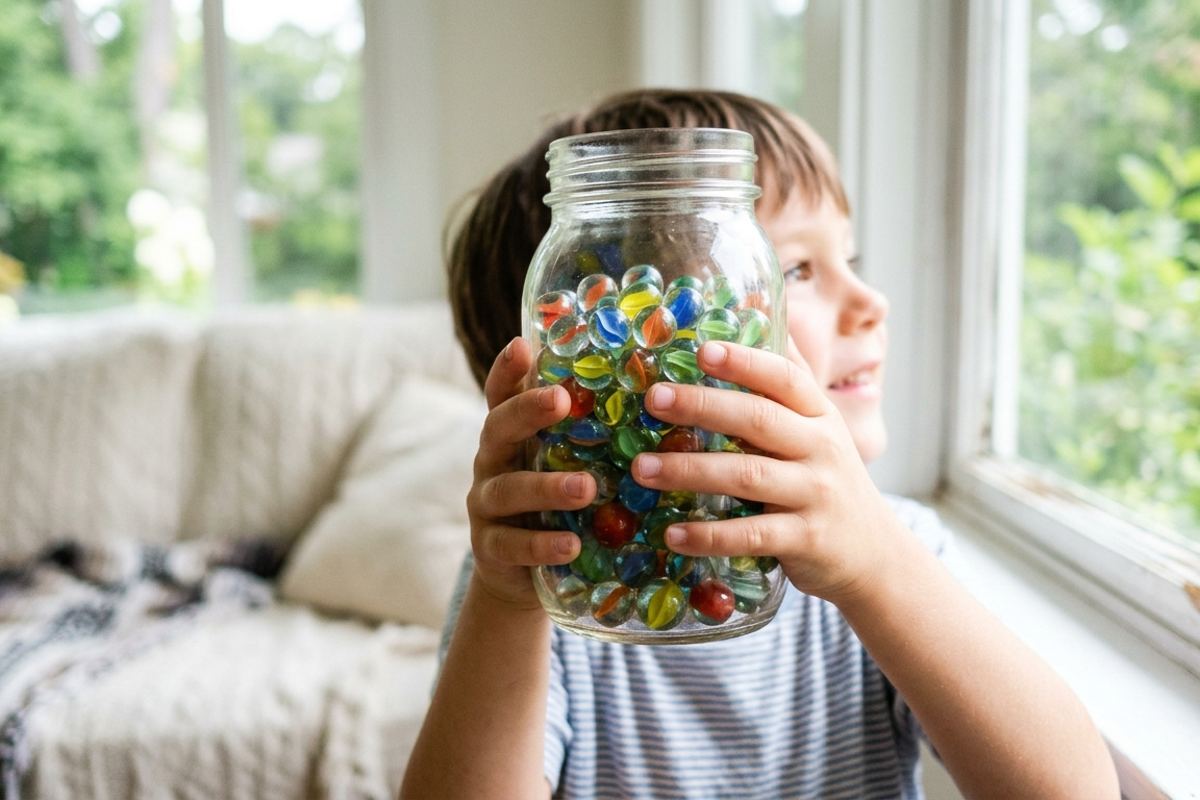
The candy jar: how estimation actually develops
A five-year-old looks at a jar of candy and guesses "a million." That's not failure. That's kindergarten being kindergarten.
Young children guess wildly because they're still learning what numbers feel like. Ten, fifty, and one hundred may all just mean "a lot." Ask how many noodles are in the bowl and you might get 7 or 700, depending on the mood and the amount of sauce.
By around 2nd or 3rd grade, many kids start making anchored guesses, using something they know as a reference point: "My marble jar has 20, and this looks like more, so maybe 35." That's real mathematical thinking. They're comparing sizes, not tossing out a number and hoping for applause.
Family guessing games are perfect here because nobody needs a pencil. A candy jar, a handful of coins, a pile of clean socks, grapes in a bowl. Everyone guesses first, then you count together. Adults should guess too, and it's genuinely good for kids to watch a grown-up be wrong by a lot.
Keep the tone light. The goal isn't crowning the Estimation Champion of Tuesday Night. It's building reference points: what 10 looks like, what 50 looks like, what "too high" feels like.
Easy estimation moments in a normal week
The best practice happens when life is already happening. No announcement of enrichment. Children can smell a setup.
A few that fit into any week:
- At the store: "Is this cart closer to $30 or $60?" Guess how many apples are in the bag.
- In the car: minutes until arrival, red lights before home, songs before you get there.
- Around the house: steps to the mailbox, socks in the laundry basket, blocks that will fit across the rug.
- At snack: raisins in the little box, spoonfuls left in the yogurt tub.
The magic words are "guess first, then check." Checking teaches calibration. Guess 100 raisins and count 28, you learn something. Guess 30 and count 28, you learn something else. Both are useful, and neither deserves teasing. Just "we thought it was more than it was" and on with the day. Estimation gets braver when nobody's worried about being embarrassed. There's a lot more of this hiding in groceries, cooking and car rides if you want the full tour.
Rounding is estimation with a haircut
School eventually turns estimation into rounding. Round 46 to the nearest 10. Round 327 to the nearest 100. Suddenly there are rules, and for some kids the whole thing feels arbitrary. Why does 45 go up? Who decided 5 is so powerful? Fair questions, honestly.
Rounding makes sense when a child already owns the idea of "closer to." If 46 sits closer to 50 than to 40, rounding up isn't a trick. It's just naming the nearest friendly number. The trouble starts when rounding is taught as a chant before the child understands the number line. The rhymes help kids remember what to do; they never explain why.
When it gets fuzzy, draw the line. Put 40 on one end, 50 on the other, and place 46 where it belongs. Ask which ten it's closer to. For 45, show that it sits dead center, and school convention says round up.
Front-end estimation is another school favorite: for 426 + 389, use 400 + 300 = 700 as a rough answer. Not exact, but it tells the child when an answer of 1,715 has wandered off into the woods.
Estimation feeds mental math
Many parents think mental math means doing exact calculations quickly in your head. The doorway is usually estimation.
A child comfortable with "about 80" for 48 + 32 can then adjust and find it's exactly 80. For 99 + 47, a kid who sees "about 100 + 50" is one small step from the slick version: one less than 100 + 47, so 146. For 6 × 19, "6 × 20 is 120, so 114." The rough answer gives them a friendly place to start.
This helps with math nerves too. A blank page feels less scary when your child has a rough idea of where the answer lives. They're not wandering around in number fog.
At home, ask for the estimate before the exact answer. "What's 39 + 22 going to be close to?" "About 60." "Great, now get the exact one." That single pause teaches kids to look at numbers before operating on them. For playful reps in between, a guessing game in the car mixes number practice with enough disguise for a tired kid after school. Exact answers matter. Knowing roughly what an answer should look like is what helps kids trust themselves enough to find them.


