
You hand your preschooler four crackers and they immediately count yours to see if you got more. They line up cars by color, insist the big cup is "more juice" even when it's half empty, and notice the red-blue-red-blue pattern on their socks. That's math before kindergarten. It's already happening in the wild, usually right next to a laundry pile.
The math your preschooler is already doing
Before kindergarten, math is less about worksheets and more about noticing. Your child is building ideas about amount, order, size, shape, and space long before anyone writes 2 + 3 on a page.
You can see it when they set one napkin at each seat. Teachers call that one-to-one correspondence: one thing matched to one thing. You hear it when they count the stuffed animals and announce "there are five!" That's cardinality, the understanding that the last number said tells how many there are in total.
Sorting shows up when all the dinosaurs with spikes get invited to the couch and the smooth ones don't. Patterns show up in "stomp, clap, stomp, clap" across the kitchen. Spatial thinking shows up when they try to shove a puzzle piece in upside down for the nineteenth time and then, with great ceremony, turn it.
None of this needs to look like school. At this age it works better when it looks like life. All of it feeds the number sense that comes before any actual arithmetic, which is the foundation kindergarten teachers quietly hope for.
Counting is more than saying the numbers
Many toddlers can chant numbers long before they can count. "One, two, three, seven, nine, eleventeen" is a classic. Cute? Very. Counting? Not yet.
Real counting has parts: saying the number words in order, touching one object per number, and knowing the last number means the total. That last piece takes time. A child can count five blocks perfectly and then, when you ask "so how many blocks?", start counting all over again. They're not being silly. They're still working out what counting is for.
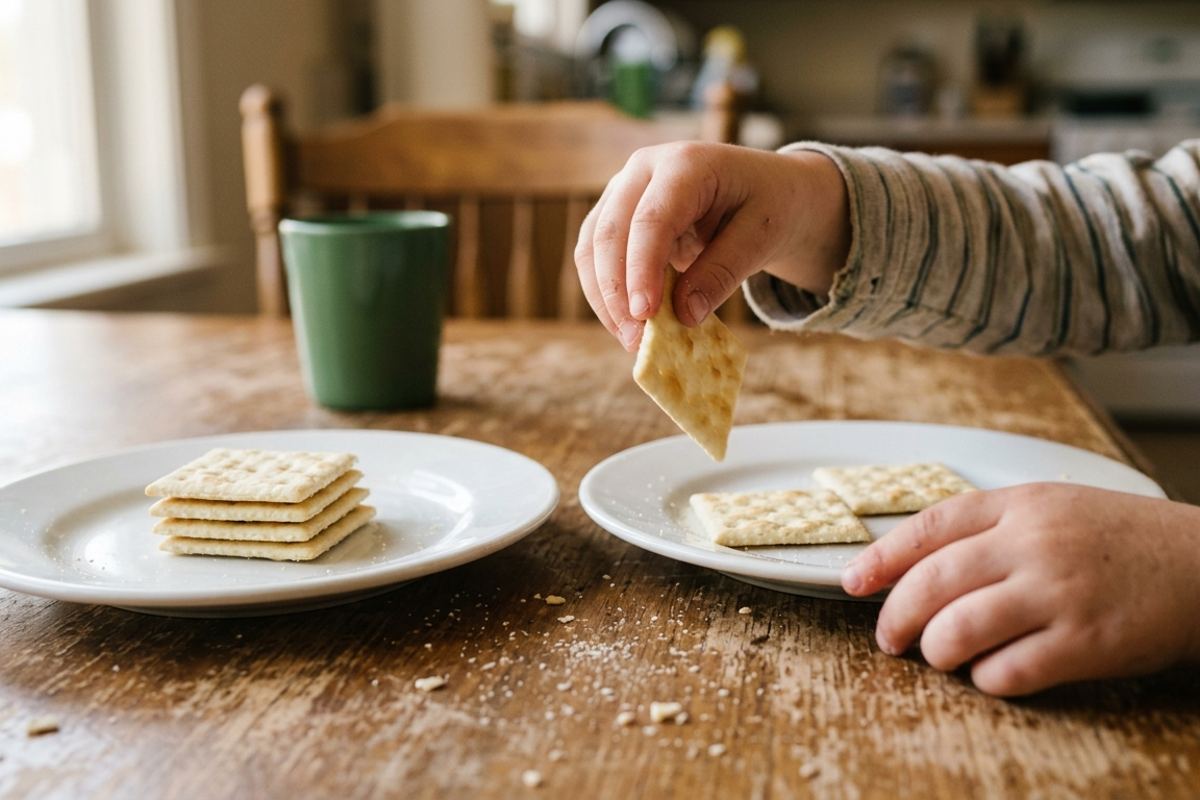
Ordinary moments do the teaching. "Can you put one spoon by each bowl?" "Let's count the steps to the mailbox." "We need four socks. Do we have four?" And slow your own counting down; adults zoom through "onetwothreefourfive" while a preschooler needs time to touch each thing. Objects in a line beat a messy pile. Crackers that hold still beat birds that keep leaving the fence. Rude birds.
One sneaky trick: count wrong on purpose once in a while. Point at two cars and say "one." Preschoolers love catching a grown-up being wrong, and it gives them a reason to pay attention that isn't "because we're practicing math," a sentence that has never made a child sprint into a room.
Comparing, sorting, and the deep love of "who has more"
Preschoolers are deeply invested in fairness, which is to say they are deeply invested in math. Who has more? Who got the bigger piece? Why does the baby get two crackers when I also got two crackers but mine are broken?
Comparing amounts is one of the big pre-K ideas, and at first kids judge by what they see. A long row of five pennies looks like "more" than a tight pile of seven. A tall skinny cup beats a short wide one. Totally normal. Their brains are still learning that amount doesn't always match appearance, and the fix is friendly: "Your line of cars is longer, but let's count and see if it has more."
Feed it with everyday words: more, fewer, same, longer, shorter, heavier. Sorting belongs here too. Blocks by color, rocks by size, toy animals split into "ones that bite" and "ones that probably don't." That's attribute-noticing, which is math wearing a play costume. Patterns as well: fork-spoon-fork-spoon at the table, then "what comes next?" If your child invents their own pattern, let it be weird. Preschool patterns have a little jazz in them.
Shapes, puzzles, and talking about space
Shape learning is more than naming circle, square, triangle. Kids need to meet shapes in different sizes and positions: a triangle is still a triangle upside down, and a rectangle can be tall and skinny, not just the door shape from a worksheet.
Puzzles are great for this. So are blocks, magnetic tiles, couch cushions, and the plastic-container drawer that sounds like a thunderstorm. When your child rotates a piece, builds a bridge, or declares a shoebox a garage, that's spatial reasoning at work.
Your words do half the job. "The bear is under the blanket." "Put the block beside the tower." "Your shoe is between the couch and the wall." Spatial talk matters because later math leans on it everywhere: geometry, measurement, maps, even lining numbers up on paper. A small teacher trick: describe what your child did before giving directions. "You turned the piece. Now the straight edge is on the outside." It connects action to language, and it feels less bossy than "no, the other way," which any preschooler will tell you is a personal attack.
If puzzles get refused, go simpler: chunky puzzles, shape sorters, a cereal-box picture cut in two. Some kids need more hands-on play first. If frustration or fine-motor struggles seem much bigger than what other kids their age show, mention it at a checkup. Once, calmly.
What to do more of (and what you can skip buying)
You don't need preschool math flashcards. You don't need a paid app with cheerful barn animals promising kindergarten readiness. (Counting is on the list of things kindergarten teachers actually look for, but so are zippers and taking turns; here's the honest readiness picture.)
Do more math talk instead. "We need two more plates." "That tower is taller than the chair." "The strawberries are gone. Zero strawberries." Zero is a surprisingly interesting idea when it means the snack disappeared.
Give real jobs. Set the table, match socks, count four apples into the bag at the store, find the biggest potato, put one sticker on each envelope. Real jobs give math a reason to exist, which is the part worksheets forget. Simple board games help too, dice and spinners and waiting for a turn, though preschoolers are famous for changing the rules of Candy Land halfway through and acting like you were briefed earlier.
Screens can have a small place, especially when you need ten quiet minutes to start dinner. A counting app or a dot-to-dot page now and then is fine. Just don't let a screen convince you it does something magical that a muffin tin and a handful of buttons cannot.
And drop "is my child ahead?" as the measuring stick. The better question is "did we notice some math today?" Count the stairs. Compare the crackers. Sort the rocks into sparkly and boring. For a preschooler, that is the work.


