

Your preschooler may proudly count to 20 in the bathtub, skip 15 entirely, and then demand "three" crackers while accepting a fistful of seven. This is normal preschool math: loud, wiggly, snack-based. Before children are ready for arithmetic, they're building number sense, which is less like memorizing a script and more like getting a feel for what numbers mean.
Number sense is not counting to 20
Counting to 20 sounds impressive because it sounds like math. But a child can chant "one, two, three, four" the same way they sing the alphabet song, without connecting the words to actual amounts.
Number sense starts earlier and messier. It's the feeling that one pile has more crackers than another. It's noticing that Daddy's shoe is bigger. It's knowing that "how many?" is a question about the group, not about the color or who got the good bowl.
A preschooler with growing number sense might protest that a sibling got more cereal (even when both bowls are overfull), know that two mittens go with two hands, or hand you one napkin for each person at the table with some coaching.
A child who counts to 20 but can't hand you three crackers isn't being stubborn. They have the number words, not yet the meaning underneath. That meaning is the good stuff. It's the soil that addition and subtraction grow in later, when kindergarten and 1st grade start asking for written numbers.
Counting is several skills in a trench coat
Counting looks like one skill from the outside. A child points at toys and says numbers. Done, right?
Not quite. First comes one-to-one correspondence: one number word for one object. Not "one, two, three" while touching the same dinosaur the whole time. One touch, one word.
Then stable order. The number words have to come in the same order each time. Preschoolers often run their own remix for a while: "One, two, five, seven, eleven!" Very confident. Completely unhelpful.
Then comes cardinality, the sneaky one: the last number said tells the amount in the group. If your child counts five cars and you ask "so how many cars?" and they start counting all over again, they're not ignoring you. To them, counting is an action, not a result. That's why kids recount the same pile again and again.
You can help by gently repeating the total: "One, two, three, four. Four cars. There are four." That little echo at the end does more than it looks like.
Sorting, comparing, patterning
Before arithmetic, preschool math often looks suspiciously like cleaning up. Sorting socks, putting spoons with spoons, lining up toy animals by size, curating a serious pinecone collection on the porch. It all counts.
Sorting helps children notice attributes. These buttons are red. These are big. These are the fancy ones from Grandma's sewing tin, please don't put them in your mouth. When children sort, they're deciding what belongs together and why. That's early mathematical thinking.
Comparing is another big piece: more and less, longer and shorter, heavier and lighter. A preschooler arguing that someone else got more blueberries is practicing comparison, even when the fairness committee has to pause dinner for a full investigation.
Patterns matter too. Red-blue-red-blue beads. Step, hop, step, hop on the sidewalk. Patterns train kids to notice what repeats and what comes next, which later connects to skip counting and place value.
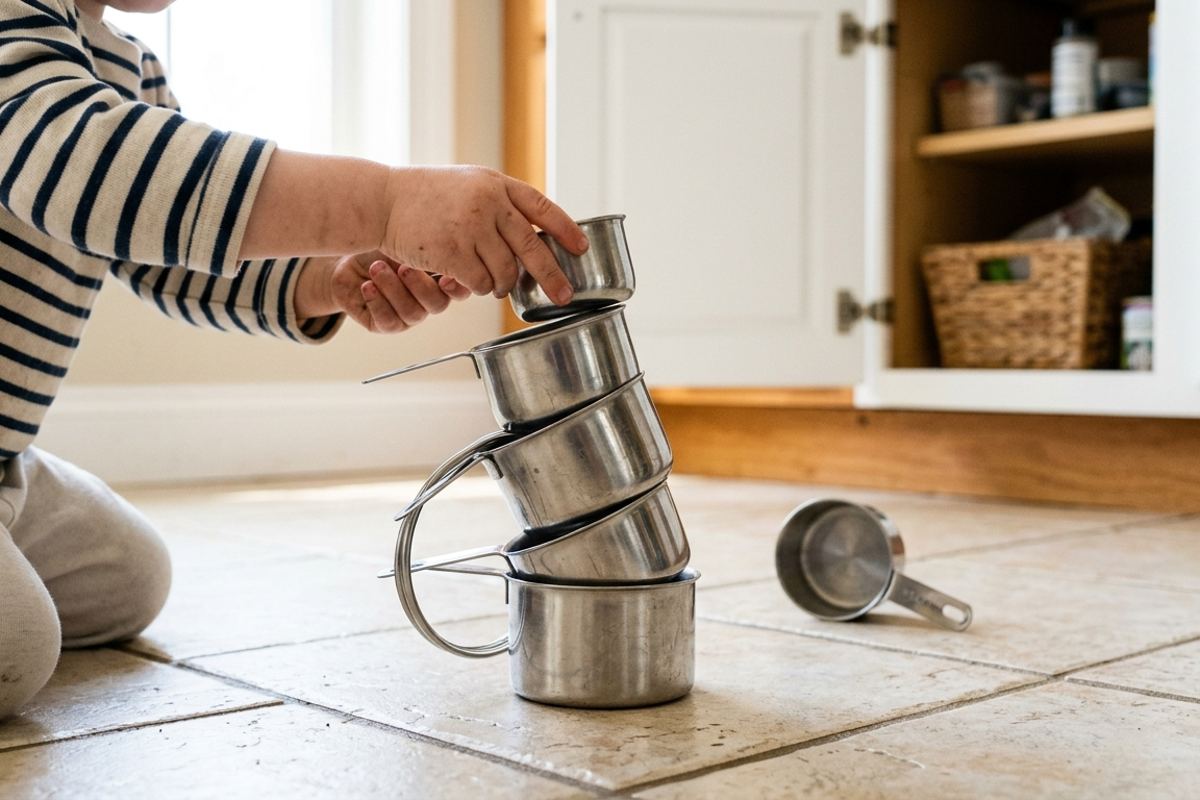
Good tools are wonderfully ordinary: muffin tins, sock piles, acorns, plastic lids, cereal pieces, and that one cup from a restaurant that somehow became a bath toy. Ask questions that invite noticing instead of quizzing. "Which pile has more?" "How could we put these in groups?" "What comes next in your pattern?"
You're not turning your kitchen into a math lab. The kitchen already is one. It just has crumbs.
Subitizing: seeing three without counting
Subitizing is the teacher word for instantly recognizing a small amount without counting. You see three dots on a die and just know. No pointing, no whisper-counting.
Most adults do this so automatically we forget it had to be learned. Preschoolers build it through repeated meetings with small groups. Dice dots are perfect because the patterns never change. Dominoes work too, and fingers, egg cartons, small groups of crackers on a plate.
This is why preschool and kindergarten teachers flash dot cards for a second or two. It isn't about speed for its own sake. It helps kids form mental pictures: three as a little triangle of dots, five as all the fingers on one hand. A child who sees five as a full hand grasps "five and one more is six" much faster than a child who only knows the chant.
You can play this in ten seconds at snack. Put out two grapes and ask how many. Then four. Then one. If they count, fine. The goal is familiarity, not a game-show buzzer.
What this looks like in a normal week
Preschool math doesn't need a special bin from the teacher store. It fits into a regular week, right next to the lost library book and the socks with no partners.
Setting the table is one-to-one correspondence in real life. "One plate for each person. One fork by each plate." At first your child may hand one person three forks and forget someone else entirely. That's information, not failure.
Snack negotiations are math practice, even when they're also deeply annoying. "You have two crackers. I'm adding one more. Now you have three." Fair-sharing is preschool math with feelings attached.
Stairs come in a steady line, so count as you climb, and don't worry if your child drops out or shouts "eight!" on every step. Dice games are terrific because rolling three means moving three, not moving until you feel like stopping. Laundry can be matched. Grocery bags can be compared: heavy, light.
No flashcards needed. If your child likes quiet paper activities, dot-to-dots and simple matching pages are nice for a rainy afternoon. But the heart of preschool math stays hands-on: touching, moving, sorting, and announcing, "Wait, I think you got more than me."


