
You're halfway through the grocery store, your child wants the cereal with the marshmallows, the cart has one wobbly wheel, and you're trying to remember if there's milk at home. Good news: you are already standing in a math lesson. Not a fancy one. A real one, with bananas, price tags, and someone asking how much longer until you get there.
The math you're already standing in
Math doesn't live only on worksheets. It lives on the grocery shelf, the oven timer, the gas gauge, the speed limit sign, and the receipt crumpled in your cup holder.
For elementary kids, especially Pre-K through about 3rd grade, the world is still very concrete. Five apples make more sense than the symbol 5. Half a cup of flour makes more sense than a worksheet with twelve tiny circles. So errands are sneaky-good practice: counting, comparing, estimating, measuring, sorting, deciding. In an hour of normal family life a kid can touch more real math than a page of problems holds.
And no, you don't need to turn every errand into school. Please don't. Nobody wants a pop quiz next to the onions. Think of it as one little math question in a place you already had to go. One sentence, one “help me figure this out,” then move on with your life and buy the sandwich bread.
Grocery store: the original math classroom
The store is full of numbers that actually matter: prices, weights, quantities, discounts, totals. For younger kids, keep it hands-on. “Can you put 6 apples in the bag?” “We need 3 green bananas and 2 yellow ones, how many is that?” “Do we have more soup cans or pasta boxes in the cart?” That's counting, comparing, adding and sorting. It looks like grocery shopping because it is.
For 2nd and 3rd graders, estimating is the good stuff. “Our cart is probably around $40 right now. Think I'm close?” Let them guess wildly; wild guesses are where estimation starts, and there's a reason estimating might be the most underrated math skill in elementary school. After checkout, check the receipt together: “You were under by about $8.” “I was way off. The cheese got me.”
Older kids can handle unit prices, especially when snacks are on the line. “This box is $4 for 8 bars, that one is $6 for 12. Which is the better deal?” They may need help dividing. Fine. The lesson that bigger boxes aren't automatically cheaper is a life skill with a surprising amount of math tucked inside. One teacher trick throughout: phrase it as needing help, not testing. “Help me decide which grapes to buy” lands better than “calculate the unit price per pound.”
Cooking: fractions you can eat
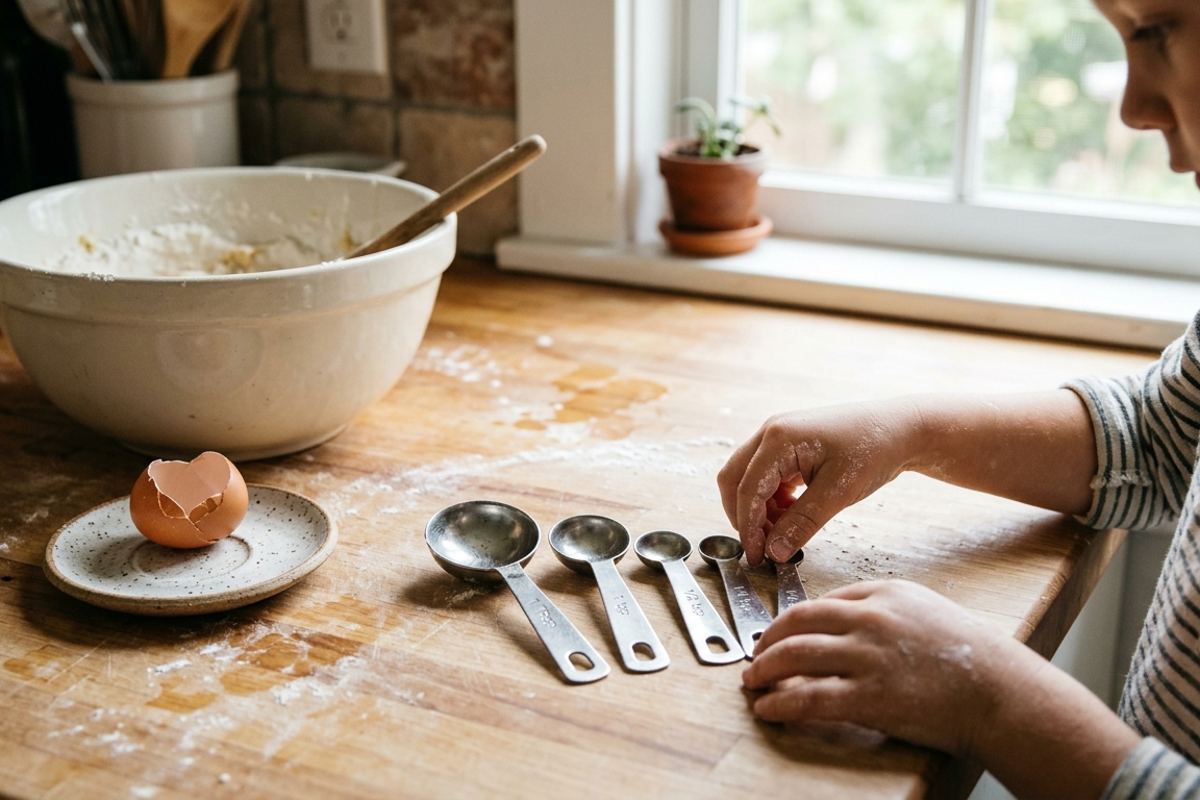
Cooking is where fractions stop being weird stacked numbers and become brownies. A measuring cup is a fraction model your child can hold, right there in the drawer with a little dried pancake batter on it.
Younger kids just fill and dump. “This is half a cup. We'll use it two times.” No lecture on equivalent fractions needed; they can see two halves filling the same space as one whole. From 3rd grade up, recipes are perfect for doubling and halving: “Grandma's recipe makes 12 muffins and we want 24. It says 2 eggs, so how many now?” “We only need half the batch and it calls for 1 cup of milk. What's half of that?”
Timers and temperature are math too. “The oven needs 350 and it's at 200. How much more?” Some kids subtract, some count up: 200 to 300 is 100, then 50 more. Both are real strategies. And if paper fractions cause groans at homework time, the kitchen softens the edges; there's more of that in fractions without tears. Fractions feel less personal when chocolate chips are involved. Spoon-licking is acceptable payment, raw-egg rules permitting.
Car rides: mental math on wheels
The car is one of the best mental-math venues because nobody writes anything down. Also your child is buckled in, which gives you a small teaching advantage. Use it kindly.
License plates scale to any age. Younger kids hunt for a 7 or count red cars until the light changes. 1st and 2nd graders can add two plate digits or decide whether 48 is closer to 40 or 50. Older kids get distance: “The sign says 12 miles to Grandma's and we've gone 3 since the last sign. How many left?” Or the golden highway fact: 60 miles per hour is about a mile a minute, so 10 miles takes about how long?
Mile markers were built for skip counting. Count by 2s, 5s or 10s past the signs; if multiplication is on the menu, try 4s and see how far you get before somebody spots a dog in another car and the whole thing collapses. Time questions come free with every trip. Instead of answering “how many minutes left?” for the sixth time, flip it once: “It's 4:10 and we arrive at 4:30. You tell me.”
Money moments
Money math is powerful because kids care about it almost immediately. This is math with consequences, and sometimes the consequence is a pack of gum.
When you pay cash, let them watch: “The total is $7.35, I'm handing over $10, so we get change back.” Younger kids count the bills; older kids estimate the change. No need to make anyone count exact coins while a line forms and someone sighs near the magazines. That's not character-building, that's just stressful. Save exact counting for the kitchen table.
The $5 budget game works beautifully in the snack aisle: “Choose one snack for the family, $5 or less.” A $4.99 box fits. Two $2.50 items fit. The $6.49 bag does not, even when the cartoon tiger makes direct eye contact. Older kids can wrestle with tax: “It says $4.99, but tax might push it over. What do we do?” Real-world rounding, plus a warm-up for the bigger conversations in teaching kids about money. Allowance moments do quiet work too. A kid with $4 facing a $6 toy needs exactly one sentence from you: “You need $2 more.” Then stop talking and let the number do some of the parenting.
Keep it casual or it dies
The fastest way to ruin everyday math is overdoing it. One question per errand is plenty. One good grocery question beats twenty tiny quizzes between the apples and the frozen waffles.
Watch the energy. Hungry, tired, or currently riding the cart like a scooter with poor steering? Not the moment for unit prices. Lit up and inventing their own number game? Follow it for a minute, then quit while it's still fun. Lines that work: “Want to help me figure this out?” “Take a guess, no penalty.” “Show me how you know.” On rainy afternoons the same spirit continues on the couch with a deck of cards, but the errands are the main event.
When they pause, count to five in your head before jumping in. Kids need those quiet seconds and adults are champion second-stealers. Look at the cereal. Pretend to study the raisins. And when the answer is wrong, keep your face friendly-boring: “Close. Let's count again.” Math confidence is built in tiny moments where mistakes aren't emergencies.
If the whole errand goes sideways, drop it. There will be another grocery trip, another timer, another mile marker, another receipt at the bottom of your bag. Everyday math works because it waits for you.


