

The tooth fairy leaves two dollars under the pillow, and by breakfast your child wants to know if that buys a remote-control car, a pack of gum, or a pony. Money is strange to kids because adults make it look strange: we tap cards, click buttons, and somehow groceries appear. A small allowance and a pile of coins on the kitchen table can make the whole thing feel less like magic and more like something they can learn.
Start with cash, even in a tap-to-pay world
Kids understand money best when they can touch it. A debit card is invisible math. A phone tap is worse, because it looks like the machine just likes you. Coins and bills make amounts real in a way plastic never will.
Start small. Dump out a handful of pennies, nickels, dimes, and quarters and let your child sort them. They don't need a lecture on American currency. They need to notice that five pennies match one nickel, two nickels match one dime, and four quarters make a dollar. For younger kids, just naming the coins is plenty.
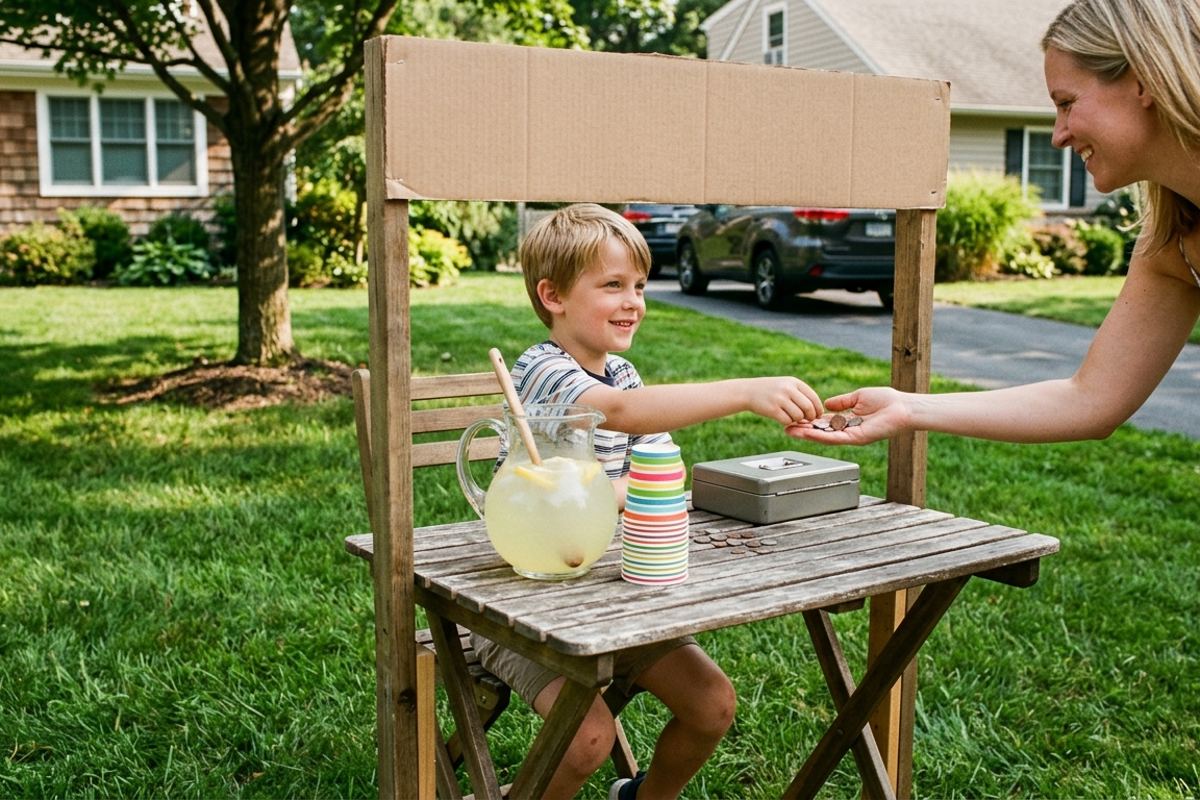
Lemonade stands, pretend stores, and "restaurant" at the kitchen table are all good practice. If your child sells you a paper cup of water for 25 cents and then has to give change from a dollar, that's real math. Slightly sticky math, probably, but real.
Cash also slows spending down. Handing over three crumpled dollar bills feels different from watching a parent tap a card. That tiny pause is useful.
Allowance: pick a system you can actually keep up
There are three common allowance setups, and parents have strong feelings about all of them.
Some families tie allowance to chores: make the bed, feed the dog, get paid. It teaches that work and money are connected, which is true in adult life. Other families keep them separate. Kids get a small amount each week because they're learning to manage money, and chores happen because they live in the house. Nobody pays Dad five dollars for unloading the dishwasher, although he may have considered invoicing.
A hybrid works for many families: basic chores are unpaid, extra jobs can earn. Putting laundry in the hamper is part of life. Washing the car or raking leaves might be a paid job.
A rough US norm is often 50 cents to a dollar per year of age per week, so a 7-year-old might get $3.50 to $7. Some families give less, some more, and some skip a season because the budget is tight. That's real life too.
The best allowance system is the one you can remember on Friday. Consistency beats the perfect chart that dies after six days.
Three jars: spend, save, share
The classic three-jar system still works because kids can see it. One jar for spending, one for saving, one for sharing. Clear jars beat a piggy bank because the money grows in front of them. A piggy bank is cute, but it hides the evidence.
Mason jars, envelopes, or three old takeout soup cups with taped-on labels all work. Fancy is not the point. Spend money is for soon: stickers, trading cards, a snack at the ball field. Save money is for something bigger. Share money goes to a food bank, an animal shelter, a classroom fundraiser, or a cause your child picks.
Let your child help choose the split within reason. "Some has to go in each jar. You decide if it's $1, $2, and $2, or another fair mix." Older kids may enjoy percentages. Younger kids need piles.
The share jar can lead to sweet conversations, and occasionally odd ones. A kindergartner may want to donate to "all the tired dogs." Honestly, fair.
Let them buy the junky toy
This is the part that makes parents twitch.
Your child saves up $6 and falls in love with a plastic spinning gadget that lights up, squeaks, and looks like it will break before you reach the parking lot. You know this toy. It has the life expectancy of a soap bubble. If it's safe and within your family rules, let them buy it.
The cheap gadget that breaks in a day teaches more than your best lecture. Your child learns that spending money means the money is gone, that packaging can be persuasive, and that disappointment is not the same as disaster. Your job is to not narrate the cautionary tale. If you must say "I told you so," say it once, in your head, while loading groceries.
Later, when the toy is broken or boring, ask one calm question: "Would you buy that again, or save for something different next time?" Then stop talking. The lesson needs room to land.
Boundaries are still fine: no candy right before dinner, no buying another stuffed animal when the bedroom already looks like a zoo with carpet. Within those lines, small mistakes are useful.
Saving for something real
Saving works better when the goal is concrete. "Save your money" is vague. "Save $28 for the blue scooter helmet with the lightning bolt" is something a child can picture.
Tape a picture of the goal to the save jar and write the price in big numbers. If the item costs $30 and your child saves $5 a week, draw six boxes and color one in each week. Kids like watching the finish line move closer. Adults do too, which is why coffee punch cards exist.
For bigger goals, consider matching: "For every $5 you put in, I'll add $1." Matching keeps the goal from feeling impossible while your child still does the main work.
Keep the timeline kid-sized. Most younger elementary kids do better with goals they can reach in two to six weeks. Six months feels like forever when you've only been alive for eight years. If your child changes their mind halfway, talk it out. Sometimes switching goals is thoughtful. Sometimes it's the junky toy aisle calling again.
The math hiding in money
Money is one of the best math tools in the house because children actually care about the answer. A worksheet asking for 25 + 25 gets a groan. Two quarters buying a gumball? Suddenly we have focus.
Coins are perfect for counting by 5s, 10s, and 25s. Many kids can chant the patterns before they understand them, and coins connect the words to amounts; there's more on that in how skip counting bridges into multiplication. Four quarters on the table make a dollar in a way "25, 50, 75, 100" alone does not.
Making change is a quiet workout too. If something costs $1.35 and your child pays with $2, count up together: $1.35 to $1.50 is 15 cents, then 50 more to $2. That counting-up method is often easier than subtracting decimals. The store itself is full of this stuff, and groceries and cooking hide plenty more math if you want to keep it going.
Money also gives you a natural reason to use math words: more, less, equal, half, double, total. It sneaks in while your child is deciding between gum and a tiny notebook shaped like a taco. For pretend menus and pencil-and-paper store games, a stack of index cards and some price stickers can stretch "playing store" a little past your usual patience.


