

Somewhere between the car and the kitchen, your child starts chanting "5, 10, 15, 20!" like they cracked a secret code at school. Skip counting sounds like a classroom party trick at first. Under that singsong voice, though, your child is building one of the first real bridges from counting to multiplication.
What skip counting is, and when schools expect it
Skip counting means counting forward by a number other than 1. By 2s: 2, 4, 6, 8. By 5s: 5, 10, 15, 20. By 10s: 10, 20, 30, 40.
Most schools start playing with it in kindergarten (around ages 5 to 6), usually with 10s and sometimes 5s. In 1st grade it becomes more regular, and by 2nd grade many teachers expect kids to count by 2s, 5s, and 10s with growing confidence, connecting it to place value, money, and early multiplication ideas.
It can look like pure memorization. Sometimes it is. Kids will rattle off "10, 20, 30, 40" without knowing what they're counting, and that's normal at first.
The shift happens when the chant starts attaching to real things: ten fingers, five pennies traded for a nickel, two socks in each pair, ten crayons in a box. That's when skip counting stops being a performance and starts being math.
Why it matters later: multiplication is skip counting with a memory
Multiplication can feel like it arrives out of nowhere, usually in 3rd grade. One week your child is adding 7 + 8, and the next week a worksheet asks for 7 × 8, which seems rude.
Skip counting softens that landing. At its heart, 3 × 5 means three groups of five. A child can solve it by counting "5, 10, 15." Three hops. Fifteen. That's multiplication before the flash cards show up.
A child who skip counts fluently has a ladder into times tables instead of a cliff. They may not instantly know 6 × 4, but if they can count by 4s they can climb there: 4, 8, 12, 16, 20, 24. Slower than a memorized fact? Sure. But it gives them something to do besides freeze.
And freezing is real. Some kids see a multiplication symbol and decide math has turned into a locked door. Skip counting hands them a key they already own. The goal isn't to skip count forever; it's to use it until the facts stick on their own. Which facts to tackle first is its own story, covered in the times tables order that sticks.
The friendly numbers first: 10s, 5s, 2s
There's a reason teachers start with 10s, then 5s, then 2s. These numbers live everywhere in a child's world.
Tens are friendly because of our number system: the ones digit sits at zero and the pattern is easy to see. Fives are friendly because of fingers, toes, and nickels, and the numbers alternate between ending in 5 and 0. That pattern is sticky. Twos are friendly because kids understand pairs: shoes, mittens, eyes, bicycle wheels.
Coins make great props. Ask "how much are three dimes?" or "can you count these nickels?" Small classroom warning: money is harder than adults expect. A dime being worth 10 while it's smaller than a nickel feels deeply unfair to a six-year-old. Keep it light.
Put it in the body: stairs, hops, claps
Skip counting sticks better when it has a beat. There's a reason classrooms chant it, clap it, march it, and occasionally make it much louder than necessary right before lunch.
Movement helps children feel the sequence, and it keeps practice from becoming "stare at this worksheet until one of us sighs."
Try hopscotch by 2s: chalk squares labeled 2, 4, 6, 8, 10, and your child hops while saying each number. If chalk isn't happening, pillows on the floor work, and yes, the couch will become part of the lesson.
Stairs work too. Pretend each step is worth a nickel and count 5, 10, 15, 20 on the way up. Going down, count backward if they're ready. If not, just count forward again. The stairs will survive.
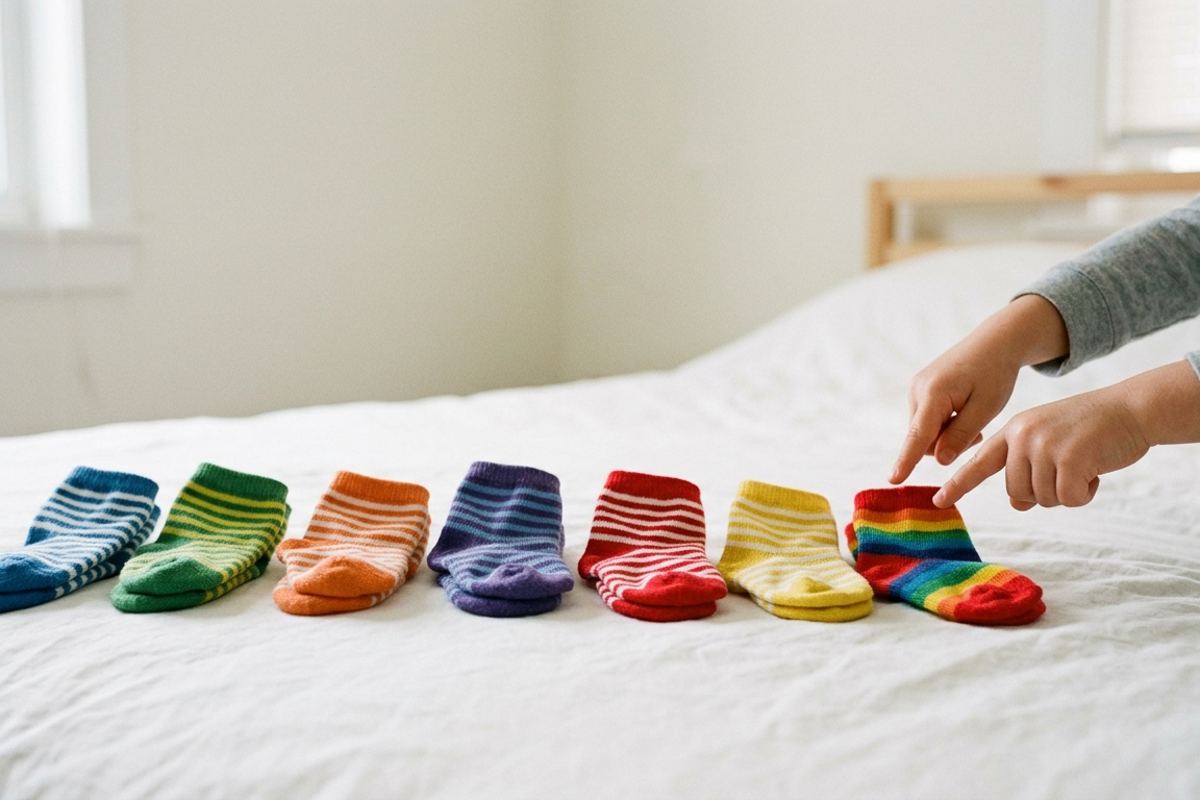
Clapping patterns fill the wait for pasta water to boil: clap softly on the numbers you skip, loudly on the ones you say. For 3s it sounds like whisper, whisper, "3," whisper, whisper, "6." Sock pairs on the bed, egg cartons, laundry: it's all skip-counting equipment in disguise.
The harder ones: 3s, 4s, and weird starting points
After 2s, 5s, and 10s, the road gets bumpier. Threes sound like a chant that keeps wiggling away: 3, 6, 9, 12, 15. Fours feel chunky. The patterns are just less visible to young kids.
This is where you can tell a memorized chant from real understanding. A child may count by 2s beautifully starting at 2, but ask them to start at 6 and keep going, and they pause. That pause is not bad. That is their brain doing math.
Try weird starting points in tiny doses: start at 15 and count by 5s, start at 40 and count backward by 10s, start at 12 and count by 3s. Counting backward is especially stretchy because it asks your child to hold the pattern and reverse it. Fingers, number lines, and hundred charts are all allowed. Tools are not cheating.
If frustration shows up, go back to objects. Crackers in groups of 3. Towers of 4 blocks. Toy dinosaurs in pairs, including the one with the chewed tail. Counting things they can touch is slower, but it makes the numbers behave. Kids get more formal practice with these patterns around 2nd grade, and the 2nd grade games mix in more of it without feeling like homework.
From skip counting to actual times tables
The big move from skip counting to multiplication is one question: "How many hops did that take?"
If your child counts "5, 10, 15, 20," ask how many 5s that was. They may hold up a finger per number: four fingers, four hops, so 4 × 5 = 20. Without that connection, skip counting stays a song. With it, the song becomes a tool.
Arrays help too. Put out 3 rows of 4 cereal pieces, count by rows (4, 8, 12), then say "so that's 3 rows of 4, which matches 3 × 4." Egg cartons, muffin tins, and graph paper all work. Equal groups are the heart of multiplication, and skip counting is how kids first count those groups without starting from 1 every time.
Try not to rush the flash-card stage. Speed without meaning gets shaky; a child who knows that 6 × 5 means six groups of five can rebuild the answer when memory blanks out. When they're ready for faster practice, racing the kitchen timer turns the reps into something they'll actually ask for. Two good minutes at the kitchen counter beat twenty grumpy ones at the table.


