

Third grade has a way of announcing itself: one day your child comes home with a multiplication chart and the facial expression of someone who has just been handed tax forms. The facts look endless at first. They are not, but the order matters a lot, especially if your kid is staring down 7×8 like it personally insulted them.
Why 7×8 has a terrible reputation
Some multiplication facts feel friendly. 2×6 has that nice skip-counting rhythm. 5×9 lands on a 5 or 0. 10×anything is basically wearing a name tag.
Then there is 7×8.
The "hard facts" feel hard because they have no obvious pattern, and they sit in the middle of the chart where kids cannot lean on 1s, 2s, 5s, or 10s. Facts like 6×7, 7×8, and 9×7 come last for most kids. They do not show up naturally in real life either. Kids count pairs of socks, hands, nickels, dimes. They do not often count seven groups of eight unless someone is packing granola bars for a very specific field trip.
The good news: your child does not need to learn 100 separate facts. Once they understand that 3×7 and 7×3 give the same answer, the chart shrinks. A lot. That "turn-around fact" idea is one of the kindest gifts in multiplication.
The order that works: 2s, 10s, 5s first
Many kids do best when the facts come in an order that gives them quick wins. I like 2s, 10s, and 5s first because they connect to things children already know.
The 2s are doubles: 2×4 is the same as 4+4, and most kids have practiced doubles since 1st and 2nd grade. The 10s are place-value friends: 10×6 means six tens, or 60. The 5s connect to fingers, nickels, tally marks, and clocks.
If your child is just starting out, resist the urge to hand them the whole chart and say, "Study this." That is like giving someone a map of the entire airport when they only need to find Gate B12.
The first round, in order:
- 2s, because they are doubles
- 10s, because they follow our base-ten system
- 5s, because kids can count by 5s pretty early
- 1s and 0s, because they are concept facts, not memory facts
The 0s and 1s need a quick explanation with objects, like crackers or Lego bricks: "any number times 1 stays itself," "zero groups means zero." Then move on before everyone gets grumpy.
For more everyday math help by grade and topic, the Math, Time & Money section is a good place to poke around when homework starts getting dramatic.
Doubling tricks: 4s and 8s ride along with the 2s
Once the 2s feel solid, the 4s are not a brand-new mountain. They are double the doubles.
If your child knows 2×7 = 14, then 4×7 is double 14, which is 28. That is a much friendlier path than trying to pull 4×7 out of thin air. Say it out loud: "Two sevens is 14, so four sevens is twice as much."
The 8s work the same way, just one more step. If 4×6 = 24, then 8×6 is double 24, or 48. Some kids love this. Some kids look at you as if you have suggested doing math with soup. Keep it concrete. Use coins, toy cars, or the cereal pieces already on the table anyway: "Two groups of 6 is 12. Four groups is 24. Eight groups is 48."
This builds number sense, which is what keeps multiplication from becoming a pile of random chants. Chanting has its place. I have heard entire classrooms recite "six times six is thirty-six" with the confidence of a tiny sports team. But the doubling trick gives your child a backup plan when memory slips.
One small warning: do not rush from 2s to 4s to 8s in one evening. Brains need a little drying time, like glue.
The 9s have a built-in cheat
The 9s look scary, but they are secretly very patterned. They deserve better publicity.
First, the answers in the 9s table have digits that add up to 9: 9×2 = 18 (1+8), 9×3 = 27 (2+7), 9×4 = 36 (3+6), all the way through 9×10 = 90. It gives kids a way to check themselves.
There is also the classic finger trick. Hold up ten fingers. For 9×4, fold down the 4th finger. You have 3 fingers on the left and 6 on the right: 36. For 9×7, fold down the 7th finger. Six and three: 63.
Is it a trick? Yes. Is it still math? Also yes. Kids are allowed to use patterns. Patterns are one of the main reasons multiplication can start to make sense.
Another helpful way to think about 9s is "one less than 10 groups." For 9×6, think 10×6 = 60, then take away one group of 6. That gives 54. Especially nice for kids who already feel confident with 10s.
Three minutes a day beats Sunday drills
Long practice sessions look productive for the first six minutes. Then the pencil starts tapping. Someone needs water. The dog becomes fascinating. By minute twelve, nobody is learning much except how slowly time can move.
Short practice works better for most kids. Three minutes a day, four or five days a week, is plenty for building fact fluency. The goal is not panic-speed math. The goal is for facts to become familiar enough that your child does not rebuild each one from scratch.
A simple routine: pick one fact family, ask 8 to 12 facts mixed up, celebrate the fast ones, and put the missed ones in a tiny "try again tomorrow" pile. That last part matters. If your child misses 6×8, do not make them redo the entire 6s table. Just bring back 6×8 tomorrow, along with two facts they know well. Confidence is not fluff. It is fuel.
Flash cards can help, but they are not magic. If flash cards turn your kitchen into a tiny courtroom, use something else. Sidewalk chalk facts, a whiteboard on the fridge, or a round of multiplication war with a deck of cards, where the times tables are the fuel and nobody is holding a red pen.
Games, car rides and the last stubborn facts
The last few facts need special treatment. Not more pressure. More repetition in sneaky little doses.
Car rides are perfect because nobody has to write. Try "I say 7×8, you say 56, then you give me one." Keep it light. If your child is tired after school, stick to easy facts or skip it. A tired brain is not being lazy. It is tired.
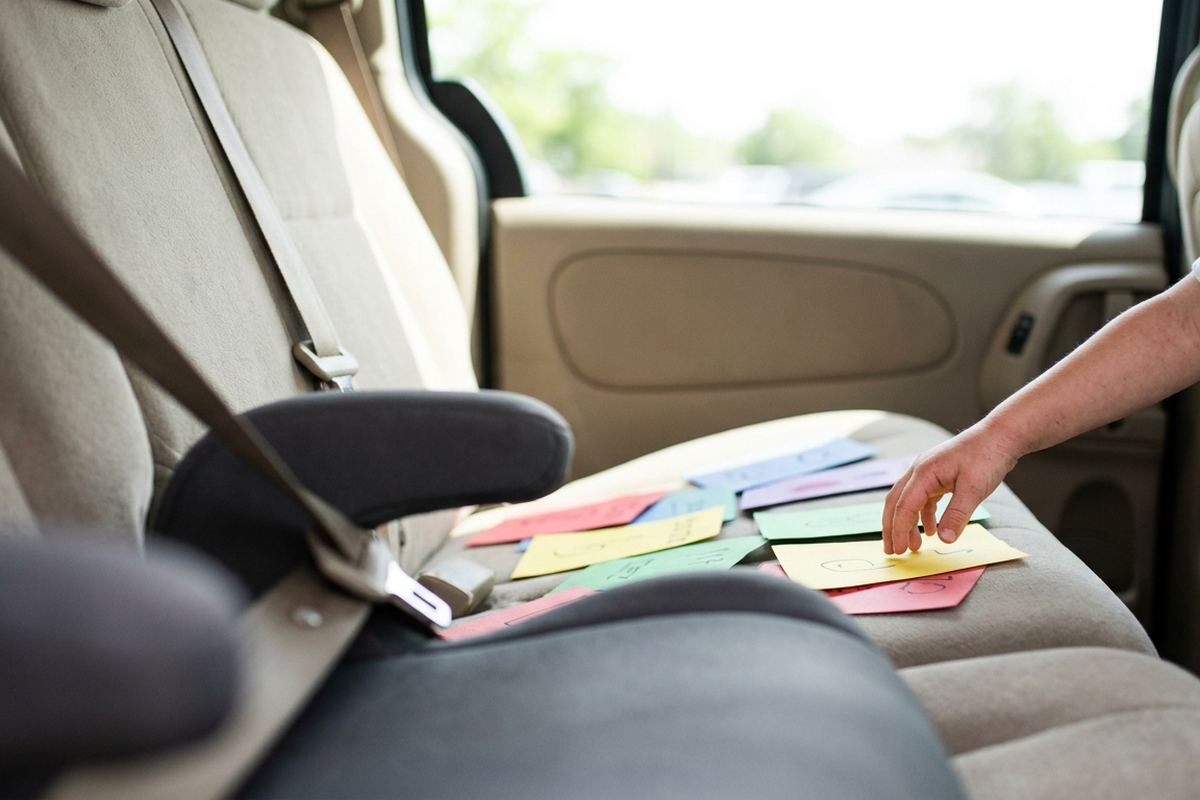
Games help too, especially for kids who shut down when practice looks like a worksheet. Multiplication war with a deck of cards works well: each player flips two cards, multiplies them, higher product wins. So do sticky notes hidden around the house, though you may find 6×7 stuck to the peanut butter three days later. For screen practice, a short round with any simple math-facts app is enough. Keep it short enough that your child still wants to play again tomorrow.
For stubborn facts, give them nicknames or anchors. 7×8 = 56: "5, 6, 7, 8." 6×6 = 36: "six squared." 8×8 = 64: "the big square fact."
Some kids also like a "last five facts" card. Write only the facts your child still misses, not the whole table. Tape it inside a homework folder or near the breakfast spot. When a fact finally sticks for three days in a row, cross it off with great ceremony. Use a marker. Make it satisfying.


