

The homework page looks harmless until your child hits: "How much time passes from 2:40 to 4:15?" Suddenly the kitchen table gets very quiet. Reading a clock is one skill. Figuring out how much time sits between two times is the one that makes plenty of 2nd, 3rd, and 4th graders stare at the wall like the wall might know.
Why elapsed time is so much harder than reading a clock
Elapsed time asks kids to do two things at once. First they have to read the clock: the hour hand moves slowly, the minute hand counts by fives, 3:45 means 45 minutes after 3. That alone takes a couple of years to settle. Then elapsed time stacks a second job on top: measuring the distance from one time to another.
The real trouble is that clocks refuse to use the base-10 system kids live in all day. In regular math, 45 + 30 = 75. On a clock, 45 minutes plus 30 minutes does not land at "75 minutes past." It rolls over at 60 and becomes 1 hour and 15 minutes later.
So when your child asks, "Wait, why isn't it 3:75?" they are not being dramatic. They are bumping into a number system adults forget is strange because we have lived inside it forever. Elapsed time combines clock reading, skip counting, addition, and that base-60 rollover in one little word problem. No wonder the pencil gets dropped.
When schools expect it
Most schools start clock reading in 1st and 2nd grade: time to the hour and half hour first, then quarter hours, then five-minute marks. If you are still at that stage, here is when kids typically learn to tell time and what the usual order looks like.
Elapsed time becomes a bigger deal in 3rd grade for most kids. That is when problems like these show up:
- "Soccer practice starts at 3:30 and ends at 4:45. How long is practice?"
- "The movie is 1 hour 25 minutes and starts at 6:10. When does it end?"
- "It's 7:40 now and we leave at 8:15. How much time is left?"
The exact timing depends on your state and math program. Some 2nd graders get a gentle introduction. Plenty of 4th graders are still practicing, especially once a.m., p.m., and schedules get mixed in. If your 3rd grader finds this messy, that is normal. Third grade math often asks kids to use skills that are still drying, like wet glue.
The number-line jump trick teachers use
Many teachers use a number-line strategy because it keeps kids from subtracting times like regular numbers. On homework it may be called an open number line, or just show up as a row of jumps.
The idea: start at the first time, hop to a friendly time, then take big hops. Try 2:40 to 4:15. Start at 2:40. Hop to 3:00: that is 20 minutes. Hop from 3:00 to 4:00: 1 hour. Hop from 4:00 to 4:15: 15 minutes. Add the hops: 1 hour 35 minutes.
That friendly time is the secret sauce. Kids do better hopping to the next hour or half hour than attempting one giant leap.
If your child tries to subtract 4:15 minus 2:40 and gets tangled, don't panic. That method works later, but it requires borrowing 1 hour as 60 minutes, which is a lot to hold in a young brain. The number line is kinder. Use a finger, draw the jumps big, let it be messy. Math paper does not need to look like a museum exhibit.
Practice hiding in a normal day
Elapsed time sticks best when it is attached to something your child cares about. A worksheet about a train schedule is fine. A real question about pizza rolls is better. And you do not need to announce "We are now practicing elapsed time." That sentence has a way of making children vanish.
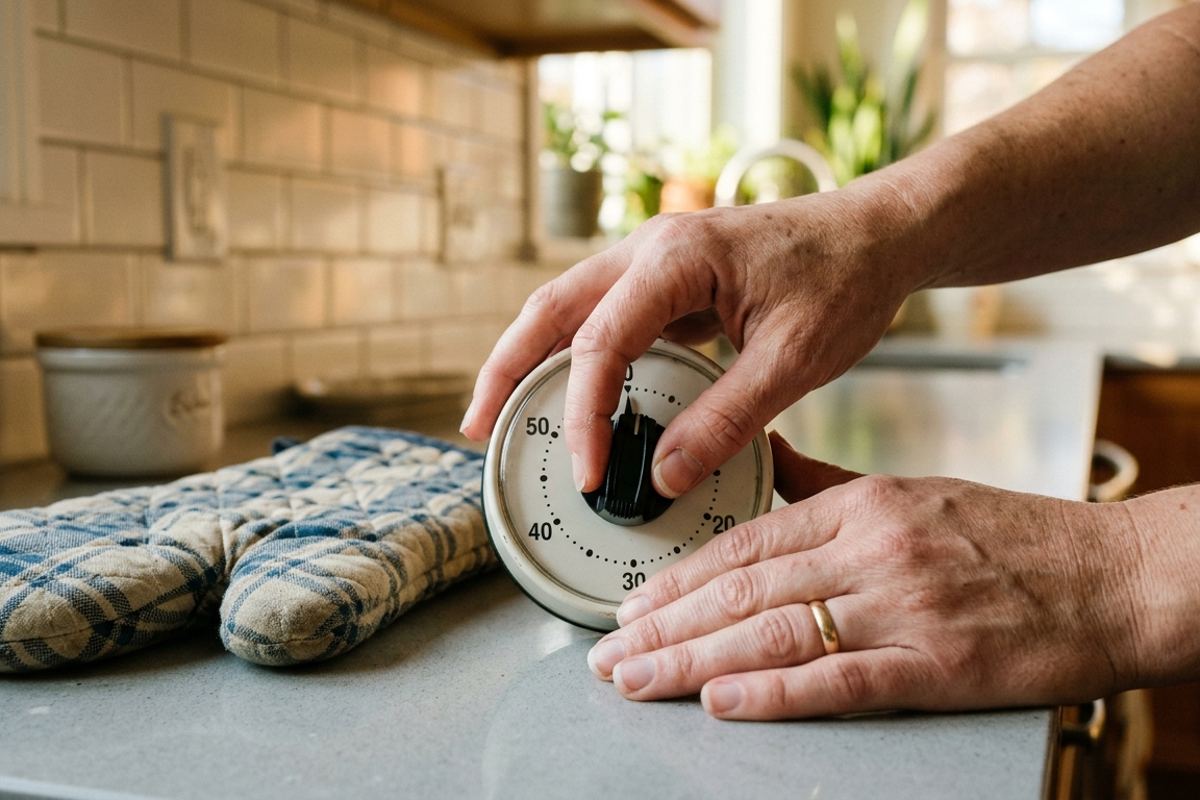
Slip it into the day instead. "The oven timer says 18 minutes and it's 5:12. About when will the muffins be done?" "The movie is 1 hour 40 minutes. If we start at 6:30, is it over before bedtime?" "Grandma's house is 35 minutes away. We're leaving at 10:10. When do we get there?"
Car rides are especially handy because kids are trapped in the most loving way possible. Try the low-pressure version: "It's 2:05 and the GPS says 28 minutes. Do we get there before 2:30 or after?" Estimating first takes the weight off. The exact minute can come later.
Timers help too. Start one for 20 minutes and point at the clock: "It's 4:10 now, so when it rings the clock should say about 4:30." Then let the clock prove it. More ideas like this live in telling-time practice you can fold into a normal day.
Why the analog clock earns its keep here
Digital clocks are easy to read, which is why kids love them and every microwave in America teaches them. But for elapsed time, the analog clock does something digital cannot: it shows time as distance.
On a clock face, your child can watch the minute hand travel from the 8 to the 12 and see 20 minutes. Half the circle is 30 minutes. All the way around is 60. The circle gives their brain a picture. Digital time gives two little codes, 2:40 and 4:15, and the child has to build the distance in their head. Some can. Many cannot yet.
If you have an analog clock in the kitchen, use it out loud. "The big hand is on the 6, so it's half past." "See how far it has to travel from the 3 to the 9? That's 30 minutes." A toy clock with movable hands helps, and so does a paper plate with marker numbers and two cardboard hands, if your child needs to physically move them to believe you.
Digital clocks are not the villain. They just do not show the road between the times.
If it's still rocky, that's normal
Elapsed time wobbles into 4th grade for lots of kids. A child can read 4:15 perfectly and still freeze on "how long from 2:40 to 4:15?" That gap tells you the clock-reading part is fine and the measuring part needs more reps.
Signs your child is in the normal learning zone: easy problems like 3:00 to 3:30 work, but crossing the hour does not. They can solve it on a number line but not in their head. They mix up "what time will it be?" and "how much time has passed?" That last one is very common. One asks for an ending time, the other asks for an amount of time. Adults hear the difference automatically. Kids may need the words underlined for a while.
Mention it to the teacher if your child cannot read an analog clock at all by late 3rd grade, or if time homework causes nightly tears. There may be a small-group strategy or a visual that finally clicks.
For most kids, steady little doses win. One real-life time question while dinner cooks. One number line. Then stop before everyone hates the clock.


