

One shoe disappears under the couch, and someone asks, "How long until dinner?" That little question is time-telling practice, hiding in plain sight. Kids don't need a special time lesson every night. They need normal days with clocks they can actually see.
Hang an analog clock where the action is
Phones are fine for adults. They're terrible teachers of time. A phone hands your child the answer: 6:42. Done. An analog clock shows the story. The minute hand creeps, the hour hand slides from one number toward the next, and your child can see that time is passing. That's the whole trick.
Put an analog clock where your child already spends real time: the kitchen and the bedroom. The kitchen clock gets used for breakfast, dinner, leaving for school, and the eternal question of snack. A bedroom clock handles bedtime and "you may get up when the little hand is on 7" for early risers who believe 5:12 is a reasonable start to the day.
Choose the plainest clock you can find: all 12 numbers printed clearly, regular numerals rather than Roman ones, minute marks around the edge, and hands that are easy to tell apart. The cute clock shaped like a sloth is charming, but if the 8 is hiding behind a tree branch, it's not doing your child any favors.
Most kids meet telling time in early elementary school, often starting with hours and half-hours in kindergarten or 1st grade and working toward five-minute intervals around 2nd grade. Some kids pick it up fast. Others can do three-digit subtraction before they trust the minute hand. That's normal, and the full timeline is in when do kids learn to tell time.
Anchor times: the built-in daily drill
The easiest practice is attached to something your child already cares about. "We leave at 7:45." "Bath is at half past seven." "Screen time starts at 4:00."
Those times mean something. They're not random numbers on a worksheet. A child who couldn't care less that the minute hand is on the 6 may care deeply that the minute hand on the 6 means cookies are done, or it's finally time for soccer cleats.
Say the time out loud when you notice it. Not as a quiz. Just narration. "Oh, it's 7:20. We need to leave in 25 minutes." "It's almost 5:00. The hour hand is getting close to the 5."
You're giving your child the language of time before expecting them to produce it alone. Kids often get stuck not on the numbers but on the phrases: quarter past, half past, almost, a little after, ten till. Those words show up constantly in real life and rarely on flash cards.
If analog clocks are new, keep anchors simple. Use o'clock and half past for a while, then add :15 and :45. Five-minute intervals can wait until the foundation stops wobbling.
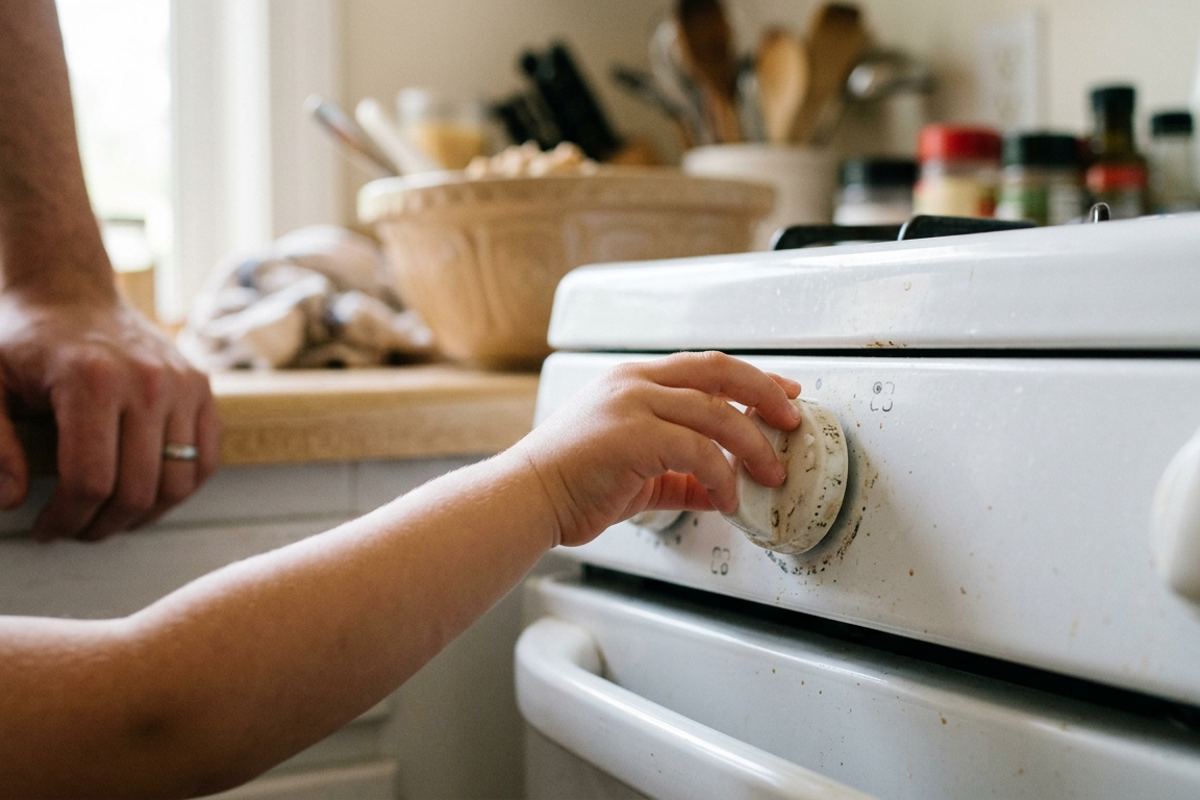
The kitchen timer is a teaching tool
The kitchen timer is one of the best little time teachers in the house, mostly because it has a job. It isn't pretending to be school. It's saving the pizza rolls from becoming charcoal.
Let your child set it sometimes: oven timer, microwave, the little twisty tomato timer from 1998. Have them watch the minutes count down. "We set it for 12 minutes. Now it says 9. Three minutes have passed."
That countdown helps kids feel duration, not just read a clock. Five minutes stops being an idea and becomes how long they have to wait for garlic bread.
Pasta math is especially good because it's real and slightly urgent: "It's 5:50. The pasta takes 10 minutes. When do we eat?" If that's too hard, walk it forward together: five minutes gets us to 5:55, five more to 6:00. Point at the analog clock while you do it, so the minute hand's jump from the 10 to the 12 has something to hang on.
One question here and there is plenty. If your child is tired, hungry, or already upside down on a chair, set the timer yourself and call it a day.
Elapsed time in the car and on the couch
Elapsed time is the part that makes grown-ups say "wait, let me think." So if your child struggles with it, they're in good company.
Reading 7:40 is one skill. Figuring out how many minutes until 8:00 is another. It asks your child to count forward, hold the endpoint in their head, cross over tens or hours, and not panic. No wonder it takes practice.
Daily life hands you easy reps. In the car: "We'll get there at 3:25 and it's 3:10. How many minutes?" "The library closes at 5:00 and it's 4:35. Do we have enough time?" On the couch: "The show ends at 8:00 and it's 7:40. How many minutes left?"
Start with friendly numbers: 7:40 to 8:00, 3:15 to 3:30. Later try trickier ones like 4:48 to 5:10, and break them apart out loud: 4:48 to 5:00 is 12 minutes, then 10 more, so 22. Kids need to hear adults solve time problems out loud, because most of us do it silently and then expect children to magically know the path. They don't need magic. They need the path.
A watch of their own
A cheap analog wristwatch can change the whole mood around time. Not a smartwatch. Just a regular watch with hands, the kind that may not survive the washing machine, so please don't spend real money.
A watch tells your child: time is partly your business now. Kids spend their day being moved along by adults. Shoes on, line up, hurry, wait, stop licking that. A watch hands them a little ownership.
Make your child the family timekeeper for a week. "You tell us when it's 7:25 so we can start shoes." "Let me know when we have five minutes left." At first they'll check every 45 seconds. This is part of the charm, and also why teachers have gray hairs. If they miss the target, no speech. "Oops, it's 7:28, we were aiming for 7:25. Try again tomorrow."
The sweet spot is often 1st or 2nd grade, when feeling "big" is the strongest currency there is. Older kids who never mastered analog time can like a watch too, if you treat it as a tool rather than a babyish fix.
What to skip
Skip the hourly pop quiz. "What time is it now? What time is it now?" After the third round, most kids stop seeing a clock and start seeing a trap.
Worksheets have a place when the teacher sends home a specific skill, and drawing hands on clock faces can help a child slow down. But if every bit of time practice feels like schoolwork, your child may decide clocks are another adult invention designed to ruin a peaceful afternoon. A clock worksheet or two on a quiet weekend is a different thing than a nightly drill.
Also not worth much energy at home: Roman numerals before regular clock reading is solid, correcting every casual slip, and turning bedtime into a time test. Bedtime already has enough drama.
If your child is around 3rd grade or beyond and can't read an analog clock at all, mention it to the teacher. Often it's just a missed skill in a very digital world. For most kids, time clicks when it becomes useful: the clock says when pancakes are ready, when the bus comes, and when they're allowed to ask if it's snack time again. Which, somehow, is always now. More on the math side of all this lives in Math, Time & Money.


