

The first time a child stares at an analog clock like it is a tiny round spaceship, you can almost see the problem. The microwave says 6:42, the tablet says 6:42, and then school hands them a clock with two sticks and twelve numbers. No wonder telling time feels harder than parents expect.
The two clocks problem: digital is everywhere, analog is on the test
Most kids live in a digital-time world. The car dashboard, the phone, the oven, the school Chromebook. Digital time is fast and exact: 7:15 means 7:15. No decoding needed.
Analog clocks ask kids to do more. They have to track two hands, understand that one moves slowly while the other moves quickly, count by fives, and remember that 12 can mean "top of the hour" or "zero minutes." That is a lot of math hiding on the cafeteria wall.
And yes, analog clocks still show up at school. Many teachers use them because they connect to number sense, skip counting, fractions, and plain old "look up and see how long until recess." Time skills get tucked into math lessons in 1st, 2nd, and 3rd grade in most districts.
Digital clocks tell kids what time it is. Analog clocks help kids understand how time moves.
If your child is also working on early number skills, the Math, Time & Money section has more parent-friendly help for the milestones that somehow always land right before bedtime.
Ages and stages: what most kids can do when
There is no magic birthday when telling time suddenly clicks. Most kids build it in layers, and the layers can look wobbly for a while.
In preschool and Pre-K (ages 4 to 5), many kids begin using time words: morning, night, before, after, later. They may know that lunch comes after playtime. That counts. Time starts as a routine before it becomes a clock.
In kindergarten (ages 5 to 6), kids often recognize clocks and may read exact hours. Some can tell you, "It's 8 o'clock," if the minute hand points to 12. Many are still guessing, and that is normal.
In 1st grade (ages 6 to 7), most schools expect practice with time to the hour and half hour. In 2nd grade (ages 7 to 8), many kids move toward five-minute intervals: 3:05, 3:10, 3:25. This is where counting by fives becomes a big deal.
By 3rd grade (ages 8 to 9), many teachers expect elapsed time: "If soccer starts at 4:30 and ends at 5:15, how long was practice?" For some kids, elapsed time is the part that causes the dramatic pencil drop.
Start with the hour hand (yes, really)
Parents often start by teaching the minute hand because it is longer and bossier. I get it. It looks like the main character.
But the hour hand is the better starting place.
The hour hand tells the story of the day in big chunks. Breakfast at 7. School at 8. Bedtime at 8 again, somehow. Kids understand those chunks before they understand "37 minutes after." When the hour hand is between 4 and 5, the time is still in the 4 o'clock hour. That one idea prevents a lot of mistakes later.
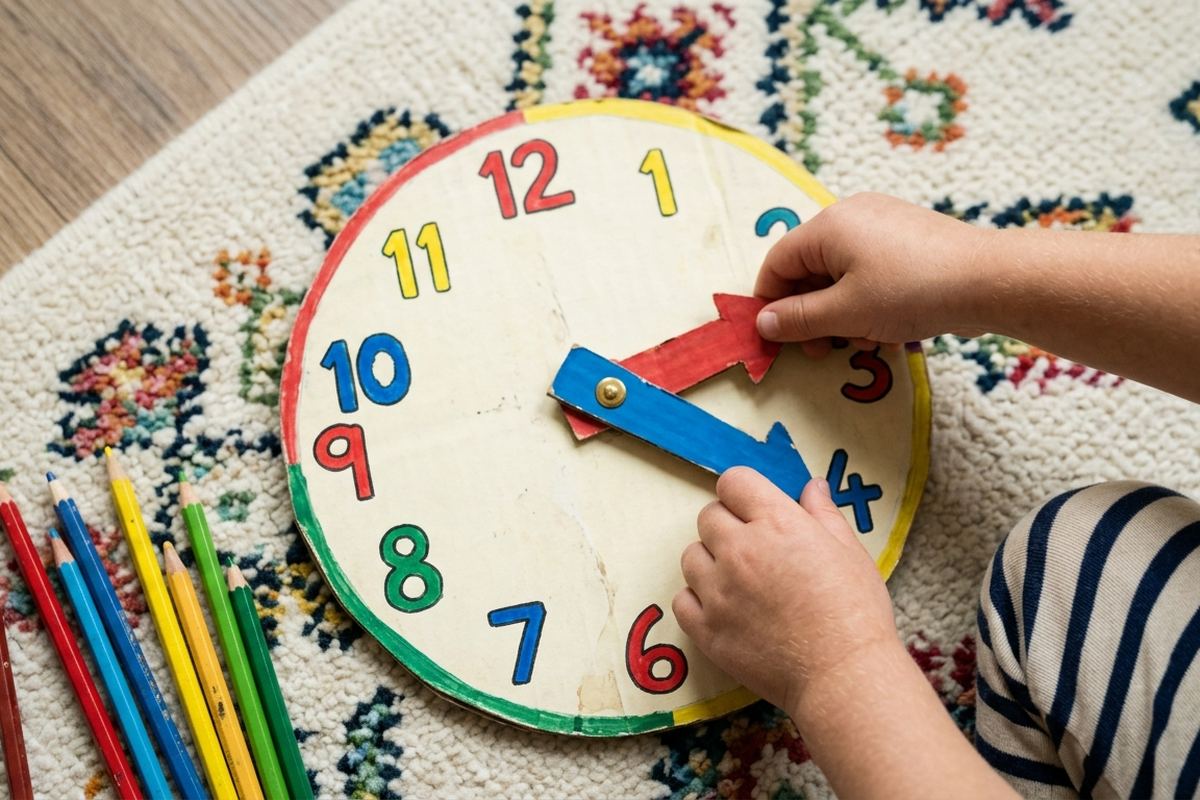
Try covering the minute hand on a practice clock and asking things like: "Is it almost 2 o'clock or just past 2?" or "If the hour hand is halfway between 3 and 4, what do you think the minute hand is doing?" That last one is sneaky in a good way. It shows your child that the hour hand does not jump from number to number. It creeps. Very slowly. Like a kid asked to put on shoes.
Once your child understands the hour hand, the minute hand has a place to land. Without that, kids read 6:45 as "9 something" because the big hand is on the 9. Reasonable mistake. Wrong clock logic, but reasonable.
O'clock, half past, quarter past: the order that works
Telling time has a teaching order that usually works better than "here is the whole clock, good luck."
Start with o'clock. The minute hand points to 12, the hour hand points to the hour. 2:00. 9:00. Nice and clean.
Next comes half past. The minute hand points to 6, and the hour hand sits halfway between two numbers. This is the first moment kids have to accept that the hour hand may not point exactly at a number. It is also a natural bridge to fractions: half the clock has gone by.
Then quarter past. The minute hand points to 3, meaning 15 minutes after the hour. Some kids love saying "quarter past" because it sounds grown-up. Others would rather say 4:15, and that is fine.
Quarter to is usually harder. At 7:45 the hour hand is almost at 8, so plenty of kids say 8:45. They are reading what they see, not what the clock means yet.
Five-minute intervals come last. If your child can count by fives smoothly to 60, the rest gets much easier. If skip counting is still bumpy, spend a few days there before pushing clock practice. A round of math games can make that feel less like a worksheet sneaked onto the kitchen table.
A clock in the kitchen beats a worksheet
Worksheets have their place. They are neat. They are quiet. They do not spill orange juice.
But the best time practice usually happens in real life, with a clock your child sees every day. Put an analog clock in the kitchen or near the homework spot. Not a fancy one with no numbers and delicate little lines. Get the plain kind. Big numbers. Clear hands. The kind a substitute teacher would silently thank you for.
Then use it when time matters. "We leave when the minute hand gets to the 6." "Dinner at half past 5." "You can read until 8 o'clock." The goal is not to turn your house into Clock School. It is to give your child repeated, low-pressure chances to connect the clock to real events. Five seconds here and there adds up.
Car rides help too. "It's 3:20 now. We'll get there around 3:40. How many minutes is that?" If your child groans, answer it yourself and move on. They still heard the math.
For younger kids, keep it playful. Draw a giant chalk clock on the driveway, use two sticks as hands, and let your child stand on the hour like a very serious human clock.
When the minute hand just won't click
Some kids can read above grade level, build elaborate LEGO cities, remember every Pokémon evolution, and still fall apart when the minute hand points to the 8. That does not mean they are lazy. Analog time is abstract.
The minute hand is strange because the numbers do double duty. The 1 means five minutes. The 3 means fifteen. Kids are being asked to ignore the number they see and say a different number instead. Adults forget how weird that is.
A few things often help. Add small sticky notes with the minute numbers (05, 10, 15) around a wall clock for a while. Practice one slice at a time: a few days of :00 and :30, then add :15 and :45, then fives. Mixing everything too soon creates that blank stare parents know well. And use digital and analog together: if the oven says 6:25, find 6:25 on the wall clock, so your child sees both clocks telling the same truth in different languages.
If your child is in 3rd grade or older and still cannot tell time to the hour or half hour after steady practice, mention it to the teacher. They may already be seeing the same thing in math class. Often it just needs more time and a different approach, but it is worth asking before frustration becomes the main lesson.


