
The fraction homework lands on the kitchen table, and suddenly your usually capable 3rd grader is staring at "3/4" like it came from outer space. You explain. They erase. Someone sighs loudly, and it might be you. Fractions can turn a perfectly normal Tuesday into a tiny courtroom drama over pizza slices.
Why fractions feel like the first real wall
For the first few years of school, numbers behave themselves. Six is more than four. Twenty is more than twelve. A bigger number means more crackers, more stickers, more minutes before bedtime if your child is a skilled negotiator.
Then fractions show up and break the deal. Now 1/8 is smaller than 1/4, even though 8 is bigger than 4. The bottom number doesn't mean "how many you get." It means how many equal pieces the whole was split into. More pieces, smaller pieces. That's a rude surprise.
This usually gets serious around 3rd grade (ages 8 to 9), though many kids meet halves and quarters earlier. Schools spend years on fractions because they're the doorway to decimals, ratios, measurement, and eventually algebra. If your child hits a wall here, they're not dramatically behind. They're meeting a new kind of number.
A lot of fraction trouble is really language trouble plus picture trouble. The child knows what half a cookie looks like, but "one-half" on paper feels like code. The job at home is to keep bringing the code back to things they can touch, split, and argue about. If the arguing starts feeling like your own old math dread talking, math anxiety runs in families and it's worth reading up on.
Food first: pizza, sandwiches, brownies
Fractions begin as sharing, which is why food works so well. Kids already understand fairness at an Olympic level. If one brownie is cut into two pieces and another into three, they'll spot who got the better deal before you've found a napkin.
Pizza is the classic, but sandwiches, waffles, quesadillas, and chocolate bars all work. Start with one whole thing, cut it into equal parts, and say the fraction in a full sentence: "You have one out of four equal pieces. That's one-fourth."
The word equal matters. If one slice is huge and one is tiny, it's not fourths. It's just a snack with drama.
A quick home test: ask, "Would you rather have 1/2 of this brownie or 1/3?" Most kids pick 1/3 at first because 3 sounds bigger. Then cut two identical brownies, one into halves and one into thirds, and let them choose again. The fairness instinct will do more teaching than a lecture ever could.
Building bricks and paper folding
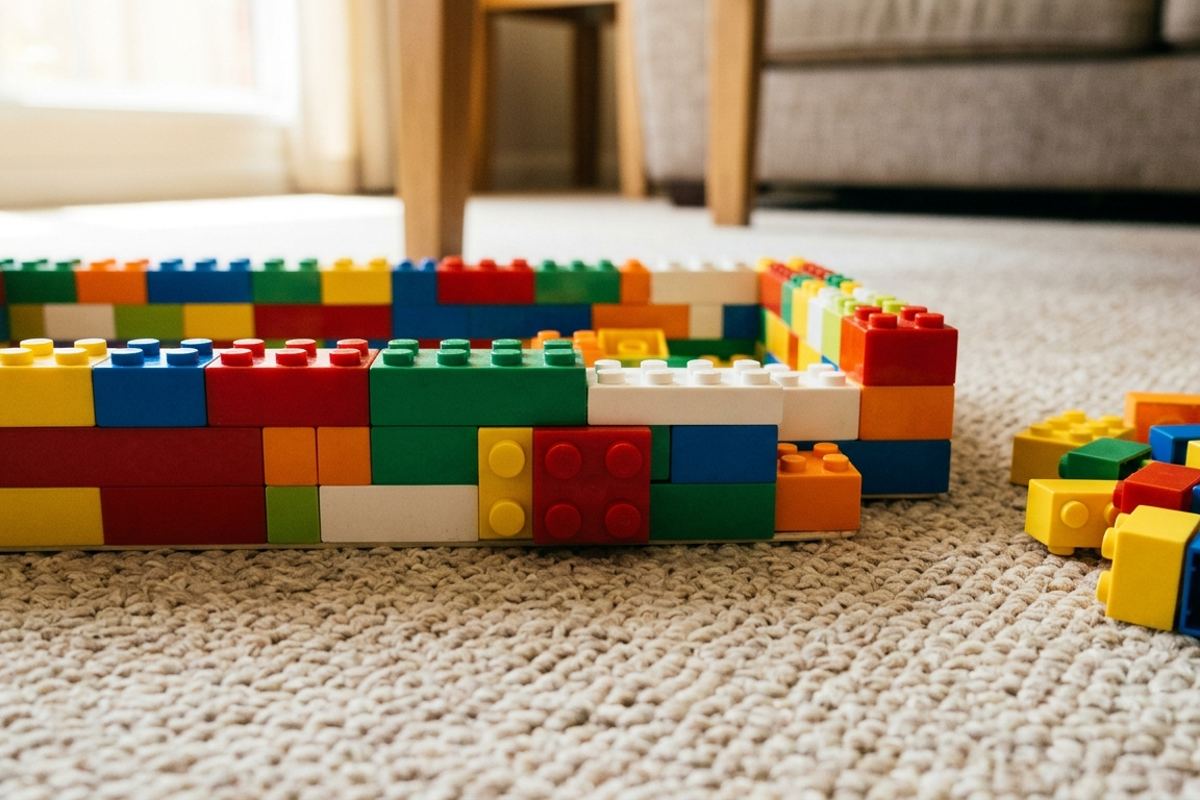
Food is great, but it disappears. Building bricks stick around long enough for kids to compare, rebuild, and change their minds.
A long 2-by-8 brick can be the whole. Two equal 2-by-4 bricks cover it exactly, so each one is 1/2. Four 2-by-2 bricks cover it too, so each is 1/4. When your child snaps pieces together and sees that two fourths equal one half, fractions stop being "the little numbers with a line" and become relationships.
Paper folding is another quiet powerhouse. Fold a sheet in half, open it, fold it into fourths, then eighths. Don't rush to symbols. First ask what they notice. Are all the parts the same size? How many equal parts now? If I color three parts, how many out of the whole did I color?
Show unequal parts too. Fold one paper into four neat strips and tear another into four random chunks, then ask which one shows fourths. Kids usually laugh because the wrong one looks so unfair. Good. That laugh means the idea is landing.
Measuring cups: fractions with a purpose
Measuring cups are fraction lessons wearing an apron. Your child isn't filling a 1/4 cup because a workbook said so. They're doing it because cookies are at stake. Motivation improves under the smell of cinnamon.
Start with the cups before the recipe gets busy. Set out the 1 cup, 1/2, 1/3, and 1/4. Let your child fill the 1/4 cup with rice or water and pour it into the 1/2 cup, then do it again. Two 1/4 cups fill the 1/2 cup. That's 1/4 + 1/4 = 1/2, but the cup proves it before the symbols do. Four 1/4 cups fill the whole. Three scoops of the 1/3 cup do too. This is how kids start to see why the bottom number names the size of the pieces.
Doubling a recipe is a nice next step for older elementary kids. Pancakes call for 1/2 cup of milk, so doubling means 1 cup. Keep it small. Nobody needs a 14-step banana bread recipe during a math meltdown.
Measuring also gives fractions real-world credibility. A half cup is not a school trick. It's the difference between muffins and muffin soup.
The words do half the work
Fraction symbols are compact, and they hide a lot. That's why the words matter so much.
Before your child writes 3/4, make sure they can say "three out of four equal parts." That sentence carries the meaning: the top number tells how many parts we have, the bottom tells how many equal parts make the whole. Use "fourths" instead of "the little ones," "eighths" instead of "skinny slices." Casual names are fine for a second, but the real names connect home talk to school talk.
A helpful ladder goes from real life to math language to symbols: "Three out of four slices are gone." "Three-fourths of the pizza is gone." "3/4 is gone." Many kids get shaky when adults jump straight to the last step.
Watch the word "whole," too. A whole can be one pizza, one measuring cup, one mile. If the whole changes, the fraction changes. Half of a giant cookie is not half of a tiny cookie, and children need to hear that more than once.
When the homework is a number line, not a pizza
At some point the worksheet stops showing brownies and starts showing a plain number line, and many parents think: wait, why did they leave the pizza? The pizza was working.
Schools move fractions to the number line because fractions are numbers, not just pieces of food. Your child needs to see that 1/2 lives between 0 and 1, that 3/4 sits closer to 1, and that 5/4 is more than 1. The line is also where those hopping strategies from the "new math" homework come home to roost.
The bridge is the word "whole." On a pizza, the whole is the pizza. On a number line, the whole is the space from 0 to 1. Draw a line, say "this space is one whole," fold a paper strip into halves and lay it underneath, and mark 1/2. Then fold a strip into fourths and mark 1/4, 2/4, 3/4, 4/4.
Here's the lovely part: 2/4 lands in the exact same spot as 1/2. Your child can see equivalent fractions instead of memorizing a rule that feels like magic.
When your child panics at a number line, go back to pizza language for one sentence: "This is still about equal parts. The picture just got skinnier." Then count the spaces, not the tick marks. That one detail saves a lot of tears, including grown-up ones. For extra practice that doesn't feel like a worksheet, the 3rd grade games keep numbers in the air on the nights everyone's pencil patience has run out.


