

The backpack hits the floor, the folder comes out, and you're staring at a math page that looks like it was assigned by a very organized alien. Boxes, bubbles, arrows, empty number lines, and the tiny instruction: "Explain your thinking." You know how to do 62 - 38. You just don't know why your child is drawing hops across the page to get there.
Why the homework looks nothing like your homework
Most of us learned math as a set of steps. Line up the numbers, carry the one, borrow from the tens place, keep it neat.
Many schools now teach the thinking behind those steps before the shortcut. That's the big shift. Your child may spend a long time breaking numbers apart, drawing pictures, and explaining why something works before anyone shows them the standard algorithm you remember. The algorithm still comes. It just comes later.
That can feel backward at the kitchen table. If your child can solve 8 + 5 in two seconds on their fingers, why fill little boxes with dots? Because teachers are building number sense: the quiet understanding that numbers can be moved, grouped, and taken apart without changing their value. The steps kids climb on the way are laid out in how kids learn addition and subtraction, and number sense is what carries them into fractions, decimals, and money later.
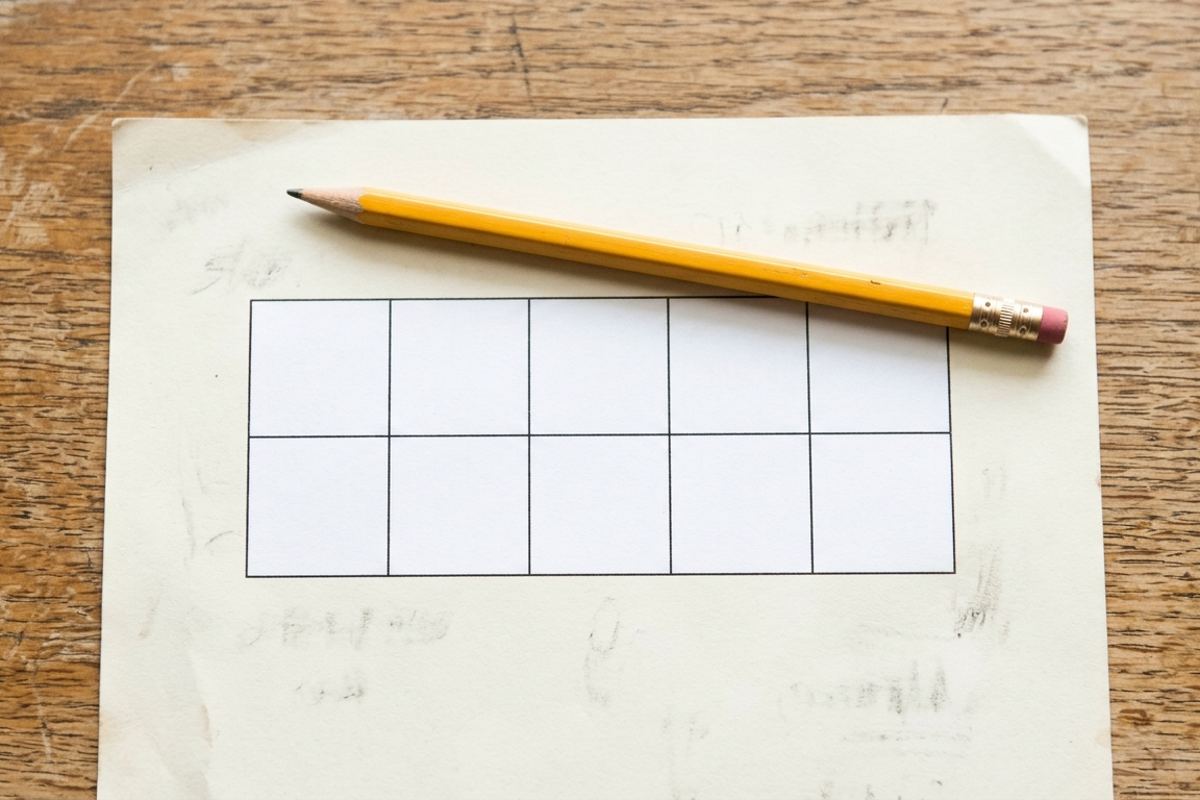
Ten-frames: the box of ten dots
A ten-frame is a rectangle with ten spaces, two rows of five. Kids fill the spaces with dots, counters, or whatever was in the supply bin that morning.
It looks simple because it is. That's the point. Ten is the anchor of our number system: ten fingers, ten ones make a ten, ten tens make a hundred. When children can see numbers in relation to ten, they stop counting every dot from the beginning.
Take 8 + 5. On a ten-frame, 8 fills all but two spaces. Add 5 more dots and your child can slide 2 of them into the empty spaces to make 10, with 3 left over. So 8 + 5 becomes 10 + 3. No magic, no finger shame. Just a picture of making ten.
In kindergarten and 1st grade, ten-frames show up constantly. By 2nd grade many kids do this in their heads, even when the worksheet still asks for a drawing.
Number bonds: breaking numbers apart
Number bonds are those circles-and-branches diagrams that look like tiny family trees for numbers. One circle holds the whole, the connected circles show the parts: 7 is 5 and 2, or 4 and 3, or 6 and 1.
Parents look at these and think, why are we decorating the number 7? Fair. But this is the skill behind mental math. A child who knows 7 is 5 and 2 can use it everywhere. For 7 + 8, they break 7 into 2 and 5, hand the 2 to the 8 to make 10, and add the leftover 5. Now the problem is 10 + 5, which nobody has to count.
Number bonds power subtraction too. If 10 is 6 and 4, then 10 - 6 = 4 and 10 - 4 = 6. Those fact families are why teachers keep asking kids to write related facts. They want children to see connections instead of memorizing one lonely fact at a time.
The open number line: subtraction by hopping
An open number line is a blank line where numbers get added only where your child needs them. No tick marks, no ruler precision. Just a place to show jumps.
For 62 - 38, adults want to stack the numbers and borrow. The open number line often counts up from 38 to 62 instead. That sounds like cheating until you notice it's exactly how people make change. If something costs $38 and you pay $62, nobody subtracts with regrouping. They count up: 38 to 40 is 2, then 40 to 60 is 20, then 60 to 62 is 2. Add the hops: 24.
On paper, your child draws a line with 38 on the left, 62 on the right, and jumps above it. One kid hops 38 to 40 to 50 to 60 to 62. Another jumps 38 to 58, then 58 to 62. Both are valid if the math is right.
That flexibility is the whole reason the tool exists. Kids learn that subtraction is the distance between two numbers, not just "take away and hope the borrowing works."
Arrays and area models: multiplication you can see
Before multiplication facts become flash cards, they're rows and columns. An array is a neat arrangement, like 3 rows of 4 muffins. Your child can see that 3 × 4 means 3 groups of 4, or turn the picture and see 4 groups of 3. Same muffins, same total, less drama than the word "commutative."
Then come area models, the big box diagrams that make some parents quietly close the folder and start wiping the counter. For 23 × 14, your child splits 23 into 20 and 3, and 14 into 10 and 4, then draws a box with four sections: 20 × 10 = 200, 20 × 4 = 80, 3 × 10 = 30, 3 × 4 = 12. Add them for 322.
Yes, it takes more space than the stacked method. Yes, the paper looks like a parking lot. But the area model shows why the algorithm works, keeps place value visible, and quietly previews algebra, where students multiply things like (x + 3)(x + 4) with the very same box. If multiplication facts are the current dinner-table villain, a few rounds of multiplication war with a deck of cards give fact practice without turning bedtime into a courtroom.
"Explain your thinking" is not a trick question
This instruction has caused many good parents to mutter things under their breath.
It doesn't mean your child needs a paragraph with a topic sentence. Teachers want evidence of a strategy, not just a naked answer that may have come from a parent, a calculator, or a lucky guess. A perfectly fine explanation is one sentence: "I made 10 first." "I counted up from 38." "I broke 14 into 10 and 4."
A drawing often counts too. Ten-frame dots, a number line, an array. For younger kids a picture usually explains more than a sentence would.
If your child says "I just knew it," ask gently, "What did your brain do first?" Sometimes they really did retrieve the fact from memory, and that's fine. Often they used a tiny strategy so fast they didn't notice: they knew 6 + 6 and added one more. That's thinking worth writing down. Keep it short. The homework is math, not a memoir.
Some nights, the worksheet wins. Your child is tired, you're tired, the example at the top of the page skips three steps, and the school portal video needs a password last seen in October.
Write a note to the teacher. Truly. Something simple: "We tried #4 and #5 but didn't understand the number line strategy. Could you go over it with Jordan?" That note tells the teacher exactly what went wrong, and it protects your child from sitting there for 45 minutes absorbing the message "I am bad at math." More survival tactics for those evenings live in homework without the battle.
Try not to reteach your own method at 8 p.m. when the homework clearly wants a specific strategy. You can say, "I learned it a different way and I'll show you sometime, but tonight your teacher wants the number line. Let's mark the confusing part." There's nothing wrong with your old algorithm; the problem is timing. Jumping to the shortcut while your child is still learning the meaning makes tomorrow's lesson feel even stranger.
The worst outcome isn't a wrong answer. A wrong answer is fixable. The heavier thing is a child deciding math is a secret language everyone else understands. So keep the evening small: one example with pennies, beans, or that one dinosaur that's been under the couch for weeks. If the fog doesn't lift, stop and send the note. Let the teacher do the morning version, when everyone's brain has had toast.


