

My youngest picked a dime out of the car cup holder last spring and asked what it was for. Not what it was worth. What it was for. Which is a fair question when you're seven and the only money you've ever seen move is a phone touching a terminal and making a small beep.
Why coins are still in the standards
Most schools teach coin names and values in 1st and 2nd grade, then build toward making change, writing money amounts, and decimal money in 3rd and 4th. If your kid has never watched anyone pay with cash, that can look like a curriculum that forgot to update itself.
Except money isn't really about shopping. It's place value wearing a costume.
A dime is ten ones. A dollar is a hundred cents. Four quarters make a whole. That's the exact structure your child needs for decimals, for fractions, for measurement, and for the word problems that manage to make three coins look like a tax form. A child who never handles money has to learn all of it as abstract symbols instead: ¢, $, .25, 0.25, quarter, twenty-five cents. Six labels for one small circle. Coins give the place-value system kids meet in 2nd grade something they can actually hold, which is most of why the unit survives.
Start with a jar of real coins
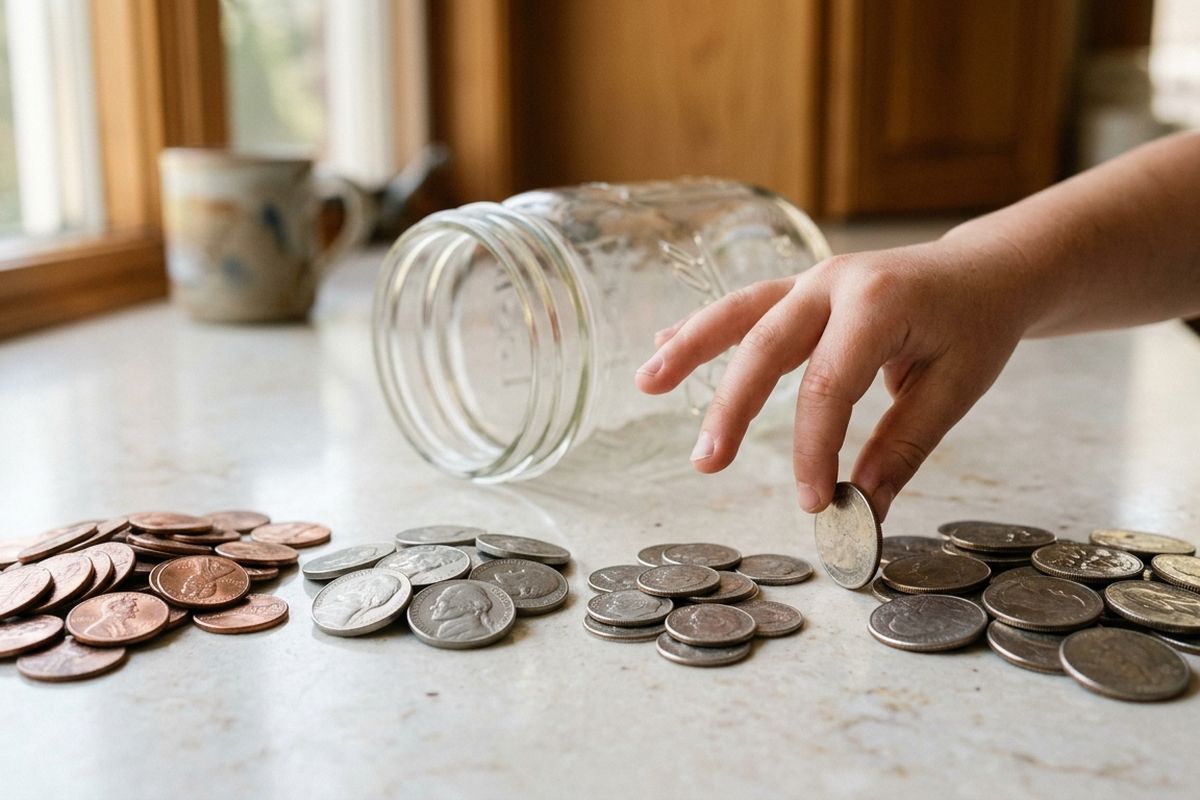
Put a jar on the counter. Not a labeled system with compartments. A jar. Empty into it the coins from pockets, the car cup holder, the bottom of your bag, and the drawer where dead batteries go to retire.
Before anybody counts anything, sort by kind. Pennies with pennies, nickels with nickels, dimes with dimes, quarters with quarters. Let your kid handle them. A dime is smaller than a penny and worth more, which offends a beginner's sense of justice deeply. The dime has ridges. The penny is smooth. The quarter is the big confident one.
Then name and touch, in that order: this is a penny, it's worth one cent; this is a nickel, five; dime, ten; quarter, twenty-five.
Pennies and dimes are usually the easy ones, because they match counting by 1s and 10s, which your child already does. Nickels and quarters are where the counting gets interesting, and by interesting I mean this is the point where a kid looks at you as though you personally invented coins to ruin the evening.
Whatever you do, don't start with a mixed pile. That's what worksheets do, and it's why the unit feels harder than it is. Sort first. Count second. Mix much later.
Skip-counting nickels, then quarters
Nickels are the cleanest entry point. Lay real ones in a row and touch each coin as you count: 5, 10, 15, 20, 25. The touching is not optional. Without it, a lot of kids chant the numbers like a song and have no idea which coin goes with which amount.
Quarters get their own rhythm: 25, 50, 75, 100. I catch myself saying that one while loading the dishwasher. Say out loud that 100 cents is the same as one dollar, because kids hear "one hundred" and "one dollar" as two unrelated creatures until somebody connects them.
Once single-coin counting is steady, mix them, and teach the order: biggest coin first, then count down. Quarter, dime, two pennies becomes "twenty-five, thirty-five, thirty-six, thirty-seven."
The classic snag is that kids count coins instead of value. Four coins on the table, and the answer comes back "four." That isn't carelessness, they're answering a different question than the one you asked. Slow it down with one coin per hand: a dime in the left, two pennies in the right, which hand is worth more? That single question does a surprising amount of work.
Making change by counting up
Making change by subtraction is where a lot of kids hit the wall. The problem looks like money but is really subtraction across a decimal point while keeping track of cents, which is a big ask in 3rd grade. Teach the cashier method first: count up from the price to the bill.
Something costs $3.40 and your kid pays with a five. Start at 3.40. Add a dime, 3.50. Add two quarters, 4.00. Add a dollar, 5.00. The change is $1.60, and nobody borrowed across anything.
That beats writing 5.00 minus 3.40 with twenty more problems waiting underneath. Worksheets love to make money look like bookkeeping; actual change is counting up.
Play store if your kid needs reps. Cans from the pantry, sticky notes for prices. Beans cost $1.30, the cereal is $4.25, your child is the cashier, you hand over a bill and they count the change out loud. It's the same practice as the mental math you can do in a real grocery aisle, just with less pressure and more beans. Set a timer for a few minutes and stop before anyone gets weird about it.
Bills, dollars and the decimal point
Bills are easier, because the number is printed on the front and isn't disguising itself as a small silver circle. The hard part is holding dollars and cents in one amount.
Take $1.25. Say it the ordinary way first: one dollar and twenty-five cents. Then build it: a dollar bill and a quarter. Then write it. Then connect it to place value, one whole dollar plus 25 out of 100 cents, and you've walked your kid into the decimal work that shows up in 4th grade through the friendliest door available. Decimals otherwise arrive like someone rearranged the furniture in the dark.
Rounding fits in here too, and takes about four seconds at the shelf. Hold up the tag: is that closer to three dollars or four? At $3.79, four. At $3.12, three. Do this even when you're paying by card, because estimating stops a kid from believing that the total is a magic number that appears on a screen. It's also the check-for-reasonableness habit that schools care about and adults genuinely use.
What to do about tap-to-pay
Tap-to-pay isn't going anywhere, and I'm not digging for exact change while my youngest interrogates the gum display and the person behind me has seven things for dinner. Kids just need to see the money moment happen somewhere.
At checkout, let your child see the total on the screen and say it out loud. Twelve forty-eight. Before you tap, ask for an estimate, and accept "about twelve dollars" as a complete answer.
Every so often, pay cash on purpose. Let your kid hand over the bill and take the change. It's slower, the cashier may look mildly surprised, and surviving a mildly surprised cashier is part of growing up.
Coins as allowance are worth the inconvenience for a while too. Two dollars a week in quarters, dimes and nickels gives you a built-in trading game: four quarters for a dollar, ten dimes for a dollar, twenty nickels for a dollar if they have the patience. That trading is the math. If you're already sorting out what chores and jobs look like during the school year, paying part of it in coins costs you nothing extra.
And narrate the invisible part of the card. I tapped it, and the money still left my account; the machine didn't make it appear. Kids don't need a banking lecture. They need the idea that tapping is paying and not wishing, so that when coins turn up on a worksheet in March, there's something real underneath them.


