

The backpack lands by the door, one shoe disappears under the couch, and someone suddenly remembers they need a poster board by tomorrow. Then you look at the dishwasher, the lunchboxes, the dog bowl, and wonder: are chores still fair on a school night? Usually, yes. They just have to be small enough to survive real life.
Chores don't have to compete with school
Chores can feel like one more thing in a day already packed with spelling words, soccer cleats, and the mysterious disappearance of every sharpened pencil in the house. But chores and school aren't enemies. They train different muscles.
School asks kids to focus, follow directions, and keep trying when something is hard. Home does that too, in a plainer way. A kid who puts their folder in the same spot every afternoon is practicing responsibility. A kid who clears their plate is learning that living in a family means doing some of the work, not just enjoying the snacks.
The trick is scale. A 25-minute chore on a Tuesday night is too much. A 3-minute chore that happens every day becomes part of the rhythm, like brushing teeth or tossing socks somewhere near the hamper. Near is a start.
Chores also hand out a kind of competence school doesn't always offer. Some kids struggle with reading logs or math facts but can feed the cat or wipe a table like a professional tiny janitor. That counts for something.
What's reasonable at each age (a loose ladder)
A reasonable chore is one your child can mostly do without you hovering like a nervous seagull. You'll need to teach it first and accept some early "creative" versions. Kids are not born knowing that wet towels don't belong in a ball on the floor. Apparently this must be taught to every generation.
- Pre-K and kindergarten (ages 4 to 6): toys in a bin, napkins to the table, shoes by the door, feeding a pet with help.
- 1st and 2nd grade (ages 6 to 8): clearing their place, packing and unpacking the backpack, dirty clothes in the hamper, watering a plant.
- 3rd and 4th grade (ages 8 to 10): part of the dishwasher, folding towels, small trash bags out, making their own snack.
- 5th and 6th grade (ages 10 to 12): starting laundry with directions nearby, packing a simple lunch, vacuuming one room, cleaning a bathroom sink.
And at every age: put away what you used. That one is eternal, and somehow still surprising.
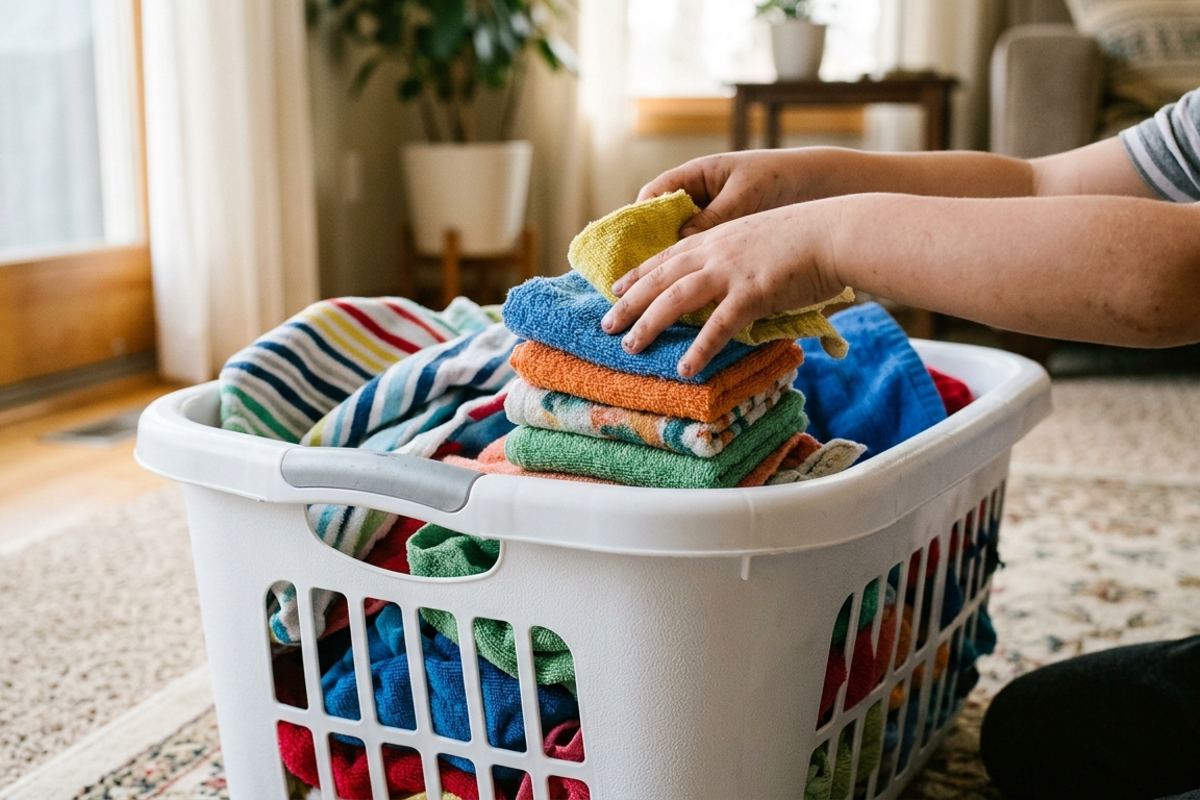
The goal is not perfection. It's ownership. A 7-year-old's folded washcloths look like sleepy burritos. Fine. They fit in the closet, and your kid did real work.
Anchor chores to things that already happen
Chores fall apart when they live in a separate universe called "later." Later is where library books, permission slips, and good intentions go to hide.
During the school year, a chore works better when it rides along with something that already happens. After snack, the backpack gets emptied. After dinner, the plate goes to the sink. Before screen time, shoes and lunchbox land where they belong. If your mornings are the weak spot, the same idea drives a morning routine that doesn't start with yelling: attach the job to the moment, not to a request.
A few anchors that tend to hold. After school, papers go on the counter, where an adult can find the field trip form before it becomes an archaeological artifact. After dinner, older kids clear one extra thing, like the serving spoon or the salad bowl nobody touched. Before bed, a two-minute floor reset: stuffed animals on the bed, books on the shelf, clothes in the hamper. Set a timer. Many kids will race a timer in a way they will never race a parent's tired voice.
Anchors are also kinder than surprise chores. "Please unload the dishwasher right now" is reasonable, but it feels like a pop quiz. "Dishwasher after breakfast" is predictable. Predictable is your friend.
When homework is heavy: shrink, don't cancel
Some nights the math page has 34 problems and your child is melting into the chair in slow motion. It's tempting to cancel chores altogether.
Sometimes you should. Sick kid, late school event, genuine overwhelm: be human, skip it, move on. But as a pattern, shrinking beats canceling. Canceling says chores only happen when life is easy. Shrinking says you're still part of this household, and we can make the job fit the night.
So instead of "clean your room," try "dirty clothes in the hamper." Instead of "unload the dishwasher," try "put away the spoons." One minute still counts.
Kids are very smart about loopholes. If the chore disappears every time homework gets annoying, they learn to wait it out. Teachers watch this exact skill applied to pencil sharpening and suddenly needing water during writing time.
If homework is heavy night after night, that's a separate problem worth a quick note to the teacher: "Homework is taking about 75 minutes and ending in tears. Is that what you expect for this grade?" Most teachers would rather know. And if the evenings themselves are the battle, there are ways to take the fight out of homework that don't involve anyone doing it for them.
Chores and allowance: linked or separate?
Families run allowance differently, and there's no single right system. The real question is whether chores are paid work or just part of being in the family.
In many homes the cleanest split is this: basic chores are unpaid, extra jobs can earn money. Basic chores are clearing your plate, hampering your laundry, feeding the pet you begged for. Citizenship chores. Nobody pays a parent to find the missing water bottle lid either, though frankly there should be a grant.
Extra jobs are different. Washing the car, pulling weeds for half an hour, organizing the garage shelf: paid, if your family chooses. That keeps allowance from becoming a nightly negotiation over whether one bowl in the sink is worth 50 cents. If you're picking a system, there's a full comparison in three allowance systems that work (and one that backfires).
If you keep allowance separate, say it plainly: allowance is for practicing money, chores are because we all help at home. That leaves room to learn saving and spending without turning every sock on the floor into a financial discussion.
One warning from the classroom side: don't use chores only as punishment. "You were rude, so go scrub the sink" teaches kids that helping at home is what happens when you mess up. Natural repair is different. Spilled cereal, help sweep. Dumped every marker on the table, help sort the caps. The chore matches the mess, and nobody has to make it a moral event.


