

There is a very specific sound to a stack of glittery envelopes coming out of a backpack at the cubbies. A little crinkle, a little sparkle, and suddenly six kids are standing very close, trying to read names upside down. And then there is the one child who watches the envelopes go by and realizes, quietly, that there isn't one for them.
In my classroom, birthday invitations were never just paper. They were friendship weather.
Why so many classrooms have the rule in the first place
From the teacher's chair, invitations look different than they do from your kitchen table. At home you're thinking about pizza, cake, the budget, and the fact that your child's cousin is somehow afraid of balloons. At school, a teacher sees the whole little ecosystem at once.
Invitations come out at the cubbies, during morning work, in the line after circle time, or right before lunch when everyone is already wiggly. Kids count. They compare. Someone says "I got one!" and someone else says "Did I?" The child who gets none usually doesn't cry. They go quiet. They sit in the reading corner holding a book and don't turn a page for ten minutes.
The whole-class rule isn't about policing fairness or telling families how to celebrate. It's about keeping the classroom a place every kid can walk into without being publicly sorted.
Most schools put the rule in the handbook or the teacher's welcome letter. Some teachers are firm: no invitations at school unless every child gets one. Others are more "please, just don't hand them out here." If you missed that line in the beginning-of-year packet, you're in good company; those arrive while everyone is labeling water bottles. It's a perfectly reasonable thing to ask about at back-to-school night.
What "whole class" actually means (and what it doesn't)
In most classrooms it means this: if invitations are handed out at school, everyone in the class gets one. That's it. It doesn't mean you have to invite every child your kid has ever met, and it doesn't mean the school decides who comes to your house on Saturday. Outside of school, you invite whoever you want.
There are variations. Some schools allow "all the boys" or "all the girls," though not every family loves that split and plenty of schools are moving away from it. Some use a "fewer than half the class" rule, so a small guest list counts as a private plan. Some ban invitation hand-outs altogether, mostly because it spares the teacher from being the envelope referee before 8:15.
The detail that matters is location. Nobody is asking you to host 24 children in a living room with one bathroom and a brave golden retriever. They're asking you where not to distribute the envelopes.
That distinction helps your child too. "We're inviting three friends from school, so we're sending those invitations from home" is easier for a six-year-old to hold onto than a speech about etiquette. Keep it plain. Kindergartners are many wonderful things. Subtle secret-keepers is not one of them.
Getting invitations to the right kids without the drama
The cleanest way to invite a smaller group is to skip school entirely. Use the class directory, the room-parent list, the PTA app, or the group text that started as "does anyone know when pajama day is?" and somehow became the unofficial news wire. Mailing them the old-fashioned way works too. Kids love mail with their own name on it. So do adults, honestly.
If you are inviting the whole class, ask the teacher what they prefer. Many will tuck one invitation into each Friday folder. Some will say no, kindly, because the school doesn't allow party mail through backpacks at all. That's not personal. Teachers follow the rules even when the cupcakes sound very nice.
Coach your child ahead of time: "We're excited about your party, but we don't talk about it at school, because not everyone is coming to every birthday." Will they talk about it anyway? Probably before the bell. Young kids treat exciting news like loose glitter. Give them one short line for when it comes up: "My grown-up is handling the invitations." Then change the subject. Loose teeth and who got the blue marker are both fine exits.
When your kid is the one who isn't invited
At some point your child will be the one left off the list. Probably more than once. It stings, especially when they tell you in that flat little voice while taking one shoe off and leaving the other on for reasons known only to them.
By Wednesday it usually stings more for you than for them.
That doesn't make it small in the moment. They'll ask "Why wasn't I invited?" or "Does Ava not like me?" Your job isn't to make the feeling vanish in thirty seconds. It's to keep it from turning into a family investigation. A few lines that work:
- "That hurts a little. I get it."
- "Families make different party choices. It doesn't mean you did anything wrong."
- "You can still be kind to them at school."
- "Let's think of something fun for this weekend."
What not to do: don't text the other parent asking why. Don't badmouth the birthday kid. Don't say "well, we won't invite them to yours," even if your inner second grader has a tiny clipboard out and is taking notes.
If your child is already having a rough patch with friends, one missing envelope can feel like proof of something bigger. Often it isn't. It's a trampoline-park limit, a cousin-heavy guest list, a parent who panicked at the pizza-place price sheet. If it keeps happening, or your kid seems lonely a lot, a quiet word with the teacher is the right next step. It may also help to read up on friendship troubles in elementary school, or on helping a shy kid find their footing in a new class.
For the weekend, plan something small and concrete. Pancakes. The library. A playground stop with a thermos of cocoa. Not a rival party, just a soft place to land.
Party formats that make inviting everyone doable
Whole-class parties sound enormous until you make them low-key on purpose. The fanciest party I ever heard described at morning meeting involved a rented pony and, if memory serves, "fancy lemonade." The parties kids talked about longest were simpler: running at the park, frosting on somebody's nose, a dad trying to untangle a kite.
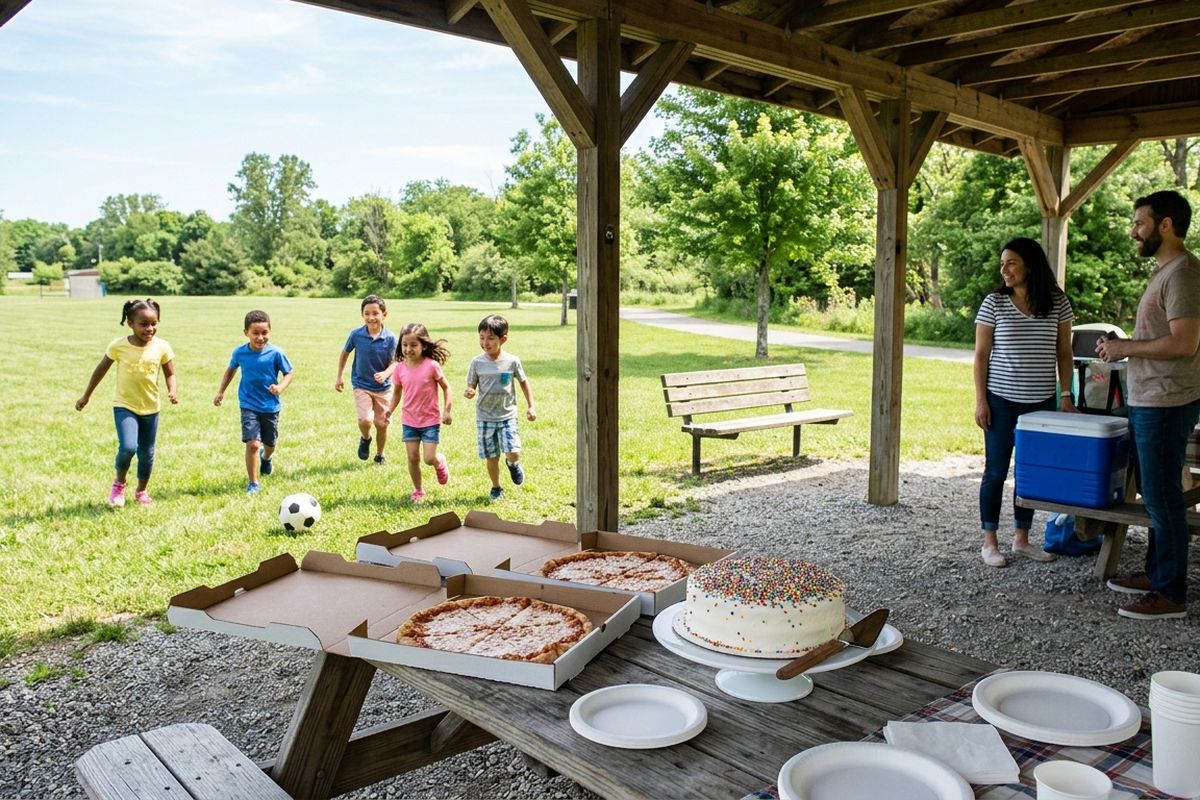
A park pavilion with pizza and a soccer ball can handle more children than your living room ever will. A backyard sprinkler party buys half the entertainment for the price of towels and popsicles. A 90-minute limit is your friend. So is a drop-in open house where families come anytime between 2 and 4 instead of arriving in one loud wave. Cupcakes at the playground right after school feels like a party without turning your Saturday into a military operation.
No-gift parties take pressure off other families. So does "bring a book to swap," which early-elementary kids find surprisingly thrilling. If there are gifts, a short note afterward is a good habit; a kindergartner can draw a cake and sign their name, and thank-you notes don't have to become a second birthday chore.
Keep the guest list realistic for your child's age, too. Whole-class parties tend to work best in K–2, when parents stay, open juice boxes, and rescue the birthday kid from being hugged by seven friends at once. By 3rd or 4th grade most kids want a few close friends and a lot less noise. That's normal, and at that point private invitations sent from home are the calmer choice. Nobody has to watch the glittery envelopes make their rounds at the cubbies.


