

Sunday, 6:43 p.m. Four parents in a group text are trying to figure out who has poster board, whose printer still has ink, and whether the presentation is Tuesday or Wednesday. One parent offers a glue stick. Another says "our printer is being weird." A third sends a photo of a half-finished title in bubble letters.
That is the real face of the elementary group project. Not the polished display board. The logistics swamp.
The two kids every group project has
There is the kid who does everything. This kid is not always bossy. Often they're just allergic to chaos: they can see the poster going crooked and the facts getting copied wrong, and their whole nervous system says "fine, I'll do it."
Then there's the kid who does nothing. Not always lazy, either. Sometimes they missed the directions. Sometimes the task is so big they can't find the front door of it. Sometimes they genuinely believe "the group" means "someone else has it," which is not a life skill we want to reinforce, but is also not rare among 4th graders.
Both kids are learning the wrong lesson.
Which one is yours? You already know. At my kitchen table this is never a mystery. The "I'll just do it myself" kid has a tone. The "I thought they were doing that part" kid has a tone too. Neither tone improves dinner prep.
Your real job: logistics, not content
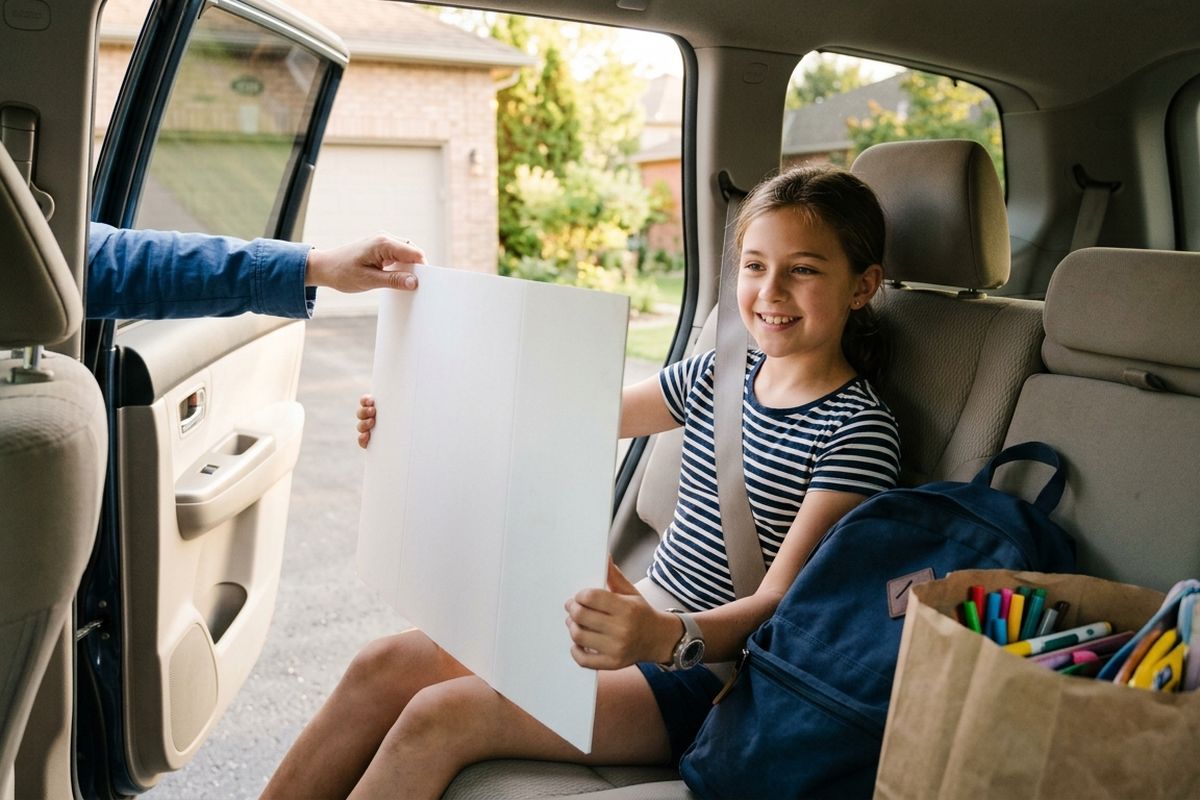
You are the calendar. You are the ride. You are the person who buys the tri-fold board two days early instead of at 8:45 the night before. You are the one who says "the kitchen table is yours from 3:30 to 4:30, then I need it back, because people in this house insist on eating."
You are not the researcher, the editor, or the glue-gun operator.
That line matters. Once parents start helping with content, the project gets weird fast. It stops being four 5th graders making a poster about the water cycle and becomes one child, two adults, a printer, and a level of font matching nobody asked for. The same hands-off rule that applies to math homework help applies here: the adult hand should not end up doing the kid job.
Useful parent help looks boring. A date on the fridge calendar. A text that says "your group is meeting here Thursday at 4." Poster board bought early. Printer checked before bedtime. A snack that doesn't leave orange dust on the project. That's plenty. Truly.
The first twenty minutes decide the whole project
Before anyone looks anything up, before anyone opens a slideshow, before one kid starts a title in twelve colors, the group needs a one-page plan. Not a pretty one. A functional one: who does what, when it's due to the group, and what "done" means for each piece.
So host the first twenty minutes. Sit them at the table, put one sheet of paper in the middle, say "before you start, write down the jobs." Then leave the room once the jobs have names on them. Three or four pieces is usually enough:
- Research: three facts about the habitat, in your own words, source written down, by Thursday
- The map, drawn and labeled, by Friday
- Two speaking lines, written and practiced, by Sunday
- Putting the board together from everyone's finished pieces, by Monday
Notice the last job. "Put it all together" is real work and it gets a name. Otherwise it lands on the kid with the neatest handwriting or the parent with the most visible tape dispenser.
The definition of "done" is what saves you later. "Make the slides" is too vague. "Two slides with one picture and three bullet points each" is something a 10-year-old can actually aim at. Here's the trick nobody tells you: those first twenty minutes aren't about the topic at all. They're about preventing the 9 p.m. collapse.
Scheduling around three other families
Scheduling is where group projects go to limp dramatically across the floor. One kid has soccer. One has tutoring. One is at the other parent's house on Wednesdays. Someone's little brother has a fever. By the time four families find a common hour, the thing is due in eleven minutes.
Keep the parent group text painfully practical. "Can they meet at our house Thursday, 4 to 5?" "We have poster board." "Please pick up at 5, I have to leave at 5:05." Don't use it to relitigate the work split or diagnose other people's children. I say this as someone who has watched a parent thread turn into a tiny school-board meeting with worse punctuation.
If your kid is upset because a partner isn't delivering, bring it back to the plan. "Your job is still your job. Their job is still their job." This is hard, especially for the kid who cares deeply about the grade.
And do not quietly do the missing piece at 9 p.m.
That's the trap. The kid says "but if I don't do it we'll all get marked down." You look at the clock, look at the blank section, and think "I could type this in six minutes." You could. You can also load a dishwasher faster than your child, and yet here we are, trying to raise people who can locate the silverware. If the hole will sink the presentation, your child can add a small note on the board saying that section was assigned to a partner and wasn't finished. That feels harsh. It's also just information. For the general flare-ups that come with any big assignment, homework without the battle has the same message: calm structure beats emotional tug-of-war.
When it goes wrong: what to say to the teacher
Contact the teacher before the due date, not after the grade comes home.
Teachers have seen all of it. The disappearing partner. The child who takes over. The parent-built volcano. The "we worked on it together" project where one kid did all the talking and another has clearly never seen the poster before in their life.
Keep the message factual. No character essays about another child, and no "I just feel like nobody cares anymore," even if that's exactly how you feel staring at a half-glued timeline next to cold pasta. Something like: "I wanted to flag what's happening with the group project before it's due. My son finished the map and his two speaking lines. The research paragraph was assigned to a partner and hasn't been shared yet. They met once in person and had one video call. I'm not sure how the group and individual parts are graded, so I wanted to check before we decide what to do next."
That gives the teacher something to work with. Ask how it's graded: a group grade, an individual piece, a peer evaluation, a separate presentation score? Many teachers build in some protection because they know group work gets lopsided.
If your child is the one doing everything, say that plainly too: "She tends to take over when she's worried the work won't get finished. We're trying to help her stick to her part. If you see that pattern at school, I'd like to know." If your child is the one disappearing, don't hide it either: "He's having trouble figuring out what his part should look like and I think he's been avoiding it. Could you clarify it with him tomorrow?" That's not tattling. That's parenting with the lights on. If you need help wording any of this without sounding like you arrived with a legal folder, talking to the teacher about a problem covers it.
One quiet line worth adding: if the same kid always ends up carrying the group, or always manages to hide inside it, tell the teacher for its own sake, not for the grade. Group projects are partly about the subject. They are mostly where kids practice being the kind of person other people can work with, and that takes a calendar, a bought-early poster board, and one very restrained parent standing near the printer, refusing to type the paragraph.


