

A folder slides out of the backpack, and there it is: a worksheet full of wobbly letters, half-erased words, and one sentence that might say "I like pizza" or possibly "I lick puzzles." Meanwhile, your child can find a video faster than you can find your keys. Fair question: in a world of keyboards and touchscreens, how much does handwriting still matter?
Writing by hand wires letters into memory
For young kids, handwriting is not about making the page pretty. When a child forms a letter by hand, they pay close attention to its shape: the tall line in h, the bump in b, the way p drops below the line like it forgot its shoes. That physical act helps the brain hold on to letters more deeply than tapping a key does.
This matters most in Pre-K, kindergarten and 1st grade, when children are still sorting out letter names, sounds and directions. A child who writes m has to notice it has humps. A child who writes t has to remember the cross. Those details pay off later when they're telling apart similar-looking letters and spelling simple words; it's the same hand-and-ear work you see in early invented spelling, where kids stretch words into sounds one letter at a time.
Handwriting also slows kids down in a useful way. Typing can be so fast that a beginning writer skips right over the sounds. Writing cat by hand gives a tiny pause for each one: /c/ /a/ /t/. That pause is part of the learning.
None of this means every spelling word needs copying ten times. Please, no. We have all seen the worksheet where the first three words are careful and the last seven look like a raccoon finished the job. Short, focused practice beats marathon copying.
What schools still teach (and the cursive coin flip)
Most elementary schools still teach handwriting, especially early on. Kindergarten and 1st grade focus on pencil control, letter formation, spacing, and staying on the line. By 2nd and 3rd grade, teachers expect handwriting readable enough for real work: stories, science notes, math explanations, and the classic "what I did over winter break" paragraph.
The part that varies wildly is cursive. Some districts teach it in 2nd or 3rd grade. Some introduce it briefly and move on. Some barely touch it. Families are often surprised, especially those who remember rows of cursive drills and that capital Q that looked like a fancy number 2 having a bad day.
Cursive still has uses. Kids need to sign their name eventually. They may want to read birthday cards from grandparents, old family recipes, historical documents. Some kids even find cursive smoother than print because the pencil stays on the page longer.
But cursive is not the grand test of an education. If your school teaches it, nice. If not, you can show the basics at home without turning the kitchen table into a 1950s penmanship academy. Start with their name, add a few common words, keep it light.
Legible beats beautiful
Some kids produce handwriting that looks like a font sample. Lovely for them. Also rare.
For most children, the goal is not beautiful handwriting. It's readable handwriting that doesn't exhaust them. A teacher needs to read the answer. Your child needs to reread their own story tomorrow and know whether the dragon ate tacos or socks.
When the page gets messy, "write neater" is about as useful as "do math better." Name the one exact thing instead:
- "Put a finger space between words."
- "Make the tall letters taller than the short ones."
- "Start each letter at the top."
- "Use the lines like a road, not a suggestion."
- "Erase one word instead of rubbing a hole through the paper."
One thing at a time. Comment on letter size, spacing, punctuation, spelling and the mystery stain all at once, and your child hears only "this is bad." Then the pencil gets heavier.
A useful home routine is the read-it-back check. After your child writes a sentence, ask them to read it to you. If they can't, pick one word to repair together. Not the page. One word. Small repairs build more stamina than dramatic rewrites.
If handwriting is so hard that your child avoids all writing, complains of pain, takes far longer than classmates, or the teacher can't read their work even when they're trying, mention it to the teacher or pediatrician. Some kids need extra support with fine motor skills, vision or writing tools. No panic. Just bring it up.
The pencil grip question
Pencil grip makes parents nervous. You see your child holding the pencil in a fist, like they're trying to subdue a tiny snake, and suddenly you're wondering about college.
Breathe. Many young children start with awkward grips. In Pre-K and kindergarten, hand strength and coordination are still developing, and most kids drift toward something more efficient over time. The classic tripod grip is common, but a four-finger grip can work fine too, as long as the child writes comfortably and has control.
The real questions: Can they move the pencil without using their whole arm? Are they pressing so hard the page gets dents? Do they tire fast? Can they see what they're writing?
A few quiet fixes help more than constant grip reminders. Hand them short pencils or broken crayons, which are hard to fist-grip. Try a slanted surface, like a binder turned sideways, to put the wrist in a better position. Let left-handed kids tilt the paper the other way so they're not smearing every word into gray fog. Store-bought pencil grips help some kids, especially when a teacher or occupational therapist suggests one; for others, the grip becomes the main event and the writing gets worse while they fight the rubber thing. Watch whether it actually helps.
Short bursts beat long battles. Five minutes of careful writing is plenty for a young child. After that, hands tire, posture melts, and the pencil starts wandering.
Typing has its place too
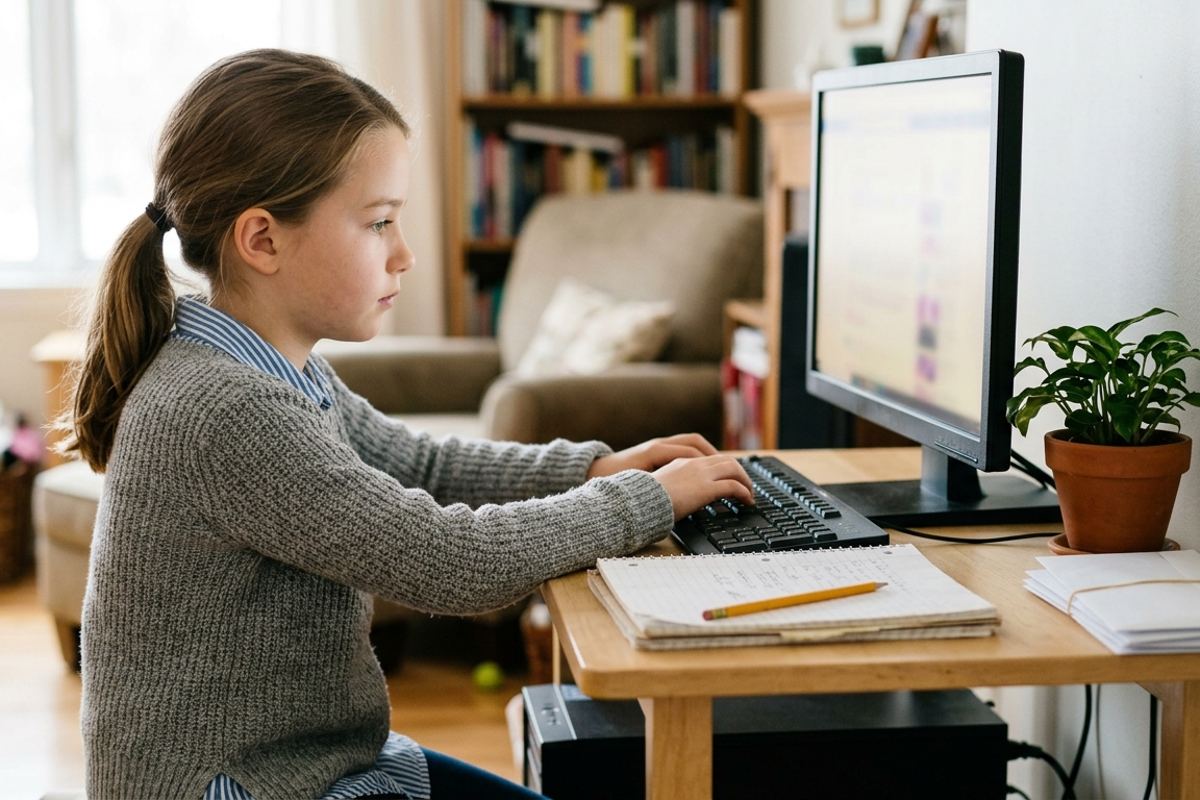
Typing is not the villain here. By upper elementary, kids often have ideas bigger than their handwriting stamina. A 4th grader may tell a hilarious story out loud and lose half of it trying to write every word by hand. Typing lets the thinking out faster, and it makes revision far less painful: moving a sentence, fixing a word, deleting the part where the character "went to the place and did the thing."
Still, typing is a skill, not magic. Plenty of kids hunt and peck for years. Formal keyboarding usually appears somewhere around 3rd grade and up, though schools vary. At home, keep it low-pressure: two hands on the keyboard, short practice, no hovering like a piano judge.
A balanced week has both. Handwrite the grocery list. Type a silly email to Grandma. Chalk spelling words on the sidewalk, write the grocery list together, or let them label the drawings on the fridge so the pencil has a job that isn't a worksheet. Draft a story on paper one day and type it the next.
For younger kids, keep handwriting in the mix because it feeds letter learning. For older kids, keep it useful, because life still has forms, labels, notes, birthday cards and math work that refuses to fit a keyboard. Then teach typing as the practical tool it is: fast, editable, and very nice when your hand is tired.


