

Your kindergartner hands you a stapled "book" from school, and there it is in proud crayon: "I lik mi dog becuz he iz fune." Your adult brain twitches. Your teacher brain, if you had one handy, would say: "Oh good. They're hearing sounds." Invented spelling looks like a bad habit forming in real time. It usually isn't. Most of the time, "becuz" is a sign your child is moving from guessing and copying into actually using the sound system of English.
What "becuz" actually shows
The myth is that invented spelling means a child is learning words wrong. The reality is more interesting: invented spelling shows your child is listening closely.
Take "becuz." That young writer heard the /b/ at the start, the "uh" in the middle, the hard /k/, and the /z/ at the end, then matched each sound to letters they know. That is not random. That is a small literacy workout happening on paper.
The grown-up spelling is a lot to hold at once. "Because" has a slippery vowel pattern and a final sound that says /z/ but uses the letter s. English is rude like that.
What "becuz" demonstrates is phonemic awareness: the ability to hear and separate the sounds inside words, and the understanding that letters stand for those sounds. Those two ideas sit underneath all of reading and writing. Before a child can spell "because" the adult way, they need to know that words can be pulled apart and built back up.
So no, "becuz" is not a spelling disaster. It's a construction site.
The stages, from scribbles to conventional spelling
Kids don't jump from random marks to perfect spelling. They move through overlapping stages, and a child might spell one word conventionally, invent another, and write "AAAAA" for a dragon roar because, honestly, that works.
Early on, writing looks like scribbles, loops and pretend cursive. That's not nothing. Your child is learning that writing carries a message; a page of loops can mean "this says I went to Grandma's." The same play with marks and letters that starts long before school is why letter play beats flashcards before kindergarten.
Next come letter-like shapes and random letter strings. "MTKP" under a picture of a cat, read back with total confidence. Print means speech now, even if the code is fuzzy.
Then beginning sounds arrive: "d" for dog, "bk" for bike. After that, kids stretch words out and catch more of what they hear: "sed" for said, "frend" for friend, "chrane" for train. This is where invented spelling shines.
Later, usually across 1st and 2nd grade, spelling turns pattern-based. Kids notice chunks: sh, th, ing, ee. They learn that "cake" has a silent e and that "jumped" refuses to sound the way it's spelled. Conventional spelling grows out of all of this. It isn't separate from invented spelling. It's the next layer.
Why fixing every word backfires right now
It is deeply tempting to correct the whole page. Your child writes one sweet sentence and your hand reaches for the pencil like it has a mind of its own.
But if every misspelled word gets fixed on the spot, your child may learn the wrong lesson. Not "spelling matters." More like "writing is where adults tell me everything I did wrong."
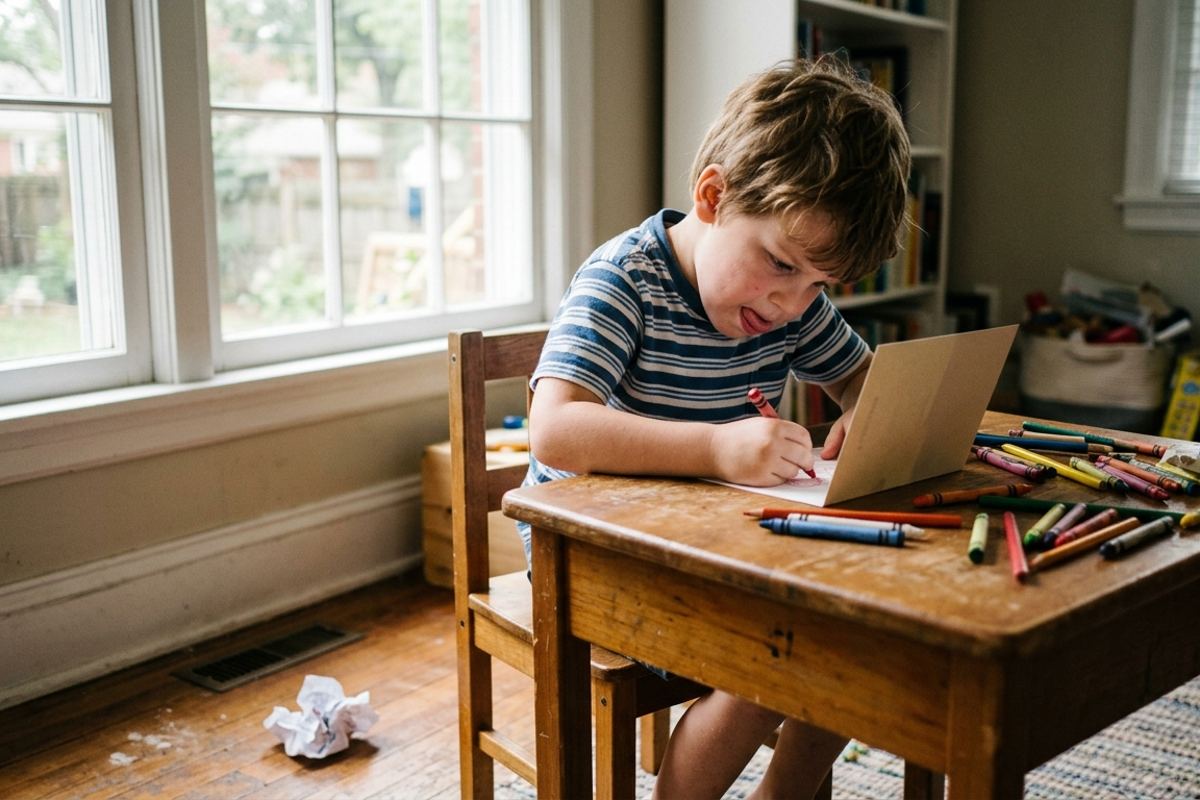
Beginning writers are juggling a lot at once. What do I want to say? What sound comes first? Which way does the b face? Do I need a space? Why is my sleeve wet? Pile corrections on top and the thinking shuts down. Some kids start writing shorter sentences so there are fewer mistakes to catch. Some ask "how do you spell..." before every single word. Some decide pictures are safer.
That doesn't mean spelling never matters. It means you choose the moment. During a first draft, especially in Pre-K through 1st grade, the goal is ideas on the page. Respond to the message first: "You wrote that the dog is funny because he sleeps on your pillow. I can picture that." Then, if your child is still with you, teach one word.
One word. "You wrote 'becuz.' That makes sense for the sounds. Grown-ups spell it b-e-c-a-u-s-e. Want me to put it on a sticky note for next time?" That small response protects both things: confidence and accuracy.
What is still worth correcting
Invented spelling is useful, but it isn't a free-for-all where spelling never counts. The trick is deciding what deserves attention today.
A good rule: correct what your child is ready to use, what they see often, and what the piece of writing is for.
- Their own name. Personal, frequent, meaningful. "Grandma" can take a while; their name should steadily move toward the standard spelling.
- Words already taught at school. If the class has worked on "the," "and," and short-a words like "cat," those are fair game.
- A final copy. A birthday card or a classroom display earns more editing than a notebook draft.
- One current pattern. If they're learning silent e, fixing "mad" to "made" in a sentence where it matters is teaching, not nitpicking.
Tone does most of the work. "Actually, that's wrong" lands differently from "you heard the sounds; this one has a pattern we have to remember."
You can also split "writer time" from "editor time." During writer time, the pencil keeps moving. During editor time, you hunt for one or two fixes together. Real authors do the same, except with more coffee and more complaining about deadlines.
How schools handle it, and when spelling starts to count
Most kindergarten and 1st grade teachers expect invented spelling, and many encourage it during journals and early stories. A child who writes "I wt to the prk" is showing the teacher a lot: an idea, several heard sounds, letter knowledge, maybe spaces, and the understanding that writing records speech.
At the same time, schools still teach conventional spelling. This is the part parents sometimes miss. Invented spelling doesn't replace phonics instruction. In a typical early elementary classroom, kids spell freely in a journal at 9:10 and practice "ship, shop, shut" at 10:30.
When does spelling start to count? It varies by school, but the usual pattern: in kindergarten and early 1st grade, the attempt matters more than accuracy. By late 1st and 2nd grade, taught words and patterns are expected to show up correctly. By 3rd grade, spelling counts in final pieces and reports, though drafts stay messy. Nobody's rough draft is a spelling bee.
If your 2nd or 3rd grader still spells almost everything phonetically, can't hold on to common words after lots of practice, or avoids writing because it feels too hard, ask the teacher what they're seeing and what practice would help. Little-and-often beats cramming here; there are lower-stakes ways to build the habit in spelling practice that isn't a Friday-night cram, and a quick round of hangman in the car keeps letters in play without a pencil at all.
A good classroom does both: it honors "becuz" as thinking, and it keeps teaching "because" until the grown-up spelling sticks.


