

The spelling list comes home Monday, rides around in the backpack all week, and somehow becomes everyone's problem Thursday night. Your child is tired. You are tired. The words are suddenly impossible, even though they looked perfectly friendly four days ago. Most weekly spelling trouble isn't really a spelling problem. It's a timing problem.
Why the Thursday-night cram doesn't stick
The classic routine is list on Monday, test on Friday. Tidy for folders and lesson plans. Less tidy for actual children with soccer practice, missing pencils, and brains that don't store spelling patterns on command.
A Thursday-night cram often works just long enough to survive Friday. That's short-term memory doing a quick tap dance. By Monday, half the words have wandered off. Spelling has to land in long-term memory, and that takes meeting the words more than once with space in between: see train on Monday, build it Tuesday, chalk it Wednesday, spell it out loud in the car Thursday. Each bump gives the brain another chance to say “oh, this one again.”
For younger elementary kids especially, spelling is part sound, part memory, part pattern, and part “wait, why is there a silent letter in there?” English keeps us humble.
Two minutes a day beats twenty on Thursday
Spaced practice sounds fancy, but at home it can be tiny. Two minutes while the pasta water heats. One word while shoes go on. Three words in the drop-off line. The goal is not to recreate school at the kitchen table every night. Please don't do that to yourself.
A rhythm that works for lots of families:
- Monday: read the list together and circle the tricky parts
- Tuesday: spell five words out loud in the car
- Wednesday: write three words on the bathroom mirror with a dry-erase marker
- Thursday: quick practice test, then redo only the misses
With ten words on the list, you don't need to drill all ten every time. Pick two. Pick the weird ones. Car rides are good because nobody sits still with a pencil: “Spell bright. Now tell me which part looks sneaky.” If your child says the gh is rude, that counts as noticing, and noticing is half the work.
One bathroom-mirror word can quietly do a lot. Write because up there on Monday and leave it. Your child sees it while brushing teeth, avoiding brushing teeth, and making foam beards. That's practice, even if no one calls it that.
Make the words physical
Some kids can stare at a word twice and own it. Many can't, and younger spellers especially need to feel the word a little. This is where things get mildly messy, which usually means you're on the right track.
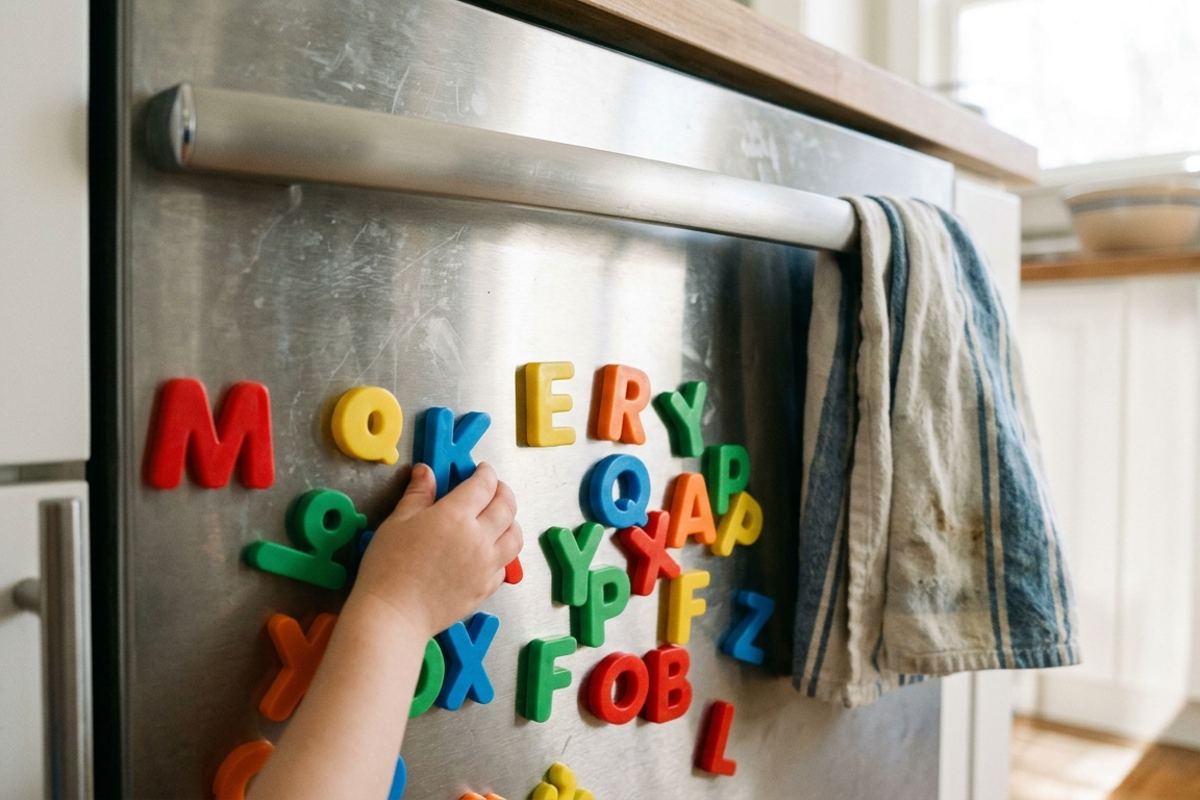
Spread shaving cream on a baking sheet and let them write words with a finger. Use magnetic letters on the dishwasher while you make dinner. Sidewalk chalk. Trace a word on your child's back and let them guess it, then switch; you will eventually spell something wrong on their back and they will be delighted.
The magnet trick has a bonus: when they build ship and physically swap the sh for ch to get chip, that one move teaches more than copying each word five times with a slowly dying pencil. And for kids who hate writing, physical practice lowers the drama. They'll refuse a worksheet but happily hop once per letter of jump on the driveway. Ridiculous? Yes. Does ridiculous stick? Also yes.
Sort the list before you drill it
Before anyone memorizes anything, hunt for the pattern. Most lists aren't random, even when they look it. One week is long a: cake, rain, play. Another is blends: stop, swim, brush. Occasionally the list is the educational equivalent of a junk drawer, but even then sorting helps.
Spend one minute asking “what do you notice?” Then group: silent-e words in one column, ai words in another, oddballs in their own corner. Make, cake, name all behave nicely. Said walks in wearing a fake mustache and causing problems. That's the word you circle. If your child can already spell cake, copying it ten times is busywork; put the time where the brain is actually confused. Sorting also shows kids that spelling has patterns at all, which makes every new word feel less like starting over. Wobbly phonetic tries along the way are fine, and honestly spellings like “becuz” are a sign of progress, not failure.
Games that do the drilling for you
A spelling game is still spelling practice, even when your child plays it upside down on the couch. Hangman with the weekly words makes kids think hard about letter order, and the paper version needs nothing but dramatic sighing. More ideas along those lines live in word games that sneak in spelling practice.
The sneakiest favorite: make your child the teacher. Hand over the list and say, “Quiz me.” Then spell a word wrong on purpose. Not every word. Just enough.
Say the word is friend and you offer “f-r-e-n-d.” Your child will pounce. “No! You forgot the i!” Beautiful. Now they're checking the word closely, hearing the sounds, and explaining the tricky part, and they're enjoying correcting an adult more than any of us should probably admit.
Keep games short. Five minutes. Stop while it's still fun, before it turns into a spelling hostage situation.
When the words never stick
Sometimes a child genuinely practices all week, sorts the words, writes them in shaving cream, and still bombs the Friday test. Week after week. That's a talk-to-the-teacher situation, and the opener can be simple: “We're practicing a little each day but the words aren't sticking. What are you seeing in class?”
The teacher may spot something useful: the pattern words are fine but sight words miss, or the words work orally but fall apart in writing, or the list is plainly too hard right now. Sometimes the fix is practical. Fewer words. Three high-use words instead of twelve that vanish after the test. Many teachers can adjust practice expectations even when the test list stays fixed.
If reading is also a struggle, or letter sounds won't stay put, mention that too. No diagnosing from the kitchen table; just bring the pattern to the teacher, and let them or the pediatrician help you decide whether more support makes sense. At home, keep it calm and small. A child who fails every Friday already feels the weight of it. Ten peaceful minutes spread across the week teach more than one tearful hour while dinner gets cold.


