

The spelling list is in the backpack, the kitchen is doing its 5:30 p.m. chaos thing, and your child has suddenly forgotten how to spell “because” even though they knew it yesterday. Straight drills can turn a decent evening into a tiny courtroom drama. Word games take the same practice and hide it under guessing, teasing, and “wait, that's not how you spell it!”
Why games work where drills don't
Spelling is repetition. That's the plain truth. Kids need to see words, say them, build them, take them apart and reassemble them before anything sticks. The problem is that “write each word five times” feels like punishment, even when nobody means it that way. Games buy you repetitions your child volunteers for: if the goal is to stump Mom or keep the word alive one more turn, suddenly they're inspecting every letter.
Games also lower the emotional temperature. A missed letter in a workbook feels like failure; a missed letter in a game is just part of the round. Laughing is allowed. Groaning is allowed. And correction comes built into the rules instead of attached to a lecture, which is much easier to swallow than “you're wrong.” If the weekly list itself is the battle, there's a companion piece on spelling practice that isn't a Friday-night cram.
Car and waiting-room games (zero materials)
Some of the best spelling practice happens when nobody has a pencil. The car line, the dentist's waiting room, the slowest checkout lane in America: all fair game.
Ghost is the classic for stronger spellers. Players take turns adding letters, building toward a real word without being the one who finishes it. S, then t, then a… add the r and you've made star, and lost the round. Soften it for younger kids by playing cooperatively: “can we build a word together that starts with st?”
I'm thinking of a word carries patterns nicely. “I'm thinking of a word that rhymes with cake and has a silent e.” Make, take, snake. Swap roles and let them give clues; they will live for the moment they catch you “accidentally” spelling snak.
Spell-it-backwards is short and silly, and it forces attention onto every letter instead of just the first sound. Start with cat and dog, work up to list words. Add-a-letter suits younger spellers: you say at, they make cat or bat; later it becomes split when blends arrive. Nobody needs to know it's phonics practice. It's just something to do until the fries arrive.
Kitchen-table classics
Old-fashioned games survive because they work, and because you can play for six minutes and quit for bath time without packing up 48 tiny cards and a spinner that rolled under the stove.
Hangman is the obvious one, whether you draw the gloomy version or a snowman instead. The trick is themed word sets: practicing long a means cake, train, play, rain; a list full of -tion words means action, station, vacation. The same idea works with a themed word list (animals, foods, Halloween) for days when you'd rather not invent the words yourself.
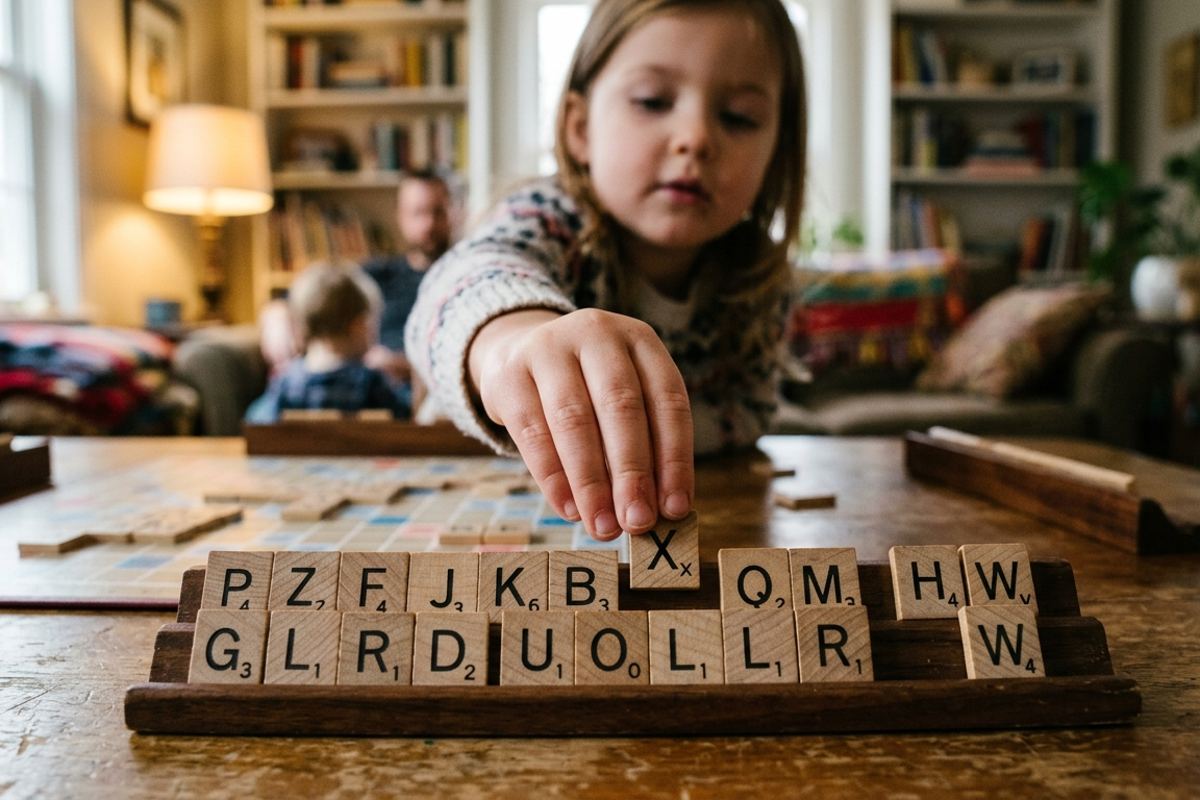
Letter tiles are a spelling gold mine. Scrabble tiles, magnetic letters, foam bath letters, the alphabet blocks from the toddler years. Hand over a pattern and ask for words: sh-words, ee-words, words ending in -ck. If they build sheap, don't pounce. Try “read that to me, does it look right?” Kids self-correct surprisingly often once they slow down and look. And the silent-e switcheroo never gets old: cap to cape, hop to hope, tub to tube. Tiny word magic.
One favorite teacher trick: let your child host. They pick the word, draw the blanks, and check YOUR spelling. Kids who become the spelling referee suddenly care deeply about correct letters. They may also become drunk with power. This is normal.
Paper-and-pencil sneaks
Some kids like paper fine, as long as it doesn't look like a worksheet. The trick is making them the creator instead of the completer.
Have your child make a word search for you: five spelling words on grid paper (or regular paper, since nobody knows where the graph paper went), written across, down or diagonally, with random letters filling the gaps. To build it, they have to spell each word correctly and check it more than once. Sneaky repetition at its finest.
Crossword-lite works too. You write the clues, they fill the words: “a yellow fruit” for banana, “the opposite of night” for day, school vocabulary for older kids. For younger children, try mystery-word boxes: draw boxes matching each letter's shape, tall for l and t, low for a and o, hanging below the line for g and y. Seeing the shape of a word helps with the tricky sight words that refuse to spell the way they sound.
Screen versions for solo practice
Some evenings you need the child happily occupied for ten minutes because the pasta is boiling over and someone just asked where their left shoe is. Screen word games earn their keep here, especially with kids who refuse paper.
Keep sessions short; ten focused minutes beats forty of random clicking after a full school day. A good game makes kids do real thinking with letters: building words rather than tapping pictures, choosing letters in order, clear correction, rounds short enough to finish before dinner. Guessing games are especially useful because they make kids test spelling possibilities. Guess chare for chair and the game pushes a rethink of the vowel team. Wordle-style guessing games do exactly this, and most kids will happily take a turn when it feels like play instead of homework.
One caution for speed demons: spelling needs eyes on the word. If your child starts guessing wildly to go fast, sit beside them for a round and ask, “check the middle, what vowel team do you see?”
Match the game to the speller
The best spelling game is just easy enough to keep your child in it. Too easy and they get goofy. Too hard and they suddenly need water, a blanket, and to tell you a long story about recess.
Kindergarten and 1st grade: stay with sounds and letters. Rhyming games, beginning-sound hunts, small word families like cat-bat-sat. Celebrate hearing the sounds even while the spelling stays wobbly. 2nd and 3rd grade is the pattern sweet spot: silent e, vowel teams, blends, -ed and -ing endings. “Is that the ai in rain or the ay in play?” is a real question kids this age enjoy. From 4th grade up, bring in roots, prefixes, homophones and wordplay: how many words hide inside transportation? Older kids love arguing about words. Use that power for good.
Whatever the age, keep wins frequent, especially for a kid who has decided spelling is “not my thing.” Three small victories beat one long game of feeling behind. And if word play regularly ends in tears even with easy words, mention it to the teacher, who can tell you which patterns the class is on and what practice would help most right now.


