

The flyer turns up three weeks early, folded into a damp accordion next to half a granola bar: no masks, no weapons, no blood. You read it once while unloading lunch containers and again after your kid announces they're going as a vampire robot ninja with a real sword.
That flyer is the small paper bridge between October magic and the actual problem, which is getting twenty-two costumed six-year-olds through the bathroom line before circle time.
What the rules are really about
They sound fussy until you've stood in a hallway with three kindergarten classes, two inflatable dinosaurs and one child who cannot see out of their mask.
No masks is about faces. Teachers need to know who is who, fast, and a kid walking toward the office should be recognizable from thirty feet. Masks also make stairs and recess harder than they need to be.
No weapons means no plastic swords, blasters, scythes or pitchforks, because they will be swung during morning meeting. Not might be. Will be.
Nothing too scary is for the younger kids sharing the hallway. A 2nd grader may love a dangling eyeball. A pre-K child headed to the bathroom does not.
And then the quiet one nobody spells out: if the costume needs an adult to unzip, unbutton or reassemble it, it's too much for a school day.
Some schools skip Halloween. Some call it a fall celebration. Some do book-character day, which is how I once met six very serious Cats in the Hat before nine in the morning. Read the flyer twice even if you've done this for years, because the rules shift by building and sometimes by principal.
The logistics nobody writes down
The flyer tells you the rules. It does not tell you where the dragon wings go during math.
First question: costume on at home, or changed at school? If the school lets kids change, assume the changing area is a classroom bathroom or a corner behind a bookshelf, with a line. Keep it simple enough that a child can do it alone.
Then label everything. The bag, the cape, the headband, the tail. You will believe no other child on earth owns that exact fuzzy orange tail. October produces twins.
- Recess shoes, not costume shoes.
- Skip full-body zip-ups if your kid needs help getting out of them.
- Send real clothes if the costume is bulky, itchy, or made of things that hate rain.
- Have them sit on the floor at home in the whole outfit. If they can't sit, it isn't a circle-time costume.
The tail that looks adorable in the kitchen drags down the hallway, collects wood chips at recess and trips the kid behind them in line. I spent a genuinely surprising portion of my teaching life saying, please carry your tail like a library book.
The parade
It lasts about fifteen minutes, takes forty to prepare for, and produces a parking lot situation that outlives us all. Usually the classes walk a loop through the building or around the blacktop while parents line the route holding phones.
Stand where your child can find you and then let go of what happens next. Some kids go into school face when they're with the class: they see you, and looking at you would break the spell, so they stare straight ahead at the back of the dinosaur in front of them. Tell the grandparents that too. Your child may wave wildly, may not wave at all, or may wave enthusiastically at a completely different family.
The child who cried at the fire drill may also cry here. Same ingredients: noise, crowding, a hallway full of adults, and a Tuesday that has stopped behaving like a Tuesday. It usually spills out later, at home, where the whole day finally falls out of them somewhere between the driveway and the snack cupboard. I also watched shy kids beam through that parade like royalty. Kids surprise you in both directions.
The kid who hates all of it
Some children do not like Halloween at school. Not needs-a-better-costume dislike. Real dislike. The seam is too itchy, the hallway is too full, the parade is too public, and the whole building smells like face paint and anticipation before a single piece of candy has been eaten.
A smaller plan isn't a failure. An orange shirt can be the costume. So can socks, or a headband that comes off after ten minutes. I taught kids who stayed in regular clothes while the rest of the room rustled around as bats, pumpkins and one memorable washing machine, and nobody's childhood suffered for it.
Ask the teacher for a job, too. Line leader, door holder, basket carrier. A kid with a task has something to do besides absorb noise, which is often the entire fix, the same way a role helps a quiet kid find a way into a new class.
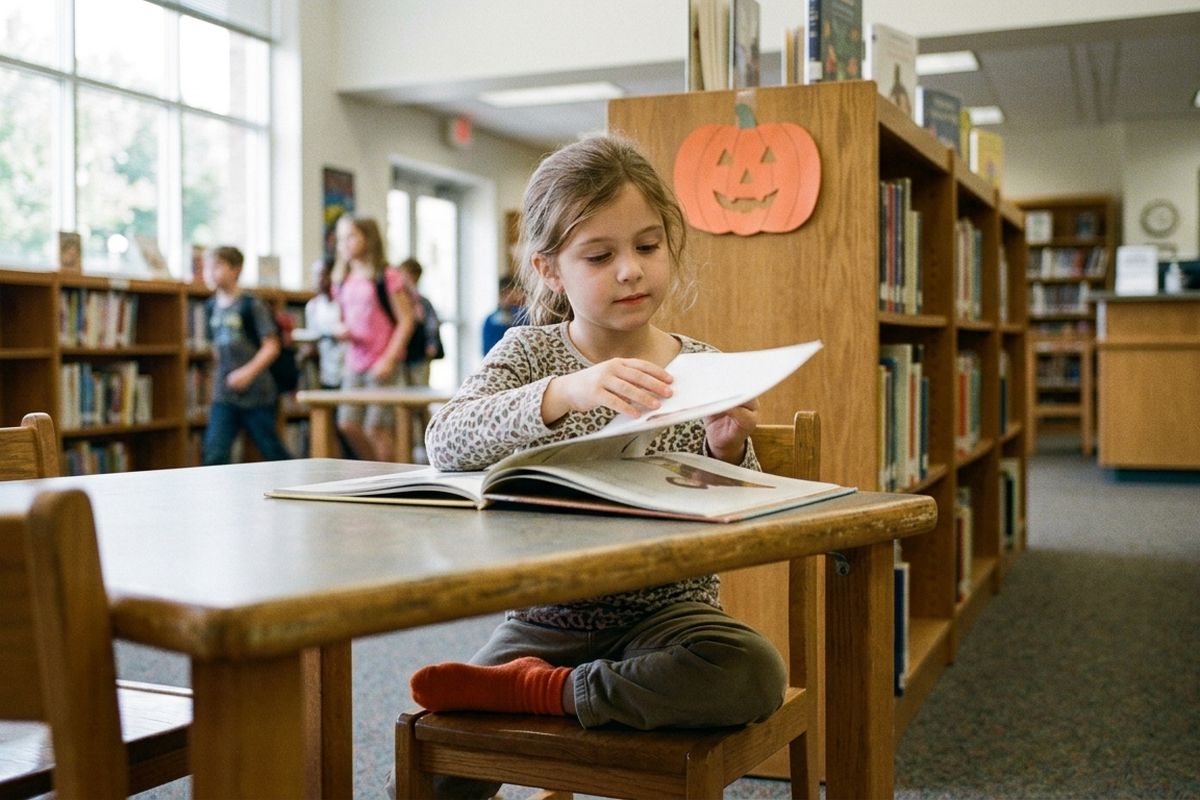
If your child really doesn't want the parade, say so in advance rather than at 8:17 in the doorway. A note is plenty: costumes and crowds are hard for him, could we have a plan if the parade is too much? The plan might be walking at the end of the line with a trusted adult, helping in the office, or sitting in the library with a stack of friendly-ghost picture books until the hallway calms down. The library was always my favorite plan B. The child comes back when it's over. No speech required.
If the reaction seems much bigger than Halloween, and clothing, noise and schedule changes are a regular struggle, mention it to the teacher or your pediatrician. No alarm. Just information.
Then there's the candy
After the parade, the teacher still has a class to teach, which is why I have real respect for anyone who has attempted phonics with children in capes. Many schools send treats home unopened or skip classroom candy entirely. The mood is fizzy anyway. Kids who ate nothing act like they ate everything, because October 31 runs its own weather system.
At home the haul becomes the event, and it happens to be sitting there in a pile on the kitchen floor, ready for math you don't have to invent. Groups of ten. Count the lollipops by twos. Tally chocolate, gummies and things nobody can identify. Line up the wrappers by color and see which row wins. Guess how many pieces are in the bag before counting, which is the same muscle as the estimation jar game and just as good for a kid's number sense.
A one-pile rule helps if sorting slides into hoarding panic: everything starts in one pile and ends in one agreed spot, a bowl or a container on the fridge. No stashes under pillows, unless you enjoy finding a melted chocolate bar in November.
Let the haul be a haul for a while. Admire it. Let them tell you which house gave full-size bars and which one handed out toothpaste. Then set whatever candy rule your family sets, calmly, without turning the night into a nutrition seminar. The day has already done plenty of talking.


