

The pencil hits the table. The shoulders go up. The homework page has three blank lines, and your child is already whispering, "I hate writing." Some kids would rather clean the garage than write four sentences about a frog. Writing is genuinely hard: it asks a child to think of an idea, hold it in memory, spell the words, form the letters, and tolerate the fact that the sentence never looks as good on paper as it sounded in their head.
\nFirst, figure out which part they hate
\n"I hate writing" can mean five different things. Before you fix anything, do a little detective work.
\nSome kids hate the hand part. Fingers get tired, letters wobble, and by the time they've written "My favorite animal is," they've forgotten the animal. Common in kindergarten through 2nd grade, and it lingers later if handwriting has always been a slog.
\nSome kids hate spelling. Big idea, but they stop every three words to ask, "How do you spell because?" That stop-start feeling turns writing into walking through mud.
\nSome kids hate choosing. Hand them a blank page and they freeze. Give them three options and suddenly they have opinions, including strong feelings about tacos.
\nAnd some kids hate being wrong. These are the ones who erase through the paper, or won't start until the first sentence is "perfect."
\nA quick test: ask for the answer out loud. If the spoken version is lively but the page stays empty, the problem is getting words down, not thinking. If talking is hard too, they need help building the idea first. And if writing regularly ends in tears, hand pain, or a huge gap between what your child can say and what they can write, mention it to the teacher. You're not being dramatic. Teachers see the whole class and can tell you whether this looks typical for the grade.
\nSeparate the hand from the ideas
\nAdults forget this because writing feels automatic to us. For kids, handwriting can swallow the whole brain.
\nSo split the jobs. Have your child say the sentence first. You write it on a sticky note, they copy it. Still writing practice, just one layer at a time.
\nOr be the secretary for a few minutes. Your child talks, you write down exactly what they say, odd grammar and all. Then read it back with a straight face: "The dragon ate the principal because he smelled like pizza." Kids love hearing their own words treated like real writing.
\nOther splits: draw first, then label three things in the picture. Dictate into a phone, then copy one sentence by hand. Type the draft, handwrite the last two sentences. And in the early grades, let spelling be inventive on first drafts; that "dragin" is actually a sign of progress, not a problem.
\nNone of this is cheating. It's how classrooms support young writers. The point is that ideas belong on the page. The hand catches up with practice, and there are good reasons handwriting still deserves that practice, but if the hand blocks the ideas every single time, writing becomes the enemy.
\n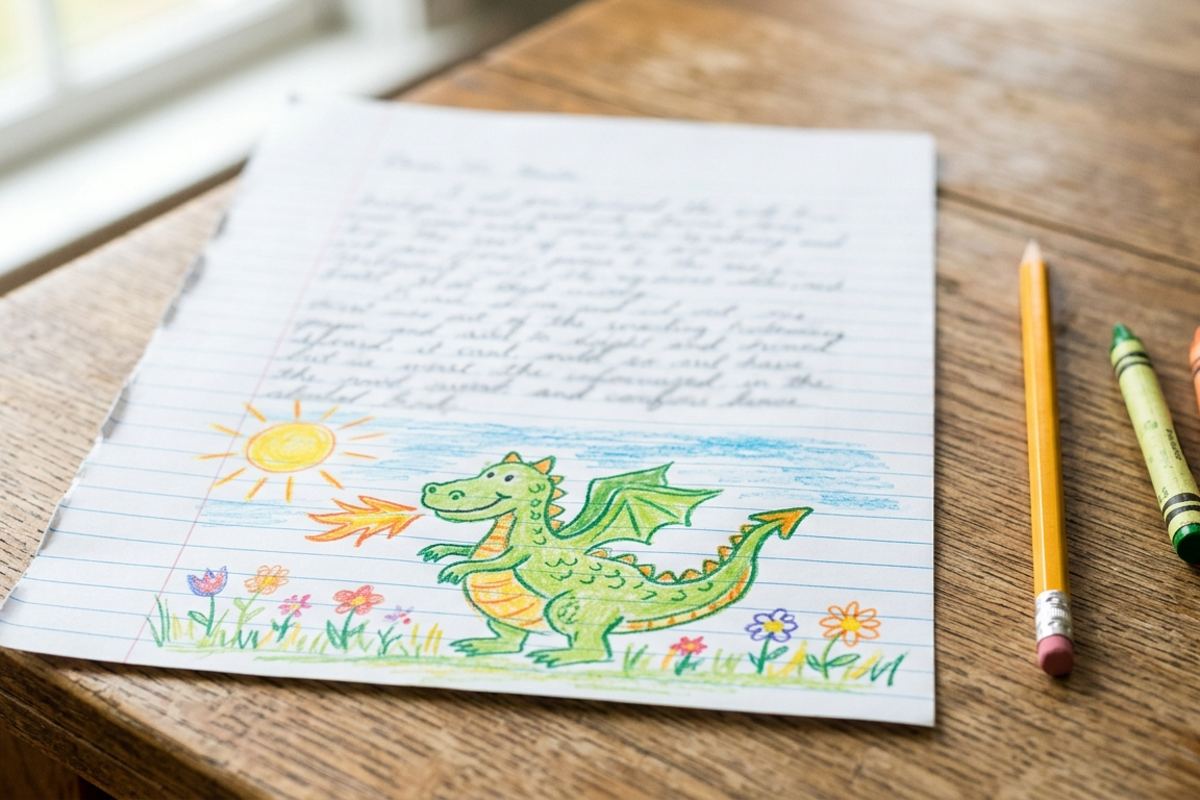 \n
\nShrink the job until it's laughable
\nA blank page is rude. It just sits there being huge.
\nWhen a child is stuck, make the task so small it feels silly. "Write one sentence" may still be too big. Try "write three words." Or "write one ugly sentence." Starting is the hardest part, so aim everything at the starting line.
\nIf the assignment says "write a paragraph about your weekend," shrink it in steps. First, a list of three things: soccer, pancakes, Grandma's dog. Pick one. Grandma's dog. Now one sentence: "Grandma's dog stole my sock." That's a beginning. A slightly ridiculous one, which is usually the best kind.
\nTimers help some kids, but keep them short. Four minutes, not twenty. "Your job is to write badly for four minutes. Spelling doesn't count. Just keep the pencil moving." Some children love official permission to be bad at something.
\nBoxes beat lines, too. Draw three boxes: beginning, middle, end. One phrase per box is enough. Later the phrases can grow into sentences. Or not, if the homework only needed a response and everyone is out of patience.
\nLaughably small isn't lowering the bar. It's building the ramp.
\nGive writing a real audience
\nKids are very good at spotting fake work. "Write five sentences about your favorite season" has a certain worksheet smell to it. Some kids will do it anyway. Others stare at the page like it personally offended them.
\nReal writing helps. A real audience can be a person, a pet, a lunchbox, or the front door: a note asking Dad to buy more cereal, a sign for a bedroom museum of rocks, a complaint letter to the tooth fairy about inflation, a menu for Friday movie night.
\nFancy can actually ruin it. A sticky note that says "DO NOT EAT MY MUFFIN" is writing with purpose. So is a grocery list where your child adds "cookies" in giant letters and hopes you won't notice. So are thank-you notes after a birthday, which are two sentences long and go to someone who will genuinely care.
\nIf your child likes games, let writing grow out of play. After a round of hangman, ask them to write one clue for a mystery word. Just one. "It is yellow and monkeys like it." That clue has an audience, because somebody has to guess it.
\nKids write more willingly when the words do something. They warn, joke, request, protest, and occasionally accuse a sibling of crimes involving couch cushions. All of it counts.
\nTopics that actually pull words out of kids
\n"Write about anything" sounds generous. For many kids it's a trapdoor. Too much choice feels like no choice.
\nOffer topics with a handle instead. Would you rather have a pet dragon the size of a cat, or a cat the size of a dragon? What's the worst pizza topping, and why is someone wrong for liking it? Invent a school rule that would make kids cheer. Write a note from the point of view of your left shoe.
\nKids who hate writing perk up when the topic lets them be funny, bossy, dramatic, or mildly disgusted. Many adults do too, honestly.
\nFor the "I don't know" kid, give sentence starters instead of more explaining: "I think ___ because ___." "The problem started when ___." "If I were in charge, I would ___."
\nPersonal topics are a gamble. "Write about your feelings" can shut a child down, especially after a long school day. A dinosaur lawyer defending a T. rex for eating the class hamster? Suddenly they have five things to say.
\nWhat not to fix in their writing
\nThis is the part that makes grown-ups twitchy: don't fix everything.
\nIf your child writes "The dragin flide over the casle and eet the king," there are about nine things you could correct. Please don't. Not all at once. When kids are still fighting to get thoughts onto paper, heavy correcting teaches them that writing is a trap. They hand you an idea, and you hand back a crime scene.
\nPick one focus. Today it's capital letters. Or one sight word. Or you leave spelling alone entirely and say, "I love the part where the dragon eats the king. Add one detail. Was the king crunchy?"
\nPraise what's actually on the page, specifically. "You started with action." "I can picture the dog stealing the sock." "This sentence sounds like you." That beats "good job" every time.
\nYes, school assignments sometimes need cleanup. Teach a tiny editing routine: read it out loud, fix one capital, fix one period, circle one word to check. That's plenty for most elementary writers.
\nIf you're scribing, keep their voice. Don't turn "The monster was so mad he exploded his pants" into "The monster felt frustrated." The first one is better. It has pants.
\nAnd when the page is finally done, resist the urge to make it prettier. A messy finished draft from a reluctant writer is not a rough draft of your parenting. It's a child getting words onto paper, which is the whole hard thing.


