

The backpack lands by the door, one shoe disappears under the couch, and you ask the question parents have asked since the dawn of lunchboxes: “How was school?” Your child, who spent six straight hours in a room full of events, feelings, pencils, smells, rules, and tiny social dramas, says, “Fine.” Then they ask for a snack.
Why “fine” is the only answer you’ll ever get
“Fine” is not always a dodge. Sometimes it is a child-sized filing system.
The school day is huge. Even in kindergarten, a child has held it together through carpet time, lining up, sharing crayons, being corrected, losing a mitten, and possibly hearing someone make a fart noise during phonics. By pickup, their brain is not ready to produce a neat little report. Some adults can barely answer “how was work?” without staring into the refrigerator first.
“How was school?” is also just too big. It asks your child to summarize a whole day, choose what matters, read your face, and turn all of it into language.
And there is one more piece. School belongs to your child in a way that feels private. You were not there. They got through it without you. That little bit of independence is healthy, even when it leaves you wildly curious about the rock in their pocket and the marker on their elbow.
So “fine” often means “I’m tired,” or “I don’t know where to start,” or “please do not make me perform feelings while I am eating cheddar crackers.”
Ask about the middle, not the whole
If you want better answers, shrink the question.
Instead of asking about “school,” ask about one slice of the day. “How was lunch?” is still wide. “Who sat near you at lunch?” is easier. “What did you do at recess?” may get “nothing,” but “what was the first thing you did when you got outside?” gives your child a starting line.
Kids answer best when the question has handles: a time (“what happened right after morning announcements?”), a place (“what was going on at your table today?”), a person (“who made your teacher laugh?”), a thing (“cubes or whiteboards in math today?”).
For younger kids, the day may not be stored in order. They might tell you about music class from Tuesday, lunch from today, and a dream from last night, all in one sentence. Normal. You can gently anchor them: “Was that today-today, or another day?”
Older elementary kids often do not want the full interview at the door. A small question while they unpack works better. “Did your class finish the seed thing in science?” feels like interest, not a press conference. If school has been feeling bumpy lately, the School Life & Milestones section has more parent-sized help than an interrogation ever will.
Questions that actually work (steal these)
The best school questions are specific, low-pressure, and a little unexpected. They ask your child to remember one moment, not judge a whole day.
A few that work in real kitchens with real children who are sticky for unknown reasons:
- “What was the weirdest thing someone said today?”
- “What did your teacher say more than once?”
- “What was easy today? What was annoying?”
- “What part of the day felt the slowest?”
- “If I had peeked in your classroom, where would you have been sitting?”
Notice these are not all sunshine questions. Kids get tired of feeling like they are supposed to say school was great. Sometimes “annoying” opens more doors than “fun.” A child who will never answer “what did you learn?” will happily tell you, “We had to redo the line because Aiden kept hopping.”
For kids who like choices, try either-or: “Better part of the day: recess or art?” And for kids who genuinely need a brain break first, give them one. Snack, shoes off, ten quiet minutes with blocks or a calm game. A short round of a card game or ten minutes of shooting hoops can be a landing pad before conversation, as long as it stays a landing pad and not the whole afternoon.
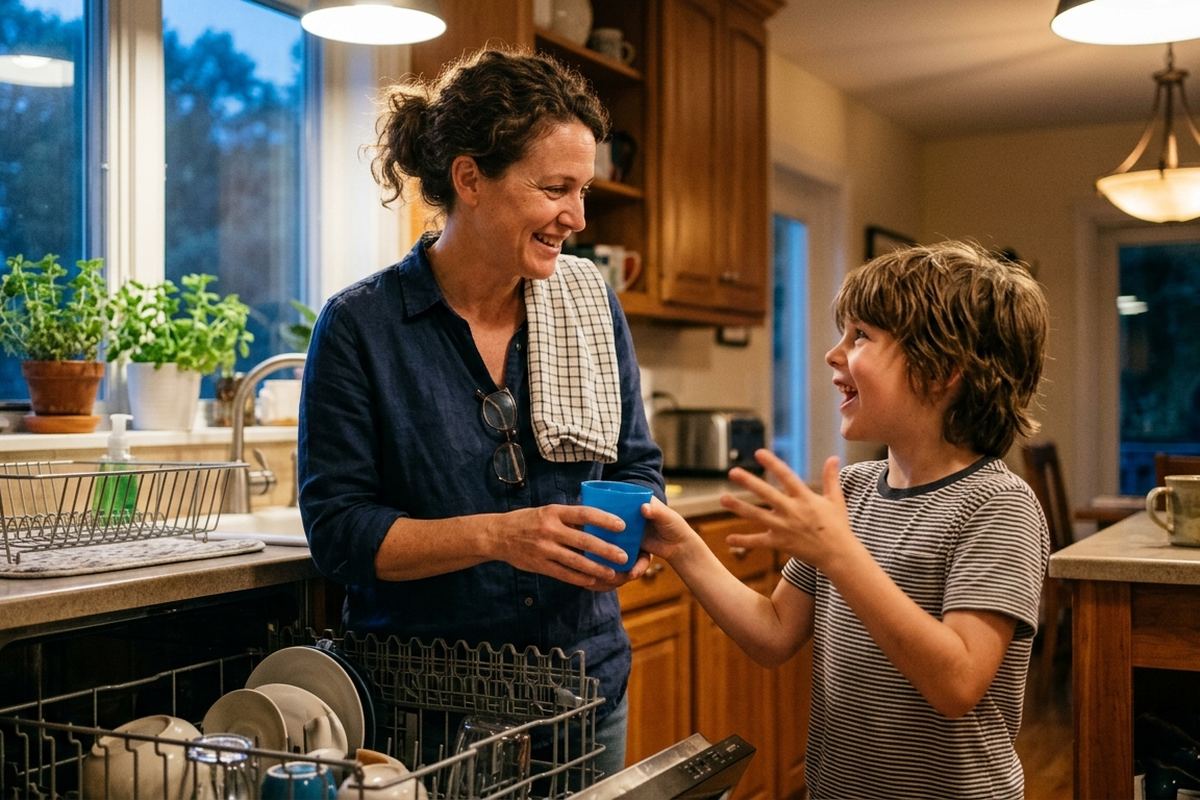
The car and the dishwasher: where kids talk
Many kids talk more when you are not looking right at them.
Face-to-face questions can feel intense, even with a gentle voice. The car works because everyone faces forward. Chores work because hands are busy. I have heard children explain entire friendship problems while sorting forks, then clam up the minute an adult says, “Tell me more about that.”
In the car, try one question and then leave room. Do not fill the silence too fast. Kids often answer on a delay, somewhere between the stop sign and the grocery store.
Bedtime needs care. Some kids become tiny philosophers at 8:43 p.m. because they love connection. Some are also very skilled bedtime attorneys. If your child suddenly has seventeen school stories after lights out, try: “I want to hear this. Give me the headline now, and we’ll talk at breakfast.” Then write one word on a sticky note: “soccer,” “Maya,” “hamster.” Otherwise you will forget, because parents are people.
Play dumb, get details
Children love correcting adults. Use this power for good.
Ask “what did you do in science?” and you might get “stuff.” Say “so today in science you probably trained a shark to read,” and your child may roll their eyes and say, “No, we planted bean seeds in wet paper towels.” Now you have something.
Playful wrong guesses work because your child is no longer producing an answer from scratch. They are fixing yours. You do not have to be hilarious. Mildly ridiculous is plenty: “Let me guess, the principal rode a scooter through the hallway.” You can also play dumb about procedures. “Wait, when you go to recess, do you just run out the window?” Kids who would never describe the recess routine will suddenly explain the line order, who holds the door, and why the big slide was closed.
For upper elementary kids, keep it less babyish. A 5th grader will not enjoy “did your teacher turn into a frog?” but might answer, “Let me guess, the group project was perfectly peaceful and nobody argued about the poster.”
One warning from the teacher side: if your child starts telling you about a conflict, resist the urge to cross-examine. “And then what happened?” is fine. “Why didn’t you tell the teacher? Who started it?” slams the door. You can come back later. And for kids who draw more than they talk, a blank page and some markers at the table sometimes let words come out sideways: “Oh, we did a picture like this in art, except mine got ripped.”
When the non-answers might mean something more
Most “fine” answers are ordinary. Some are not. You are looking for patterns, not one quiet afternoon.
Pay closer attention if the non-answers come with changes you can see: sudden tears before school from a kid who used to walk in easily, stomachaches on school mornings, a friend’s name that disappears from the daily stories, sleep or appetite changes, or homework that used to be manageable now bringing panic before the pencil is even sharpened.
In those cases, soften the questions even more. “You don’t have to tell me the whole thing. Was it a kid problem, a grown-up problem, or a work problem?” Or: “Do you want advice, help, or just someone to sit here?” Some children will talk to a stuffed animal before they talk to you. Some will only open up after you say, “I’m not mad. I’m trying to understand.”
If your gut keeps tapping you on the shoulder, send the teacher a short, calm note: “Sam has been very quiet about school and upset in the mornings this week. Are you seeing anything different in class or at recess?” Teachers cannot see everything, especially at recess and lunch, but they can watch more closely once they know. And if worries start affecting sleep, eating, or attendance, mention it to the pediatrician too. No drama. Just adults comparing notes, which is often how kids get the help they need.


