

Homework is half-finished, someone wants a snack, and the tablet is already calling from the couch. School nights turn into one long negotiation: "just five more minutes," followed by "you said ten," followed by you doing math you did not sign up for at 6:42 p.m. Most families don't need a perfect screen-time system. They need one that still works when dinner is late and somebody forgot the spelling folder.
Why the minutes-per-day fight never ends
The "30 minutes a day" rule sounds clean when you make it. It sounds less clean when one child used 12 minutes before soccer, another watched 18 while you made pasta, and now both are standing in the kitchen like tiny attorneys.
A stopwatch rule makes you the referee of every evening. You track, pause, subtract, and remember who already watched what. If you forget, your child will not. Children recall screen-time promises with the accuracy of a courtroom transcript.
The problem isn't the number. The problem is that the limit lives in your head instead of in the evening. When the rule depends on you keeping time, every interruption becomes a loophole. "But the video wasn't over." "But the game was loading." "But I paused it when I went to the bathroom." Now you're ruling on whether a bathroom break counts as screen time, which is not where anyone hoped to spend their weeknight energy.
Minutes are slippery for kids anyway. Ten minutes of a show feels too short; ten minutes waiting for a sibling feels like a century. A better school-night rule doesn't ask you to be the family timekeeper. It gives screens a predictable place in the evening.
Anchor screens to the evening, not the clock
Instead of "you get 30 minutes," try "screens happen after homework and before dinner," or "after dinner until bath starts." The window can be short or long depending on your house. The order stays the same.
Order beats duration because the evening starts to police itself. Homework runs long? The window shrinks without you delivering a speech. Practice night is packed? Screens don't fit, and that's the schedule talking, not you being mean. The next routine gives the screen an outside edge: you're not saying "time's up because I said so," you're saying "dinner is on the table." Much less exciting to argue with spaghetti.
Some families like screens before dinner because kids are fried and parents need to cook. Fair. Others avoid it because turning screens off makes everyone cranky right when the peas arrive. Also fair. The best window is the one your real evening can repeat four school nights out of five.
Not all screen time spends the same
A math game, a show you watch together, and a solo scroll are not the same thing. Kids know this, even when they pretend not to.
On a Tuesday, the good-enough line is simple: screen time that doesn't wreck the rest of the evening. If your child can stop when the window ends, come to dinner without acting like you canceled their birthday, and get through bedtime, the plan is working.
The real difference is whether the thing has an ending. One episode ends. A game with rounds ends; a race or a puzzle finishes and is done. A video feed never ends. It keeps serving one more thing, a digital snack bag with no bottom, and that's where the wheels come off for many elementary kids. A rough school-night ranking:
- Best fit: one episode, a game with rounds, a drawing app, a word or puzzle game
- Fine sometimes: a show with a parent nearby, a video chosen ahead of time
- Harder on school nights: autoplay feeds, games with live teammates waiting
- Weekends, if at all: anything that ends in yelling
This is not about making every screen educational. Kids can watch a silly cartoon and be perfectly okay. But after a long school day, pick something with edges. And co-watching changes the flavor: one show together can be cozy, while solo screen time has its place when you're handling dinner and the toddler who just colored on a sock. The goal isn't purity. It's a school night that lands safely.
The last hour before bed
If you hold only one screen boundary tightly, make it this one: screens off before the bedtime routine starts. Not five minutes before lights out. Not "you can watch while brushing teeth," which turns toothbrushing into a slow-motion documentary. Before the routine starts.
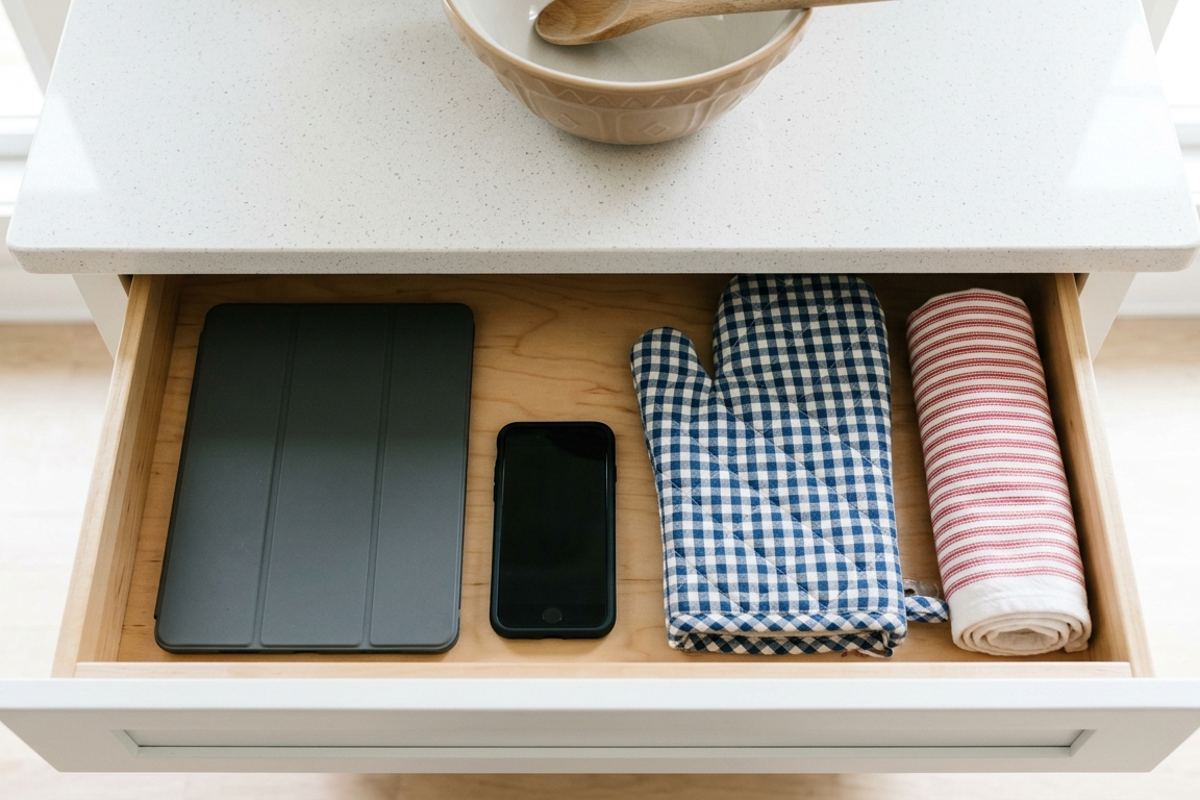
For many families that means chargers park in the kitchen after dinner. Tablets, handhelds, school laptops, all of it. The bedroom stays boring in the best possible way. This one boundary earns more than any daily limit, because it protects the part of the evening kids struggle with most: downshifting. Bedtime already has enough moving parts. Pajamas itch, the stuffed animal is missing, someone suddenly remembers a library book and a deep need to discuss volcanoes. A screen adds one more transition at the exact moment your child has the least patience left.
Skip the sleep-science lecture. Plain language works: "Screens stop before bedtime starts. Your brain needs a quieter ending." If your child is used to screens right up until bed, expect a few rough nights. Not because the rule is wrong, but because you changed the rhythm. Fill the gap with something slightly dull: bath, drawing at the table, an audiobook with blocks, or reading aloud, even to a kid who can read alone. Dull is not a failure at 8 p.m. Dull is the point.
One more tip: don't let school devices sleep in bedrooms "just for charging." Even responsible kids are still kids. If the device is two feet away, curiosity wakes up fast.
Put the rule where everyone can see it
A screen rule works better when it's not floating around in the parent brain. Put it on a card. Tape it to the fridge or the wall near the charging spot, and use the same words every night. Not a contract with subsections. Just the rule:
School-night screens. Homework and reading first. Screens during the after-dinner window. Off when pajamas start. Devices charge in the kitchen.
When the rule is visible, "you always change it" loses steam. You point to the card instead of rebuilding the whole case from scratch while stirring taco meat. It also settles things between adults: if one parent says yes, one says no, and a grandparent is visiting, the fridge card is the neutral party. Very glamorous. Very effective.
Let your child help make the card if that lowers the temperature. Marker color, a tiny tablet with a sleepy face, a checkbox for "charger parked." Don't let them negotiate the entire legal code, but a little ownership helps. If your evenings vary, write the flexible part in: "Screens happen in the screen window. Some nights the window is short." That sentence is gold. Then use the same calm phrase when the window closes: "Screen time is done. Charger spot." Not angry, not apologetic. Boring and consistent, like the lunch menu.


