

Dinner is half-started and somebody just groaned at the sight of a math worksheet. Fair. After a full school day, "do ten more problems" can feel like being handed a tiny gray cloud. A board game, though, can sneak in the same practice while your child is busy hoping you land on the bad square.
Why a board game beats a worksheet on a Tuesday night
Worksheets have their place. Teachers use them because they're neat, quick to check, and easy to send home in a folder that already contains one permission slip and a mysterious leaf.
But games do something worksheets usually don't: they make repetition feel like it matters. When your child rolls a die, counts spaces, compares cards, or pays rent, they're doing math with a reason attached. They want to move ahead. They want you to draw the terrible card that sends you backward. That little bit of emotional investment changes the work.
In a simple board game, a kindergartner might count spaces 40 times without anyone calling it practice. A 2nd grader adds dice over and over. A 4th grader keeps score, trades money, and quietly learns that a risky move is probably not worth it. The math is tucked inside turns, rules, and mild family drama.
When you do want a screen version, the math games hub covers the same ground, but a physical board brings in touch, waiting, turn-taking, and the satisfying clatter of dice across the table. More on when each format earns its keep in math games vs. worksheets.
The counting-and-moving classics
The Chutes and Ladders tier is easy to underestimate. Adults look at the board and think, well, it's just spinning and moving. For young kids, that's plenty.
These games build one-to-one correspondence: each number said matches one space moved. That sounds simple until you watch a 4-year-old say "one, two, three, four, five" while their game piece gallops seven spaces ahead like it has somewhere to be.
A board that runs to 100 also gives kids repeated exposure to bigger numbers without turning into a lesson. They start noticing that 47 comes before 48 and that the rows follow a pattern.
There's a nice moment to watch for. Early on, a child who rolls a 7 counts every space out loud. Months later they move in chunks, or know that from 23, seven more lands near 30. That is math growth. It does not need a speech from us.
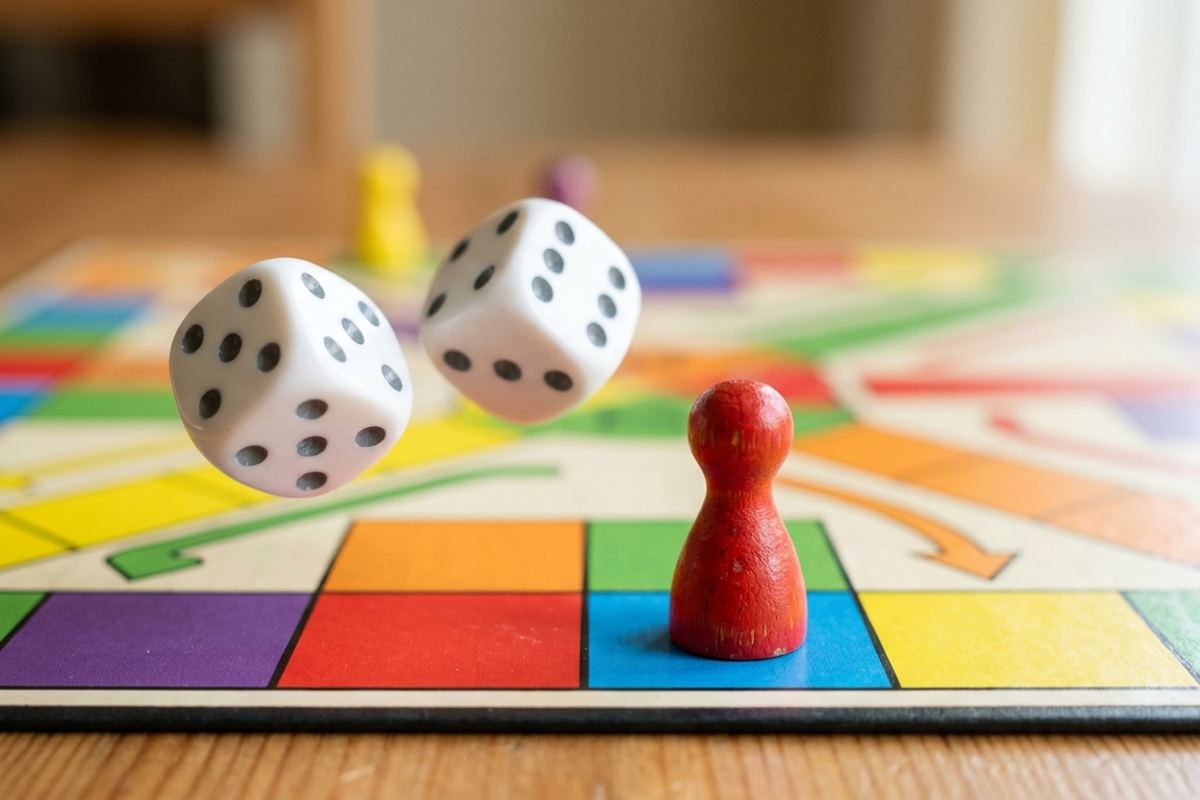
Dice games: instant addition practice
A pair of dice is one of the cheapest math tools you own. Dice in the junk drawer are addition practice. Dice in the glove box are a portable math kit for restaurant waits, soccer siblings, and the car line that refuses to move.
Young kids start by counting every dot. Then they begin recognizing the dot patterns without counting, which teachers call subitizing. Your child sees five dots and just knows. Once one die is easy, roll two. At first they'll count all the dots; later they'll start from the bigger number and count on: "Six... seven, eight, nine." That's a real step up in thinking.
Tiny games that need zero setup:
- Roll two dice. Highest total wins the round.
- Race to be first to say the sum.
- Roll two and subtract the smaller from the bigger.
- Roll three dice for an older kid and add all of them.
For older elementary kids, Yahtzee-style scoring adds another layer: grouping numbers, multiplying small amounts, deciding which box to use. That's strategy wearing a math hat.
Money and trading games
Money games teach math with feelings attached. That's why they stick.
In a Monopoly Junior kind of game, your child counts bills, buys properties, pays other players, and notices that money disappears when you spend it. The first time a kid runs out of cash and can't buy the thing they wanted, you can practically see the budgeting lesson land.
Younger kids match bills or count by ones. Then come fives, tens, and simple change: "You owe me $3 but gave me $5, so I give you $2 back" is a real math problem, and much more interesting when your child is collecting rent from Grandpa.
Trading games add the idea of value. Is two small things worth one bigger thing? Spend now or save? Kids don't always choose carefully. Sometimes they spend every dollar immediately and look deeply betrayed when the next turn costs money. Better to learn that with pretend cash than at the snack bar at the bowling alley.
For 2nd through 4th grade, money games quietly support skip counting, subtraction, and mental math. They also build patience, because making change takes a minute. Especially when the banker is 7 and has strong opinions.
Card games you already own
A plain deck of cards looks too simple to be useful. It isn't. A $2 deck covers math practice from kindergarten through 4th grade and fits in the drawer with the birthday candles and dead batteries.
War is the easiest start. Each player flips a card, bigger number wins. That's comparing numbers, which matters more than it looks: greater than, less than, and equal, without a single symbol on a page.
Once that's easy, change the rules. Two-card war: flip two, add them, higher sum wins. Subtraction war: smaller from bigger. Multiplication war for 3rd and 4th grade fact practice. Or Make 10: find pairs that add to ten, like 6 and 4. Aces can be 1. Jokers can live in the box unless your family enjoys chaos.
Even quick games of tic-tac-toe train planning-ahead thinking, and the paper version costs nothing but the back of an envelope.
Getting game night to actually happen
Family game night sounds charming until real life walks in wearing cleats and asking what's for dinner. You don't need a full evening or matching snacks. Ten minutes counts.
A short game after dinner beats a big weekend plan that never happens. One round of addition war. Half a board game. A dice race to 50. If your child begs to keep going, lovely. If not, you still got math into the day without anyone sharpening a pencil.
Leaving a game set up on a side table helps too. Kids play more when the board is already out and the pieces aren't buried under three puzzle boxes. Just watch out for the cat, who believes all pawns belong on the floor.
About winning: let your child win sometimes, but not always. Kids need the joy of success and the practice of losing without flipping the board. You can also think out loud while you play: "Hmm, I could buy this, but then I'll only have $2 left." That gives them a peek at real decision-making. If your child miscounts, "check that move one more time" works better than turning the table into a mini classroom. The goal is for math to feel useful and ordinary, right there between the spaghetti plates and the missing dice.


