

The library can turn a calm child into a small person with enormous opinions. One minute they're hugging a 400-page fantasy novel with print the size of sesame seeds, the next they've got a board book they adored back when they still put their shoes on the wrong feet. I stood next to that shelf with a lot of young readers, watching the same hopeful face announce "I can read this" while the book quietly reserved judgment.
The five-finger rule, and where it breaks
The rule is simple enough to run right there in the aisle. Your child opens to a full page, starts reading, and puts up a finger for every word they don't know. Zero or one, easy. Two or three, about right. Four or five, probably too hard to read alone.
As a quick check it earns its place. It stopped a few of my students from choosing books purely by cover shine, which is a genuine force in early childhood. If the dragon has glittery wings, all bets are off.
But it's rough, and it falls apart fastest on nonfiction. A 2nd grader can trip over megalodon, photosynthesis and Galápagos and still understand the page completely once you say the words together. It also breaks on desire. Some kids will bulldoze through four fingers because the subject matters to them. Others hit four and quit before the story got a chance.
Treat it as a weather report rather than a verdict. Conditions look sunny, breezy, a bit stormy. It doesn't decide whether anyone goes outside. And if the letters and numbers coming home from school are adding to the confusion, reading levels in plain parent language helps keep those labels in proportion.
Interest beats level most of the time
A kid who groans through one page of assigned reading can turn into a small determined scholar the moment the book involves sharks, tornadoes, soccer, baby animals, or a villain with a cape and poor judgment.
Interest buys effort. It does not make the book easier. The words still have to be decoded and the sentences still have to be held in a head that is also thinking about snacks. What motivation buys you is the second attempt at a hard paragraph, and the question "what does this word mean" instead of a slow slide off the couch like melted butter.
I watched this constantly in the reading corner. The child who dodged most books would sit for twenty minutes with a bug book that was technically too hard, because they needed, urgently, to find out which beetle sprays the stink.
When a high-interest book is above level, change the job rather than the book. They read the captions, you read the main text. They read one page, you read the next two. Or they flip through first and pick three pages worth fighting for. That still counts as reading, and for a kid who resists in general it is usually the first door I'd try, along with the other ways into reading for a reluctant reader.
The "too easy" book is doing something
Parents confess this one at the library in a whisper, like sneaking cookies before dinner. They picked something too easy.
I understand the worry. Your 3rd grader comes back with one sentence per page and you can picture the reading muscles deflating. Easy books are not empty calories, though. Easy reading is how fluency gets built: smooth, expressive reading that doesn't burn every ounce of brainpower on decoding. It's the difference between "The. Dog. Ran. Down. The. Hill." and a kid reading it like it happened.
They build confidence too. Some children spend the entire school day being stretched, and a book they can read without sweating is a genuine rest. Adults do exactly the same thing. Not many of us end the day with a dense biography and a sharpened pencil.
Rereading counts as well. The fourth trip through the same Mercy Watson or Frog and Toad is practice in pacing, expression and story shape, and you'll hear them land the joke before it arrives. I'd only start paying attention if a child never chooses anything with a little stretch in it, and even then I wouldn't take the easy book away. I'd put one more book next to it.
Let them take the graphic novel
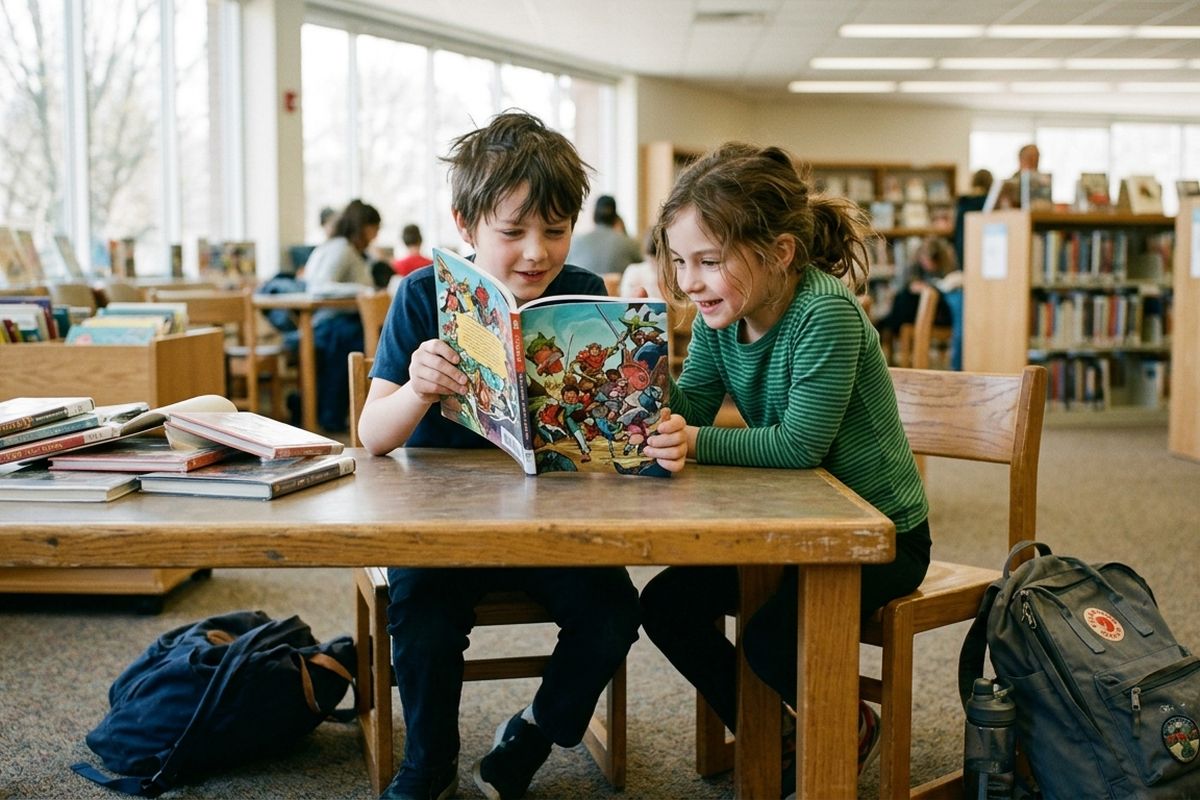
Graphic novels make some adults twitchy because the pages look busy and the pictures are clearly doing some of the work. In the classroom I watched them get kids reading longer, talking more about what they read, and finishing thicker books than they otherwise would.
The reading is real. Following dialogue, tracking who is speaking, reading faces, moving through panels in the right order, filling in what happened between one picture and the next. That last one is inference, which is the skill teachers spend years coaxing out of kids. Also, if a child is voluntarily sitting on a library floor reading, I am not rushing over to lecture them about it.
Where graphic novels can go thin is range. One series, one difficulty, for six months, and a nudge is fair. Not a ban, a nudge, and not at the checkout desk in front of everybody. "You can definitely get that one. Let's find one other thing too, chapters or facts or poems, your call." One other book. Not five, not an improvement plan with a clipboard. For the relative who asks whether that's really reading, why graphic novels count will save you a few deep breaths at Thanksgiving.
A library routine that survives Saturday
A routine that only works on a calm Tuesday isn't a family routine, it's a fantasy. This one holds up when everyone is a little hungry, a toddler is howling by the train table, and the tote bag is at home on the counter:
- Three books are your child's pick, no editorial comment
- One book is yours
- Twenty minutes of browsing, then checkout
- One real question for the librarian before you wander off
Three-and-one keeps ownership where it belongs. Your child gets the funny, the strange, the faintly ridiculous. You get to slide in one book that stretches a little or connects to something they're doing at school.
The twenty-minute cap exists because endless browsing turns into decision soup. Too many covers, too many choices, and some kids stop choosing and start flopping. Say it kindly and set it out loud: twenty minutes to pick, then we check out. That's mercy with a deadline.
The librarian question beats wandering because librarians know those shelves the way a kindergarten teacher knows who is about to knock over the paint water. Give them something to work with. "She likes funny animal books and can read a few pages on her own, what would you suggest?" Or, "he loved this series and wants something a bit harder." If your child is getting their own card for the first time, a little planning makes the visit feel like an occasion, and the first library card visit is worth doing properly.
One last thing, learned the hard way: check out more books than you think you need. Some will be duds, one will sit untouched, one will surface under the couch three weeks later wearing cracker crumbs. Picking the perfect book was never the goal. Keeping enough books within arm's reach that reading has a fair chance of breaking out is.


