

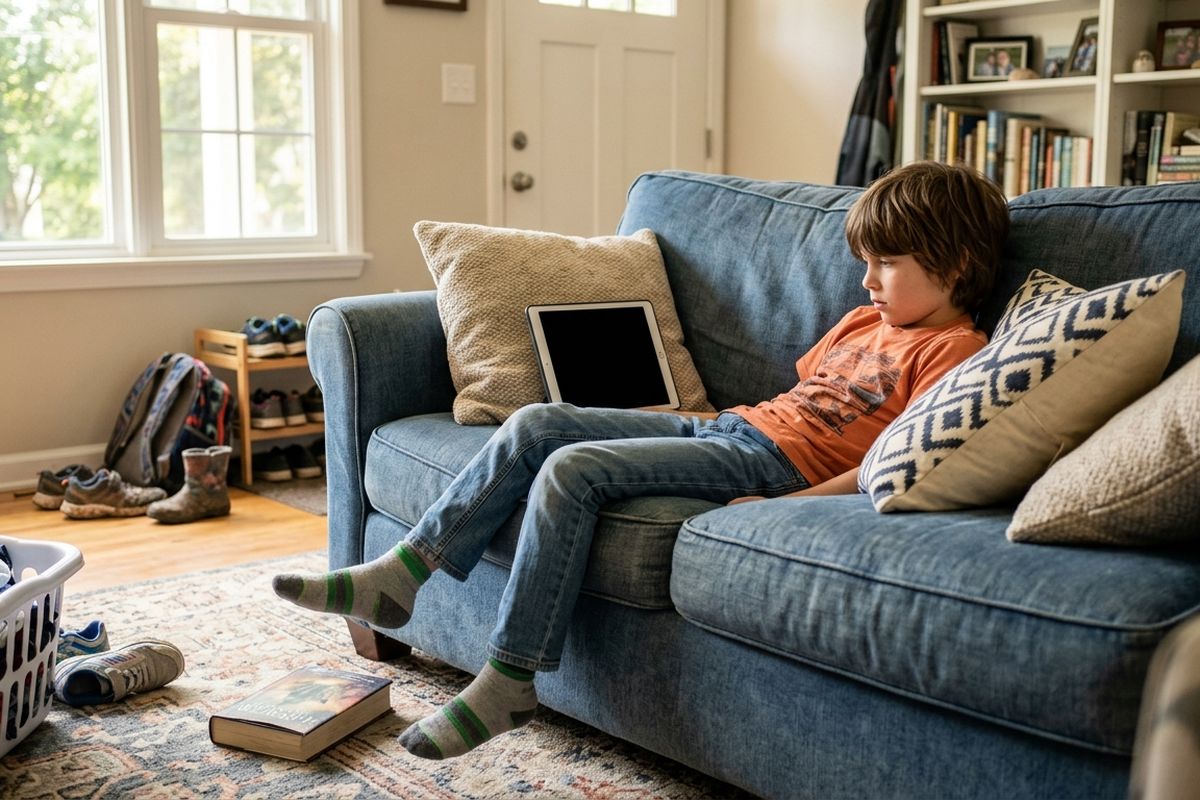
A kid is sprawled sideways on the couch, one sock half off, tablet propped against a pillow, allegedly reading. You're standing there with a laundry basket trying to work out whether this counts as reading or whether you've been outmaneuvered by a nine-year-old with excellent loophole instincts.
At my kitchen table this has never been a philosophical question. It's 7:42 and somebody still has to brush their teeth.
The finding everyone cites, and what it actually says
The headline version goes: kids understand more when they read on paper.
The real version is drier, which is usually how you know it's closer to true. Across a lot of research, paper tends to come out somewhat ahead when readers tackle longer, denser text they have to think about. A science chapter. A social studies article. Three paragraphs on erosion and one diagram that makes everybody sad.
The gap isn't huge, though. It shows up more with informational text than with easy story reading, more when there's time pressure, and it mostly fades with a regular story a kid can sink into.
Two explanations hold up. People read faster on screens, and faster isn't better: readers skim, hop around, and come away convinced they got more than they did. I have confidently answered an email and then found the one sentence I skipped was the entire point. The other is that a paper book gives your brain a map. You feel where you are, left side, near the bottom, about two-thirds through. A screen flattens that, and some readers lose the sense of where they are in the thing.
What the research does not say is that screens damage reading, or that a child on a tablet is doing something harmful. The honest phrasing is boring: paper tends to help somewhat, for longer and harder reading. Anyone handing you a tidy percentage is selling something.
The real variable is the device, not the pixels
An e-reader with notifications off behaves almost exactly like paper. It holds books, it turns pages, and it doesn't wink at your child from the corner of the screen every eleven seconds.
A tablet is a different animal. It's a machine with a book on it, plus messages, videos, a camera, a browser and several things sitting there looking innocent. The pixels were never the problem. The interruptions are. A notification mid-chapter costs more than the format ever will; your kid technically returns to the page, but the brain already took a side trip.
Same goes for the reading apps that stop every two pages to clap. Badges, sound effects, a quick three-question check, a streak that must be defended. Slice a story into enough trackable pieces and a child never gets to sit with one whole thought. Reading needs some quiet. Not monastery quiet. Just nobody-is-poking-me quiet.
So: do-not-disturb on, badges off where you can turn them off, airplane mode for downloaded books, and if you have the option, a device that only does books. That one change settles most of the paper-versus-screen argument before it starts.
Audiobooks are a different question with a better answer
Listening isn't cheating. I know this one makes people twitchy, and there's a whole separate argument about whether audiobooks count, but the short answer is yes, with one asterisk.
Once decoding isn't the bottleneck, understanding a book by ear looks a lot like understanding one by eye. A kid following a chapter book while you drive is building vocabulary, hearing how sentences are put together, and learning how a long story works: how chapters end, how a character changes, how a book can be worth staying with for more than eight minutes. For stamina it's genuinely useful. A child who can't yet read a long series independently can still live inside one.
The asterisk: listening gives no decoding practice and does nothing for recognizing words on sight. A kid still learning to read needs eyes on print too.
The best combination is unglamorous. Audiobook in the car, same book in paper at home. The car is where this actually happens in most families, because everybody is trapped and the snacks are already packed. A long series beats one impressive title nobody wants to hear, and I say that as a person who has spent real highway miles with the same four characters.
What the format debate hides
A kid who reads forty minutes a day on a tablet is in better shape than a kid who reads five minutes a day on paper. That comparison isn't close, and we can get precious enough about format to miss it entirely. Reading gets easier by reading more. Vocabulary comes from meeting the same word for the fifth time. Stamina comes from staying on the page past the first bored sigh.
Screens make some books reachable, too. A library hold that arrives at 9 p.m., which is exactly when somebody announces they've finished their book and has nothing to read. Text size you can crank up for a child who finds dense pages exhausting. Wider spacing and dyslexia-friendly fonts, which some kids read noticeably faster. If print is a consistent struggle, ask the teacher a practical question rather than a diagnostic one: are there formats that seem easier for my kid?
Kids also read a lot of short screen text. Captions, comments, sports updates, a wiki about one very specific deep-sea fish. That's reading. It's just not the kind that builds stamina for a chapter that asks you to hold three ideas at once, which is the same reason the does-it-count argument about graphic novels usually lands in the wrong place.
Paper still wins a few things that have nothing to do with comprehension. It doesn't need charging. It doesn't get confiscated because somebody was sneaky with the tablet. And it's visible to a kid who forgot it existed, which is underrated. At my house, the paperback physically blocking the lamp gets read. The digital title three taps deep does not.
House rules that survive a Tuesday
The perfect screen rule is easy to write at 10 a.m. with coffee. The test is Tuesday night, when dinner ran late and the backpack has produced a permission slip you've never seen and somebody still owes twenty minutes of reading.
School reading on paper when you have the choice, especially the long informational stuff with questions attached. If the assignment only exists online, fine, kill the noise and move on. Free reading in whatever format actually gets read. If a kid has finally found a series they'll inhale, I'm not going to stand in the doorway lecturing about the merits of cellulose.
One rule needs teeth: airplane mode, or notifications off. Not "try to ignore them." Off. A buzzing rectangle next to a 4th grader is not a fair fight. The rest of the household limits can stay blunt rather than becoming a nineteen-part treaty, which is roughly how school-night screen rules survive contact with a real week.
Bedtime gets its own rule. Paper or e-ink, and the tablet charges in the kitchen. Partly the light. Mostly the fact that a tablet in a dark bedroom turns into something else by 9:15, and I didn't need a research review for that. I have a hallway and ears.
Whatever the format, ask the same question afterward. What happened in the part you read? If the answer is thin, the format is probably the least of it: they're tired, the book is too hard, or they're fake-reading with the confidence of a small attorney. That last one has its own tell and its own fix.
And keep physical books where people trip over them. Not styled in a basket for a photo. A paperback on the counter next to the bananas everyone is pretending not to notice.


