
The page is blank, the pencil has been sharpened four times, and your child has developed an urgent concern about the exact angle of the eraser. Somewhere in the kitchen a parent is saying "just write something," which is fair, because dinner isn't going to cook itself. I saw that face at the writing center most mornings: chin in hand, paper untouched, every idea apparently gone forever.
Why "write about your weekend" freezes kids
That prompt sounds friendly to adults. Open, personal, easy.
To a 1st or 2nd grader it's an invisible four-part project. Remember the weekend. Pick one part of it. Decide what order things happened in. Spell "restaurant." By step three the pencil has rolled under the table and somebody needs a small break.
It also quietly assumes the weekend contained something report-worthy. Plenty of weekends are laundry, the grocery store, a cousin's birthday party where the pizza was fine, and forty minutes of looking for one shoe. A kid decides nothing happened, because nothing happened that sounds like a story.
In my classroom, "tell me about your weekend" produced one of two things: a full-page account of a trip to the store, or absolute silence. One little boy wrote about his cat every Monday for most of a year. The cat sat. The cat ate. The cat looked at him mean. The cat had more range than you'd think, but that's what happens when a child finds the one safe idea they can reach and holds onto it.
Writing asks for several hard things at once. If handwriting or spelling or getting thoughts in order is already effortful, a big memory prompt lands like a laundry basket full of unmatched socks.
Prompts that aren't "my weekend"
Small prompts work better because they put a fence around the idea, and the fence is a kindness. It says: stay in here, you don't have to tell your whole life.
Odd and specific beats broad and personal. "The worst smell at school" is far easier than "write about school," because a child can immediately picture the cafeteria trash can, the wet mittens, that hallway smell nobody wants to identify. Now there's somewhere to start.
- The worst smell at school
- What your shoe saw today
- A rule you would make for cats
- Three things in the fridge, and which one is the villain
- Something you would change about the bathroom
I would rather read "the yogurt is the villain because it hides in the back and gets old" than a tidy sentence about having a nice weekend. There's a person in the yogurt villain.
Opinion prompts do similar work, because nobody has to remember events in order. They just have to decide. Which is worse, a wet sock or a mushy apple? Should dessert come first on Fridays? For a child who freezes when asked to recall, an opinion is a relief: they already own it, along with strong feelings about the cafeteria carrots.
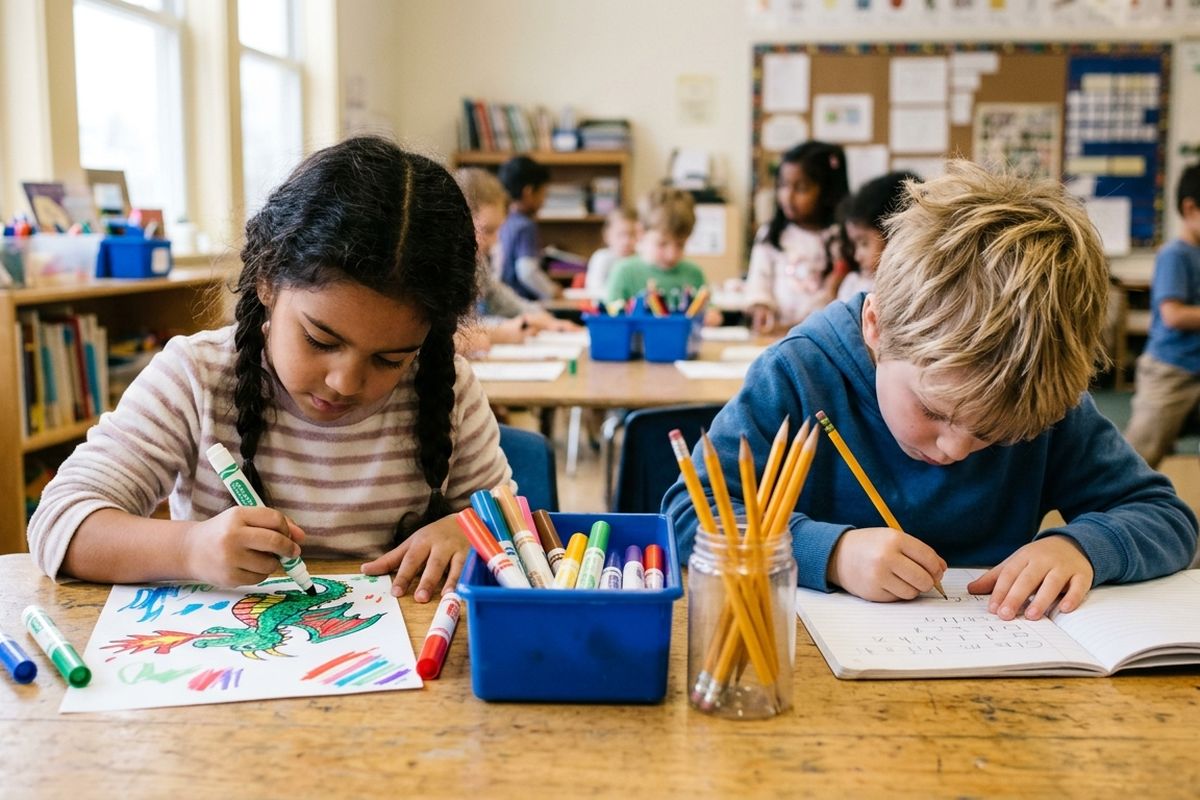
Lists count. Drawing counts.
Some kids hear "journal" and picture a neat paragraph with the date at the top. That's one kind. It isn't the only kind.
A list of ten animals that should never be allowed in the principal's office is writing. A labeled drawing of a bedroom with "sock pile" and "monster maybe" is writing. A comic strip with speech bubbles is writing. A page titled "things I hate about peas," numbered one through six, is writing, even if number four is just "green."
At the writing center, the drawing came first almost every time. A dragon, a bus, a house with fourteen windows, a person whose arms grew directly out of his head. Then I'd crouch at the table and ask about one part of it, and the sentence would follow. The picture holds the idea still long enough for words to catch up, which is the same thing that happens later when kids learn the invisible steps behind writing a paragraph.
If your kid wants to draw first, let them draw first. Then: draw the moment, and write one thing somebody said. Speech bubbles are a gift for reluctant writers, short and naturally funny. A dog says "no bath." A shoe says "I saw gum." That counts.
The two-sentence journal is the other small thing that works. One thing that happened, one feeling or opinion about it. "I spilled cereal on the floor. It looked like a tiny crunchy beach." Done. Keeping the bar that low is what lets the habit survive; two sentences four days a week beats one dramatic Saturday that ends with somebody crying over a full page, and that's true for most of the kids who say they hate writing in the first place.
Don't correct the spelling in a journal
A journal is for getting ideas out. It is not the place for the red pen.
Spelling has its own homes: spelling practice, word study, the quick "let's learn this one" moment while you're making lunches. A journal needs more air than that. If every attempt gets corrected, a lot of kids learn a different lesson than the one intended, which is that writing means being wrong where people can see.
Invented spelling is normal well into 2nd grade. "Frend." "Becuz." "I likt the prk." It usually means a child is listening hard to sounds and trying to get them down, which is real progress even though it looks like a mess.
If you can't read something, ask like you're curious instead of checking. "Can you read me this part?" or "I need to know what this says, the drawing is killing me." Let your child be the expert on their own page.
When you do respond, write back like a pen pal instead of a teacher. A line in the margin is plenty. I would also be scared of a talking lunchbox. Poor shoe. Gum is a terrible ending. Now I have to know what the cat did next. A question keeps it going without turning the notebook into an assignment; circling "yogurt" and writing it correctly above does the opposite, and usually closes the notebook.
There's a point where it's worth raising it with the teacher instead: when the frustration looks bigger than ordinary reluctance, or when handwriting, spelling or reading seems unusually hard next to what you see from classmates. Most teachers would much rather hear it early. The everyday journal, though, stays protected. It's where ideas get to come in with muddy shoes.
Making it a habit without the battle
The habit survives when it's tiny and predictable. Five minutes after snack. Five minutes before bed with a clip-on light. Five minutes while you drink your coffee and pretend not to hear someone humming the same two notes.
Same time each day means less negotiating. Short means it doesn't look like a mountain. Set a timer and stop when it rings, mid-sentence if that's where you are. Stopping while it still feels doable beats stretching it until the notebook becomes the enemy.
Let your child pick the notebook. Spiral, composition book, a tiny pad with a fox on it, plain paper stapled down one side. Ownership does more than the paper quality does. Pencils matter less, unless your child holds strong pencil opinions, which many do. I once taught a boy who could only write with the fast pencil. It was an ordinary yellow pencil. We respected the fast pencil.
For the first week or two, write alongside them, and keep yours deliberately boring. "I forgot my water bottle. It was in my bag and then somehow not in my bag." Kids need to see that grown-up writing isn't always fancy; a lot of it is just noticing something.
When they say they've got nothing, offer two prompts and then stop talking. Shoe, or fridge villains? Once they pick, walk away and fold towels nearby. Available, not hovering like an editor with snacks. And when the journal is an actual school assignment, your job is smaller than it feels: help pick the prompt, check how much is expected, then leave the sentences alone.


