

The first division lesson at your kitchen table usually starts with someone yelling, "Hey, they got more than me!" Maybe it is goldfish crackers. Maybe it is strawberries. Maybe it is the last three dinosaur nuggets and a child with courtroom-level confidence. Before division ever shows up on a worksheet, it shows up as fairness, and kids feel fairness in their bones long before they can write 12 ÷ 3 = 4.
Your kid already divides (ask the snack fairness police)
If you have ever handed out cookies to a group of kids, you have seen early division in action. Children may not say "quotient," bless them, but they notice when one plate has four grapes and another has three. They notice fast.
That instinct is the beginning of division: taking a whole amount and making fair groups. Little kids police sameness constantly. "I need one too." "She has bigger." "Why does his pancake have more chocolate chips?" It can be exhausting. It is also math. They are comparing amounts, matching one to one, and checking whether the groups came out even.
You can use that fairness radar without turning snack into school. "Let's make it fair: one for you, one for me, one for Dad." Or, "We have 8 apple slices and 2 plates. How do we share them?" No pencil, no division sign, just the problem your child already cares about deeply: nobody gets shorted on apples.
Dealing cards, splitting pizza: division you can touch
Division makes sense when kids can move the pieces. A deck of cards teaches more than a page of problems at first. Take 12 cards and 3 people. Deal them out one at a time: one for you, one for your child, one for the stuffed bear who has somehow been invited to math. When the cards are gone, count the piles. "Everyone got 4. So 12 shared by 3 people is 4 each."
That is division. Nobody wrote anything down.
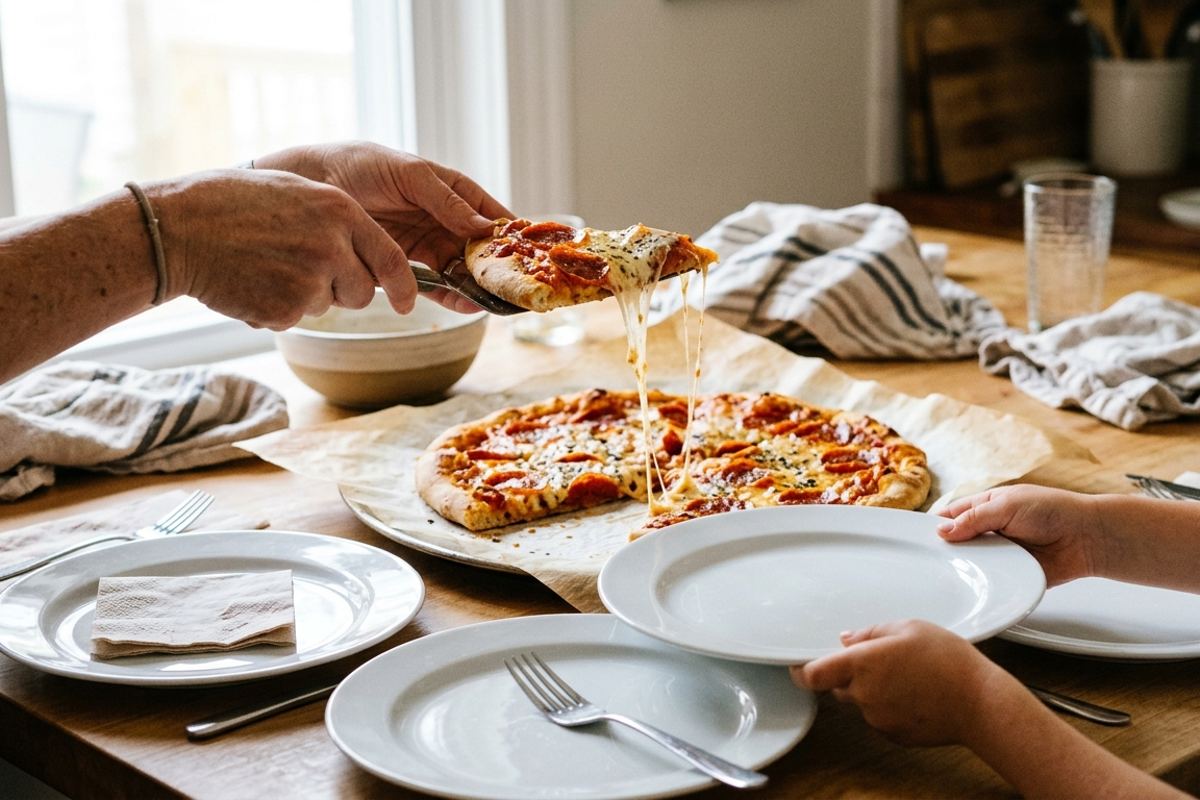
Pizza works the same way, with more opinions. Eight slices, four plates: one slice on each plate, then another round, and each plate ends with 2. Crackers at lunch, pennies from the junk drawer, blocks on the floor, mini marshmallows if you are feeling brave.
The key is dealing one at a time, especially for younger kids. Placing one object in each group, again and again, lets them watch the fairness build. School will give that action a symbol later. At home, the action comes first.
The two questions hiding inside division
Division actually asks two slightly different questions, and kids bump into both in normal life.
First: "How many does each person get?" You have 12 cookies and 3 kids. Share them equally: how many each? This is the sharing kind, and kids usually get it first because it matches what they already do with snacks and turns.
Second: "How many groups can we make?" You have 12 cookies and want 3 per bag. How many bags? Same numbers, different job. Now the group size is decided and your child figures out how many groups there will be.
Both are division. You do not need to name the types unless your child enjoys labels. Just alternate them in everyday talk. "Ten carrot sticks, two plates: how many on each?" And another day: "Ten carrot sticks, two in each lunchbox: how many lunchboxes can we pack?"
This matters because school problems switch between the two, and the wording throws kids. A child who happily shares 12 cookies among 3 friends can freeze on the bags version. That is not failure. It is the same idea wearing a tiny disguise.
Leftovers are the best part
Perfect division is tidy. Real life is not. Try 13 crackers and 4 people. Deal them out: everyone gets 3, and one cracker sits in the middle of the table.
Now watch the math become extremely serious. Who gets the extra? Do we break it? Does the grown-up eat it "to keep things fair," which is a suspiciously convenient adult move? Your child is now thinking about remainders.
A remainder is just what is left after making equal groups. Young kids do not need the word. They need the experience of seeing that some numbers refuse to split evenly. The leftover is not a mistake. It is information. With a 3rd grader you can attach the school language: "13 divided by 4 is 3, remainder 1."
If your child argues that one person deserves the extra, let them make the case. If they suggest cutting the cracker into four tiny pieces, even better. Fractions just walked into the room wearing crumbs, and that instinct will serve them well when fractions get formal a grade or two later.
Remainders also teach that answers have to fit the story. If 13 kids ride in cars that hold 4, you need 4 cars, not 3 remainder 1 with a child jogging behind.
Division and multiplication are the same fact family
Most kids meet division after starting multiplication, which is a gift if we connect the two instead of presenting division as a brand-new mountain.
If your child knows that 3 groups of 4 make 12, they already have a path to 12 divided by 3. Same numbers, different direction. Draw 3 rows of 4 dots, count 12, then ask: "If 12 dots sit in 3 equal rows, how many in each row?" Multiplication built the total. Division takes it apart. Teachers call this a fact family, and it is why shaky division often traces back to shaky multiplication; if that is the situation at your table, start with what understanding multiplication really means and the division will get cheaper.
One tone tip: try not to present division as the punishment that follows multiplication. Kids pick up on "wait until you see division." It is not the villain sequel. It is multiplication turned around. For kids who like practicing both directions at speed, a round of fact-family flash cards against the timer turns review into something that feels more like recess.
When school makes it official
Most kids collect informal division ideas in the early grades through sharing, grouping, and skip counting. Schools usually start naming division around 3rd grade, often right alongside multiplication. Long division comes later: many kids see it in 4th grade and keep working on it in 5th. The exact timing depends on the district and the program.
At home, your job is meaning, not algorithms. You do not have to recreate the school method at the table, especially when it looks nothing like the one you learned. Long division has a way of making calm adults mutter, "We used to just do it the normal way." Deep breaths. Many schools teach partial quotients or area models before the traditional setup, and those methods are trying to show what happens before kids memorize steps.
What helps most: keep sharing real things, ask "does that answer make sense?", connect division back to the multiplication facts, and tell the teacher if homework is taking forever or causing tears. If your 4th or 5th grader cannot explain what division means, mention it calmly. The algorithm can wait a little. The idea underneath needs a solid place to stand.


