

Third grade multiplication can be sneaky. Your child comes home proudly chanting "six times seven is forty-two," and you think, great, we are rolling. Then the homework says, "There are 6 bags with 7 apples in each bag. How many apples?" and the kitchen table gets very quiet.
\nMemorized is not the same as understood
\nThere is nothing wrong with memorizing multiplication facts. Fast recall matters, especially once kids hit bigger problems and division. A child who knows 6 × 7 without counting on fingers has brain space left for the rest of the math.
\nBut memorized is not the same as understood. A child can rattle off "6 times 7 is 42" because they have heard it like a song, then freeze on the apples question because the fact is floating by itself. It is not attached to a picture, a story, or a meaning.
\nThat difference starts to bite around 4th grade, when multiplication stops being tidy flashcard facts and turns into multi-digit problems, area, factors, and remainders. If multiplication only means "say the answer fast," the whole thing wobbles.
\nThe goal is not to throw away the flashcards. The goal is to give every fact a place to land: equal groups.
\nMultiplication is just groups-of
\nAt its heart, multiplication means "groups of." That's it. Six times seven means 6 groups of 7. Say the whole thing out loud: "six groups of seven." It sounds almost too simple, which is exactly why adults skip it. Kids need to hear it until the words make a picture.
\nEqual groups are everywhere once you start looking. A muffin tin has rows of cups. Four chairs with 4 legs each is 4 groups of 4 legs. Three snack bags with 5 crackers each is 3 groups of 5.
\nA common moment: your child counts all 16 chair legs one by one. That answer is fine. Then gently add, "Yes, and we could also think of it as 4 chairs with 4 legs each. Four groups of four." That tiny sentence is the bridge from counting to multiplying. Most schools introduce this in 2nd or 3rd grade, though timing varies.
\nArrays: the picture worth a thousand drills
\nAn array is just objects arranged in equal rows and columns, and it is the best multiplication picture there is. Three rows with four in each row: that is 3 × 4, and your child can count 4, 8, 12. Or count every single item. No shame. Counting is where understanding starts.
\n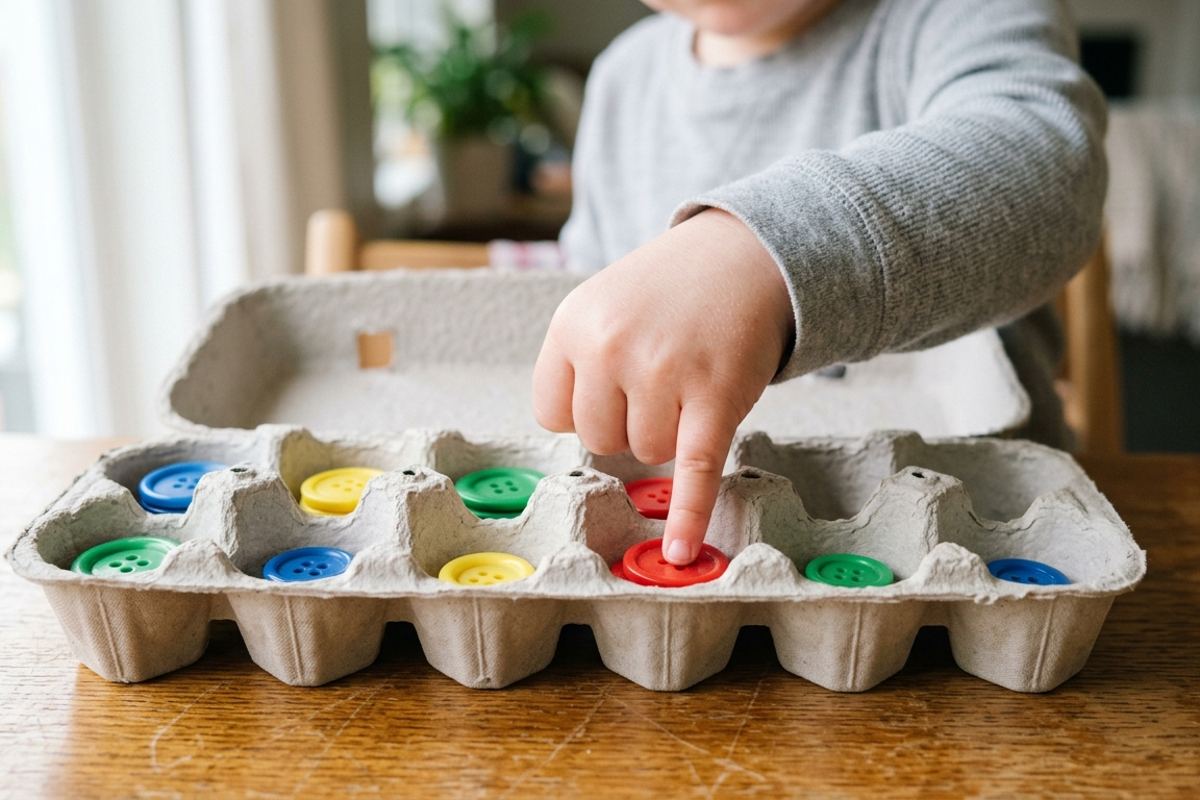 \n
\nArrays are also where the turn-around fact finally makes sense. Kids are told 3 × 4 and 4 × 3 both equal 12, and to many of them that sounds like a rule adults invented to save time. With an array they can turn the paper sideways and see it: three rows of four becomes four rows of three. Same rectangle, different description. This pays off again later when area shows up, because a 7-by-8 rectangle is just an array in disguise.
\nAt home, try a quick array hunt. Bathroom tiles, windows on an apartment building, buttons on the remote, an egg carton with buttons dropped in the cups. Ask, "How many rows? How many in each row? What fact do you see?" If they say "2 rows of 5," you are in business.
\nSkip counting is a bridge, not cheating
\nSome kids get their facts by skip counting: 5, 10, 15, 20. Parents sometimes worry this means the child does not really know the fact yet. True, sort of. It also means they are building the structure that memory will hang on. Skip counting is the bridge between counting and multiplying, not a crutch.
\nThe 2s, 5s, and 10s come first because kids hear them in real life: pairs of shoes, nickels, dimes, fingers. When a child solves 6 × 5 by counting "5, 10, 15, 20, 25, 30," they are tracking six groups, which is real multiplication thinking.
\nThe trick is keeping the group count visible. You will see the classic problem with 7 × 4: a child counts 4, 8, 12, 16, 20, 24, 28 and then looks at you like they just crossed a desert. The answer is right, but they lost track of the jumps twice along the way. Hold up a finger for each group as they count. One group of 5 is 5, two groups is 10, three groups is 15.
\nThe break-apart trick that beats brute force
\nThe break-apart trick is where multiplication starts to look like thinking instead of chanting. Take 7 × 8, a fact with the personality of a locked drawer.
\nInstead of yanking the answer from memory, split the 8 into friendlier pieces: 7 groups of 5 plus 7 groups of 3. So 35 + 21 = 56. Or split it into 4 and 4: 28 + 28 = 56. Same answer, different doorway.
\nIt looks longer at first, and it is not meant to be the forever method. It is meant to show your child that facts are connected: if you know the 5s and the 3s, you can build the 8s. This is exactly the thinking that 4th grade multi-digit multiplication runs on. When they later solve 23 × 6, they are breaking 23 into 20 and 3, multiplying each, and adding. That only feels reasonable if they already see numbers as things you can take apart, which is the same idea that makes place value worth understanding early.
\nYou can practice in normal life. "We need 6 packs of juice boxes with 8 in each pack. Could we do 6 groups of 5 plus 6 groups of 3?" Your child may roll their eyes. That is allowed. Eye-rolling blocks learning far less than we fear.
\nWhat ten minutes at home looks like
\nTen minutes is plenty. More than that and multiplication practice becomes a family hostage situation.
\nA simple rhythm, a few times a week: one array hunt (the waffle, the LEGO plate, the 12-pack of sparkling water in the pantry). One groups-of question at dinner or cleanup: "Four people, three meatballs each. How many meatballs?" "If your backpack has 3 folders and each folder holds 2 papers I still need to sign, how many papers are haunting me?"
\nThen one quick game. Roll two dice and multiply them. Flip two playing cards, face cards count as 10. Build arrays with pennies or cereal squares. If your child likes racing against a clock, a two-minute kitchen timer and a stack of fact cards turns the drill into a game they'll ask to replay.
\nKeep the memorizing going alongside all of this. Songs, car quizzes, flashcards, and a sensible order for learning the tables all help. Just pair each fact with meaning often enough that your child can answer both questions: "What is 6 × 7?" and "What does 6 × 7 mean?"


