

The lunchbox comes home looking like a tiny crime scene: one bitten cracker, a warm yogurt, the strawberries somehow wearing sandwich crumbs. You packed food. Your child packed it right back home. Before you take it personally, take a breath, and maybe don't open the thermos until you're emotionally ready.
Why the lunch you packed came home untouched
School lunch is not lunch at your kitchen table. It's lunch with a clock ticking, a noisy room, a sticky table, a friend telling a story about a loose tooth, and an adult calling "five more minutes!" from across the cafeteria.
A child who eats a full turkey sandwich at home may stare at the same sandwich at school like it has betrayed them.
There are a few very normal reasons food comes home. Some kids are too distracted to eat much. Some are slow eaters who spend half the period opening containers. Some don't like food that has changed temperature or texture; a quesadilla that was perfect at 7:30 can become suspicious by noon. Some save the good stuff for last and run out of time. Some are too busy talking, because apparently lunch is also a board meeting.
For younger kids, packaging matters more than we think. If the orange is hard to peel, it may as well be locked in a bank vault. If the granola bar wrapper fights back, the granola bar loses.
None of this means you packed a bad lunch. It means school lunch has its own little ecosystem, and your child is still figuring out how to eat inside it.
The returning lunchbox is data, not an insult
I know. You sliced the apple the way they like, found the one cheese stick brand they currently accept, and wrote a tiny note on the napkin. Then it all came back, like a bad review written in half-chewed baby carrots.
Try to treat the lunchbox as a report, not a rejection.
Look at what comes home for a few days. Not forever; you're not launching a federal investigation. Did they always eat the crunchy thing? Did the sandwich come back only when it had mayo? Did the thermos food get ignored three times in a row? Did they eat everything on pizza day because they bought lunch and sat with a friend who also bought lunch?
Then ask questions that don't sound like a trial. Instead of "why didn't you eat this?" try "was it hard to open, too cold, too soggy, or did you run out of time?" Give choices, because "I don't know" is often the honest answer after a long school day.
One teacher trick: ask later, not the second they walk in. The after-school brain runs on fumes and playground dust. A snack, some quiet, maybe one easy round of something fun, and you may get a real answer instead of a shoulder shrug.
Give them a vote (with boundaries)
The lunchbox negotiation works best when your child gets a vote, not the whole government.
Ask "what do you want for lunch?" and many kids will answer with chips, cookies, and a single grape for decoration. Decide everything yourself, and they may treat school lunch as a place to practice peaceful resistance. The sweet spot is structured choice.
Try: "Pick one main food, one fruit or veggie, and one crunchy side from these options." Then show the actual options you're willing to pack, not the imaginary grocery store in their heart. Maybe the mains are a turkey roll-up, a cheese quesadilla or a mini bagel with cream cheese; the fresh thing is apple slices, cucumber coins or grapes; the crunchy side is pretzels, popcorn or crackers.
That little bit of control changes the mood. Kids eat more of what they helped choose, even when the choices are deeply specific. "I only like the square crackers on Tuesdays" is not rare in elementary school. It's basically a dialect.
Boundaries still stand. You're allowed to say cookies are not the main course. You're allowed to refuse to pack three separate lunches. And the vote doesn't have to happen at 7 a.m. Morning decisions get weird fast, so make a simple list on Sunday and let your child circle a few approved choices, the same way a routine that survives past September gets decided before the chaos, not during it.
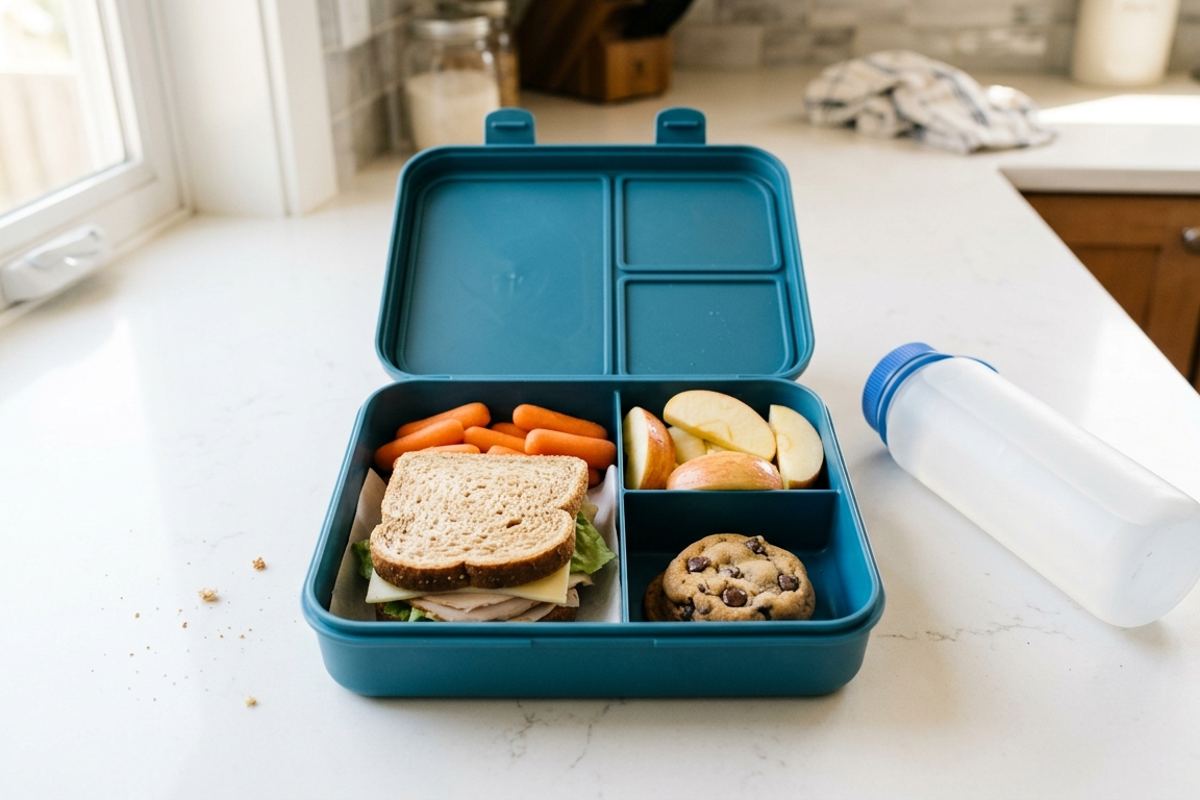
A packing formula that survives real mornings
A good school lunch does not need to look like a bento-box raccoon wearing cucumber glasses. Cute is fine. Eaten is better.
Use a repeatable formula so you're not inventing lunch from scratch while someone yells that their sock feels "wrong":
- One anchor food: sandwich, wrap, pasta, rice, hummus with pita, leftovers they actually like
- One fresh thing: fruit, cucumbers, carrots, cherry tomatoes, an applesauce pouch
- One backup bite: crackers, pretzels, cheese, yogurt, trail mix if your school allows it
- One small yes: a cookie, a few chocolate chips, a sticker, a folded joke
The backup bite is not a throwaway. It saves lunch on the day the anchor food suddenly becomes unacceptable because the cheese touched the bread at the wrong angle.
For kids who get overwhelmed, smaller portions help. A whole sandwich can look like a mountain; half a sandwich plus two easy sides feels doable. For slow eaters, cut food into quick bites before it goes in the box. And if your child likes finding a note or a joke inside, tuck in a riddle or a tiny maze drawn on a napkin. Skip it if notes embarrass them. Some kids beam. Some shove the note to the bottom like it contains state secrets.
Stop grading yourself meal by meal
One untouched lunch can ruin your mood if you let it. Please don't give a single lunch that much power.
Kids' appetites bounce around. Growth spurts, wiggly teeth, classroom stress, breakfast size and seating charts all matter. Some schools eat lunch at 10:45 in the morning, which is less "lunch" and more "second breakfast with fluorescent lighting." Other kids eat after recess and are too wound up to focus on food.
Look at the week, not the Tuesday. If your child eats a decent breakfast, has a real snack after school, and gets enough chances at food across the day, one sad lunchbox is a data point with crumbs in the corners, not a parenting grade.
Build in a "safe lunch" for tough weeks too: the boring lunch you know they usually eat. A bagel, grapes and pretzels. Rice in a thermos. Cheese, crackers and fruit. It doesn't need to impress another adult on the internet. It needs to keep your child from turning into a small raccoon by 2:15.
If lunch battles are getting big, shrink the problem. Pick one change for the week: easier containers, smaller portions, more choice, or a different main. Not all four. And if your child regularly eats very little across the whole day, seems worried about eating, or you're concerned about growth or energy, mention it to the pediatrician. Otherwise, wash the lunchbox, note what came back, and pack tomorrow's version with slightly less drama.


