

Somewhere around the fortieth reading of the same bedtime book, you pause before the rhyme and your 3-year-old shouts the missing word. It feels like a party trick. It's actually reading practice, and it started long before anyone showed them a letter. Some of the most useful reading work is pure listening: noticing that sun starts like sock, that banana gets three claps, that cat can be stretched into /c/ /a/ /t/.
The skill hiding under reading: hearing sounds in words
Before kids can use letters well, they need to hear the sounds those letters stand for. That listening skill is called phonemic awareness.
A phoneme is one tiny sound in a word. Dog has three sounds: /d/ /o/ /g/. Shoe has two: /sh/ /oo/. This is not about spelling yet. Your child doesn't need to know that shoe has four letters. They just need to hear that it has two sounds.
This is why a child can sing the whole alphabet song and still struggle to read. The song is memory. Phonemic awareness is sound work. Reading needs both, and the sound work usually comes first.
You may also run into the bigger term phonological awareness, which covers rhymes, clapping syllables, and noticing words in sentences. Phonemic awareness is the smaller, trickier part: the individual sounds inside words.
What it looks like at 3, 4 and 5
At 3, most kids are not identifying phonemes like tiny reading professors. Thank goodness. What you'll notice is that they enjoy silly sounds. They laugh at "bee-mee-lee," fill in the rhyme in a familiar book, and chant the same nonsense line fourteen times while you're trying to make pasta.
At 4, many kids start hearing bigger chunks. They clap parts in names: Em-ma, Ben-ja-min. They notice rhymes, with plenty of near misses. "Cat and cap rhyme!" Not quite. But they're listening closely, and that counts.
At 5, in Pre-K and kindergarten (ages 4 to 6), many kids begin working with first sounds. They hear that mom, moon, and milk start the same. Some can blend when you ask, "What word is /m/ /ap/?" A few can pull sit apart into /s/ /i/ /t/, which is harder.
The range is wide. Some kids hear sounds early and easily, some need many playful tries, and kids growing up with two languages can look uneven in perfectly normal ways.
Games you can play in the car with nothing
The best phonemic awareness games need no workbook, no pencil, no table cleared of laundry. The skill is listening, not looking, so spoken games are the whole toolkit. Two minutes is plenty. Stop before your child starts answering everything with "banana" just to end the conversation.
- Name sound hunt: "I'm thinking of someone in our family whose name starts with /m/." Use the sound, not the letter name: /m/ like the start of mmmilk, not "em."
- Silly rhymes: "What rhymes with log? Dog, fog, zog, wog." Made-up words are allowed. They arguably improve the game.
- Robot talk: say a word in chunks, "Put on your /sh/ /oe/," and your child blends it into shoe. Start with two chunks.
- Snack syllables: clap foods. Pret-zel, ap-ple, wa-ter-mel-on.
Keep it light. If your child misses one, give the answer and move on. "Yep, dog and dish both start with /d/. My turn."
Rhymes, syllables, first sounds: a rough order
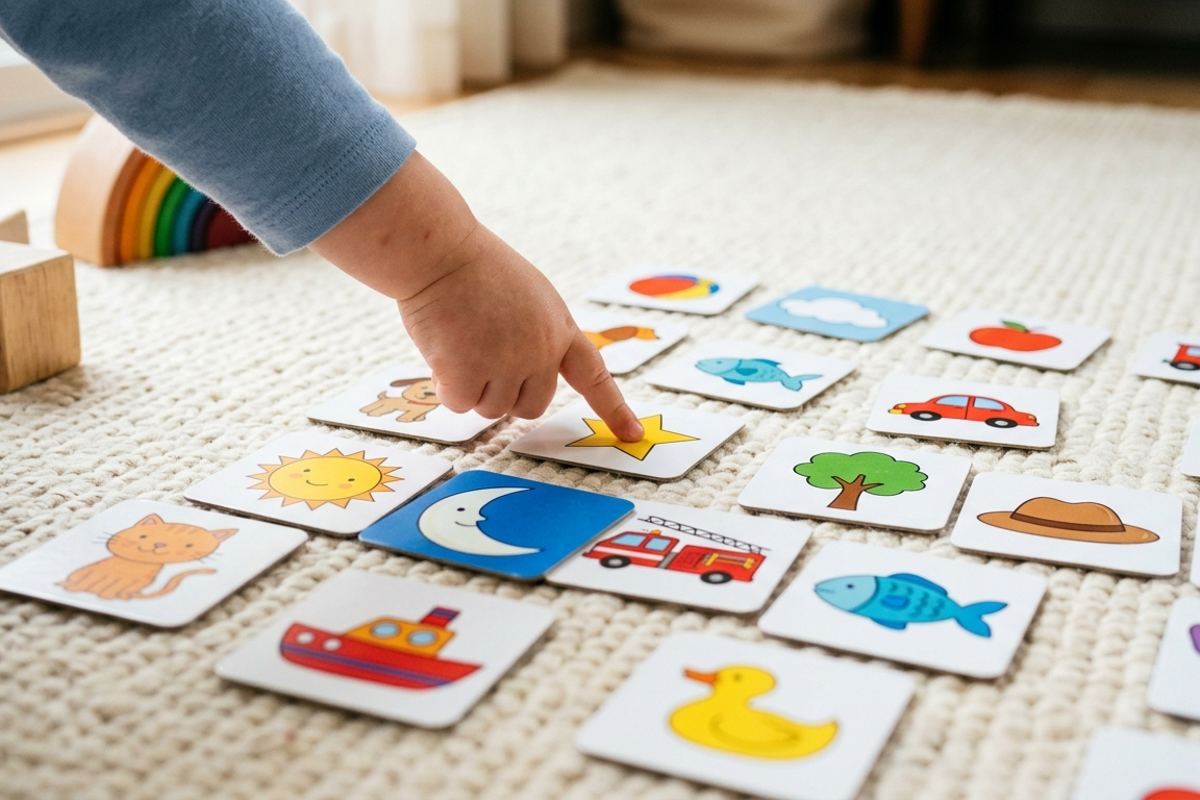
Kids usually notice big sound pieces before tiny ones. Think of it as zooming in with a camera.
Rhyming often comes first, because the ending chunk is big and fun. Books with strong rhyme let kids guess what's next, and your child gets to shout the answer with great pride and possibly applesauce on their shirt.
Syllables are another big piece. Clapping di-no-saur is easier than hearing each sound in dog. Names are the natural practice ground, because kids care deeply about their own name, their friends' names, and stuffed animals with dramatic names like Sparkle Princess Pickle.
First sounds come next. "What do you hear at the start of ball?" You want /b/, not the letter B. If your child says "buh," fine, but keep that extra "uh" soft. Clean sounds pay off later.
Ending sounds and middle vowels are harder. Plenty of kindergartners hear the /s/ in sun long before they hear the /u/. Short vowels are slippery little things. And pulling apart every sound in a word, called segmenting, is usually one of the last skills to land. Blending is easier: you say /c/ /a/ /t/, they say cat. Segmenting runs the machine in reverse, and that takes more control.
How this connects to phonics later
Phonics is where letters and sounds get matched: the printed letter m stands for /m/. That matching only makes sense if your child can hear the sounds in the first place. If you want the full picture of that next stage, there's a plain-English walkthrough of how kids learn to read with phonics.
Picture a child looking at the word map. If they know the letter sounds but can't blend, reading feels like juggling wet spaghetti. They say "/m/ /a/ /p/" and stare at you like the word vanished. Blending those sounds into map is phonemic awareness doing its job.
Same with spelling. A child who can stretch fish into /f/ /i/ /sh/ has a real shot at writing something close, even if it comes out "fsh" at first. That's not laziness. It's a window into which sounds they can hear.
None of this means you should hold off on letters, by the way. Letter names and sound games grow happily side by side, and learning letters before kindergarten can stay just as playful.
When hearing sounds stays hard
Some kids just need more time with sound games. But a child can have a big vocabulary, love stories, and still find this hard, which feels confusing because they seem so good with words.
Worth watching in Pre-K through early 1st grade: rhyming never clicks, even with familiar words. Your child can't tell whether two words start with the same sound. Blending /s/ /un/ into sun stays very hard after lots of playful practice. Early reading feels like memorizing whole words, with no sounding out at all.
Hearing itself matters too. Ear infections, stuffy seasons, or mild hearing differences make sound work harder, and so do speech sound difficulties. A child who says tat for cat may need help hearing and saying that first sound.
If you're unsure, ask the teacher: "Rhyming and first sounds are really hard at home. Are you seeing that too?" That one sentence starts the right conversation. If the concern sticks around, the teacher or pediatrician can point you to the next step, maybe a hearing check or a speech-language screening. In the meantime, keep home practice short: rhyming books, silly long words to clap, robot talk while finding shoes. Quit while everyone still likes each other.


