

The spelling list comes home Monday, gets wrinkled under a juice box by Wednesday, and becomes a family emergency Thursday night. Friday afternoon your child announces, "I got 10 out of 10!" Beautiful. Then on Tuesday they write becuz in a story, and everyone at the kitchen table quietly loses faith in the system.
The Friday ritual: what a spelling test actually measures
A traditional Friday test measures one thing fairly well: can your child study these words, in this format, for this moment?
That's not nothing. Kids practice listening carefully, writing under a little pressure, checking their work. For strong memorizers the weekly list even feels satisfying. Monday list, Thursday practice, Friday win.
But a test score is a short-term performance check, not proof the spelling has moved into everyday writing. If the words were practiced in the same order every night, your child may partly be remembering the list itself. Word 6 is because. Word 7 is friend. The brain loves a routine, even a sneaky one.
There's a study-skill layer too. A high score can mean "knows how to prepare for a quiz." A low score can mean trouble with sounds or patterns, or it can mean soccer ran until 7:45 on Thursday and nobody had dinner. The Friday test is a snapshot. Useful, but small, like judging a whole birthday party from one cupcake crumb.
Why acing Friday doesn't mean spelling it right on Tuesday
Real writing asks far more of a child than a spelling test does. On Friday, the teacher says the word and waits; spelling it is the entire job. In a Tuesday story about a dragon who opens a taco restaurant, spelling competes with ideas, punctuation, handwriting, spacing, and the urgent need to explain why the dragon's salsa is too spicy.
Teachers call that gap transfer: using a skill in a new situation. It doesn't happen automatically just because a word was right on a test.
What practice research keeps finding, loosely put: kids remember better when they have to pull a word from memory several times, spread over days, in mixed-up order. Cramming can win Friday's quiz. It's lousy at producing spelling that still shows up in a notebook two weeks later. This is why many teachers now build lists around patterns, or sneak in review words from earlier weeks. A list with train, rain, paid, wait teaches more than four unrelated words, if the child notices what's going on with that long a.
What makes spelling stick: patterns beat memorized lists
Memorizing beautiful letter by letter gets a child through Friday. Understanding why words work helps them spell words they've never studied.
English spelling looks like a junk drawer, but it's less chaotic than it feels. Early on, patterns mean hearing that sh in ship is one sound with two letters. Around 2nd or 3rd grade it's noticing that hoping keeps the long o while hopping doubles the p. In upper elementary it's word parts: sign, signal, signature. Suddenly the silent letter isn't random at all.
So try this with any list your child brings home: ask "what do these words have in common?" If the answer is "they're all annoying," fair. Nudge again. Maybe three share a vowel pattern, two are endings like jumped and bigger, and two are the classic troublemakers like said and does that refuse to play by the rules (there's a whole story behind those, covered in what sight words actually are). Sorting and comparing words teaches more than copying them five times ever will.
That's the goal: spelling that travels. A child who studied stay and can handle staying learned something bigger than one word.
A ten-minute home routine that beats Thursday-night cramming
Ten minutes a day beats forty tearful minutes on Thursday. I say this as someone who has watched a child write because perfectly at 8:10 on Friday morning and lose the a by lunch.
Keep it short and boring enough to repeat. A simple week looks like this:
- Monday: sort the words into groups. Same vowel sound, same ending, or just "know it" and "don't know it yet."
- Tuesday: look, cover, write, check. Fixing a mistake right away helps more than rehearsing the wrong version five times.
- Wednesday: you say the words out of order, they write without looking. Mix in two words from last week's list.
- Thursday: one silly sentence that uses two or three words. "The brave snail carried a bright umbrella." Sillier is better.
The magic isn't the worksheet. It's the repeated try-to-remember moment, spread across days. There's a longer version of this approach in spelling practice without the cramming, if your household has fully declared war on Thursday nights.
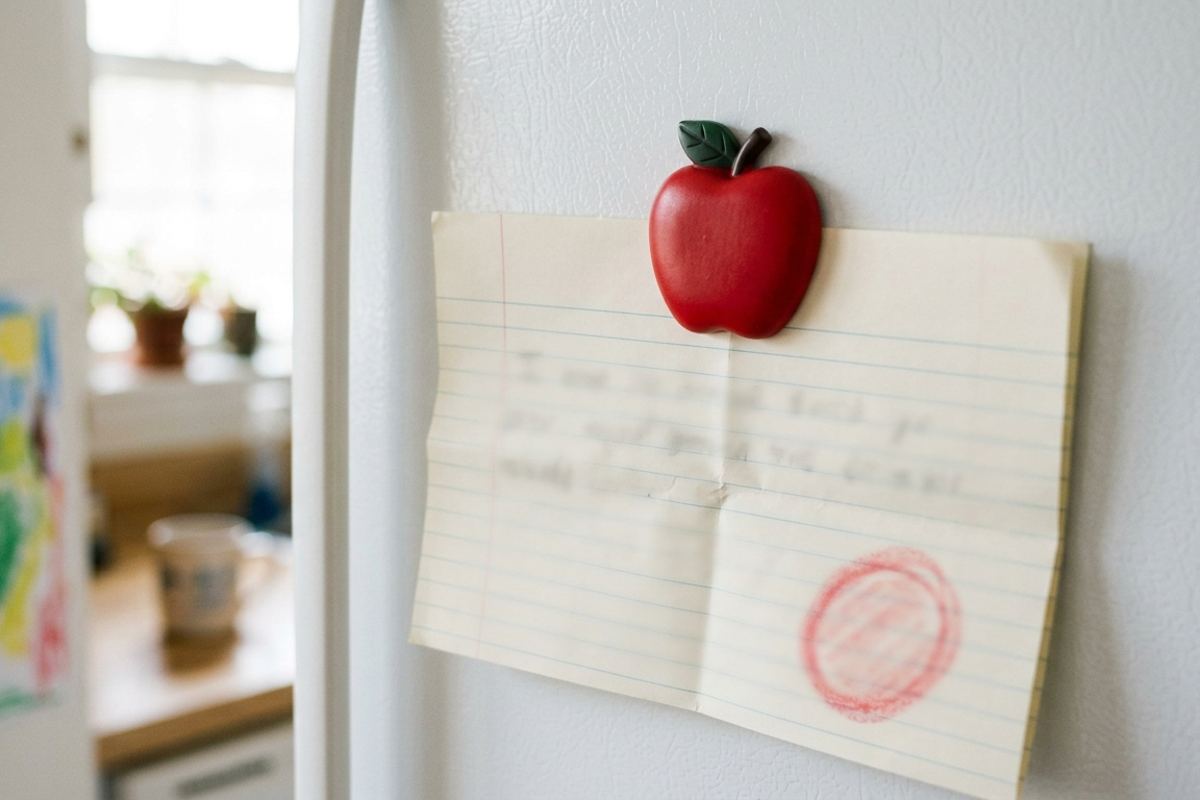
If your child gets bored, switch the tool, not the skill: whiteboard marker on the fridge, sidewalk chalk, a notebook with a terrible dinosaur sticker on it. A light word game works as a warm-up too. A round of hangman gets a kid thinking about letters and patterns without anyone announcing that it's spelling time. Just know the real finish line is still writing the word in a sentence when nobody is cheering with sound effects.
One thing to quietly deprioritize: copying each word ten times. A child paying close attention gets a little out of it. A child thinking about Minecraft is mostly rehearsing the shape of their own mistake.
What to say about a bad spelling grade
A bad spelling grade feels personal to some kids. They see the red marks and decide "I'm bad at spelling," and that sentence sticks harder than any word on the list.
Start with calm facts. "You got 6 out of 10. Let's see what kind of mistakes they were." Now it's detective work instead of shame. And the mistakes really do tell you things. Sip for ship means the sounds need work. Trane for train shows the long-a idea is there, just the wrong outfit. Jump for jumped means they stopped listening before the end of the word. Missing said and was means the irregular words need their own extra practice.
Then hand your child a sentence that keeps the door open: "This grade tells us what to practice next. It doesn't tell us what kind of writer you are."
If the same errors keep showing up for weeks, or spelling is wildly harder for your child than everything else, mention it to the teacher. Not asking for a label, just asking "what are you seeing in class, and what should we try at home?" For everyone else: pick two missed words tonight, sort them, write them, put each in one goofy sentence about a sneezing frog, and let the kid go be a kid. If you want the practice to hide inside play entirely, word games are sneaky spelling practice and nobody has to know.


