

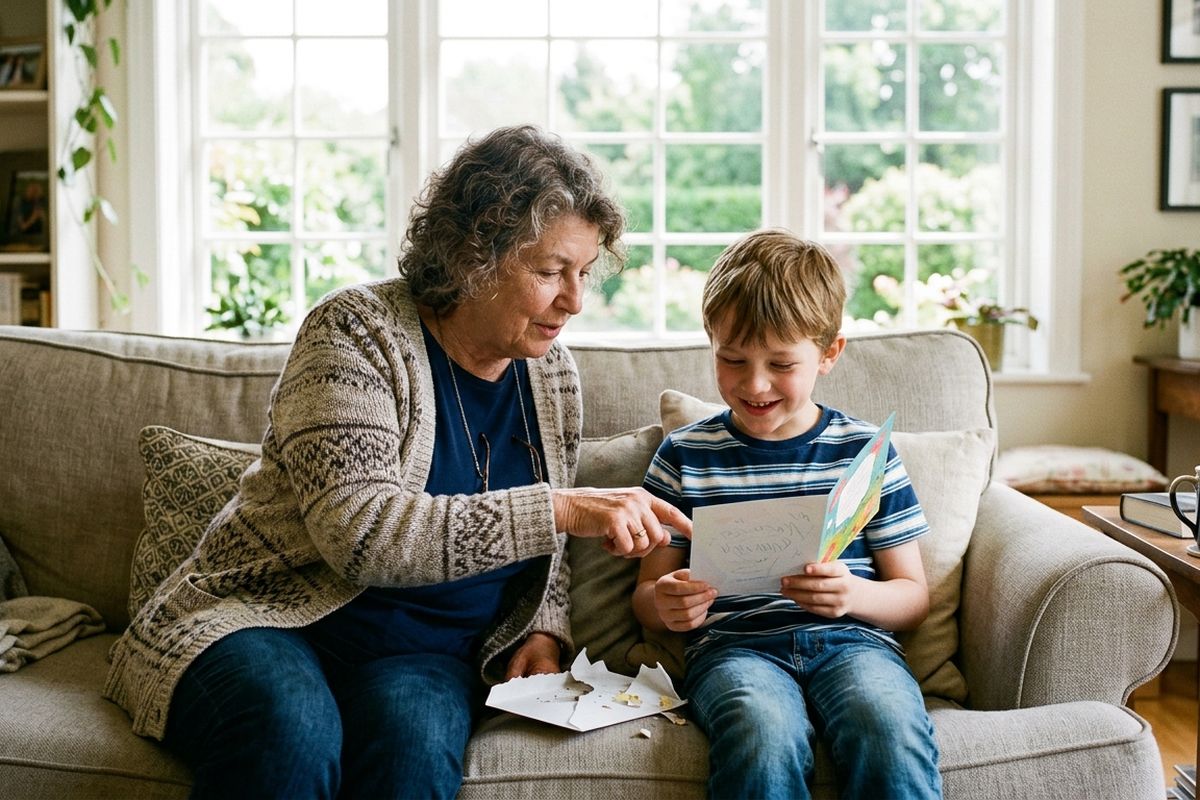
The birthday card shows up with five dollars tucked inside and a whole lovely note from Grandma in looping cursive. Your child studies it like a coded message from a picture-book wizard, gets "Happy Birthday" because they have seen that shape before, maybe gets "love," and then hands it over with the look. Please translate.
The honest answer: it depends on your state
Cursive is one of those school topics where two parents can both be telling the truth and describing completely different childhoods. Some states put cursive in the elementary standards. Many don't. Even where a state mentions it, districts vary, and so do individual schools, depending on time, materials and how much else is already crammed into the day.
When it does appear, it usually lands around 3rd grade. That timing makes sense. Most kids have a decent print foundation by then, they can stay with a pencil a bit longer, and they notice patterns in letter shapes. But "usually" is carrying a lot of weight in that sentence. Some schools introduce a little in 2nd grade, some touch it for a few weeks and move on, some never get to it.
So a child who can't read the birthday card has not necessarily been shortchanged. It may just mean their state doesn't require it and their teacher is fitting reading groups, science, a fire drill and fourteen missing glue sticks into one day. I taught the grades before cursive, and parents still asked me about it, usually with a mix of nostalgia and mild panic.
What cursive actually helps with
It can help with handwriting. Not magically, and not for every kid, but there are real reasons it has hung around.
Cursive forces attention to letter formation. Where does this letter start, which way does the stroke travel, how does it hook into the next one. For some children that sequence is easier to hold onto than stopping and restarting for every printed letter. The pencil keeps moving and the word starts to feel like one action instead of five.
Some kids who flip letters find cursive friendlier, because a cursive b and a cursive d are not mirror twins the way the printed ones are. I wouldn't sell it as a fix. Reversals are a normal part of early writing for a while, and there's more worth knowing about why b and d keep swapping places. For a child who is otherwise ready, though, the different shapes can take some pressure off.
Then there's the fine-motor side. Loops, curves, spacing, pressure, control. It is the pencil version of peeling a sticker off the sheet without tearing it: a little frustrating, oddly satisfying, good for small muscles. The research on cursive specifically is thinner than the arguments about cursive, which tend to get dramatic fast. What we have better evidence for is handwriting in general helping kids write and remember, and cursive is one flavor of handwriting practice rather than the key to the castle. The longer version is in why handwriting still matters in a keyboard world.
And what it doesn't do
Cursive is not a reading cure. A child who is working hard to decode print will not suddenly take off because the letters now connect. Reading needs sound work, vocabulary and a patient adult who can survive the same Elephant and Piggie page six times, which is a different set of machinery entirely. That machinery is laid out in how kids actually learn to read.
It is not a spelling cure either. A kid can write "becuz" in gorgeous cursive. The loops are charming. The spelling still needs work.
And it is not required for good handwriting. Plenty of adults print quickly, legibly and comfortably their whole lives. If your child's print is readable and doesn't hurt, there is no rule saying cursive is the real version.
The signature argument is the one that gives adults pause, and it deserves an honest answer. Signatures do still exist, on school forms, bank paperwork, and the pharmacy screen that has never once captured anyone's actual name. But a legal signature doesn't have to be traditional cursive. It has to be a consistent mark that belongs to one person. Knowing enough cursive to read a note from a relative and to sign your name is genuinely useful. Needing a full page of beautiful script is a much harder claim to defend.
Teaching it at home if the school skips it
If your child is curious, or if the cards keep arriving in mystery script, you can teach a little at home without turning the kitchen table into a Victorian schoolhouse.
Think small. Fifteen minutes a week is plenty. Cursive sours fast when it becomes a long copying session, and handwriting always went better in my classroom when we stopped before the first dramatic pencil flop.
Start with the easy lowercase letters that share a movement: l, e, i, t, then u, w and j. Most cursive programs group letters by stroke rather than marching from a to z, which is the sensible way around. Capitals can wait; they're fussier, and half the adults I know have quietly abandoned them anyway. Use paper with a dotted middle line if you have it, because cursive lives and dies by height. Without lines, early cursive turns into a row of sleepy noodles.
One more thing: don't start with their name. It's tempting, it feels personal, and it is usually a trap. Names come with awkward capitals and strange letter pairs, and a kid named Xavier did not ask to begin on hard mode. Start with slightly boring practice words instead. It, ill, tell, little. Once a handful of letters are there, write a few words for them to read rather than copy. Reading cursive and writing cursive are cousins, not the same skill.
When to leave it alone
If your child is still fighting print every day, cursive can wait. Letters hard to form, spacing all over the place, one sentence producing a full-body slump: adding a second alphabet to that is not kindness. Print doesn't have to be pretty, but there should be enough control that a new style feels interesting instead of punishing.
Pause too if the hand actually hurts. Tiredness after careful writing is ordinary, especially for kids who grip the pencil like it might escape. Pain is not. Neither is shaking the hand out every two minutes or refusing to write because it feels miserable. Shorter writing times, a look at the pencil grip, and a word with the teacher are the better next moves, and how to raise something with the teacher is easier than most parents expect. "Do you teach cursive later, or should we practice a bit at home?" is the whole message. Nobody needs a manifesto in the folder.
For the signature part, keep it light. When your child is ready, show them how to write their first and last name in a way they can repeat, part cursive, part print, whatever holds together. Then practice it on the important documents: a library card, an adoption certificate for the stuffed turtle, official permission to eat the last cookie.


